“Open thy doors, O Lebanon, that the fire may devour thy cedars. Howl, fir tree; for the cedar is fallen; because the mighty are spoiled. Howl, O ye oaks of Bashan; for the forest of the vintage is come down.” Verses 1, 2.
HERE is foretold a work of destruction. In verse 3 the voices of the howling shepherds and of the roaring lions are heard, because their glory and pride are spoiled.
The remainder of the chapter shows that all this is but a figurative description of a condition which will exist among the people. There are brought to view in the chapter: A flock of the slaughter, two staves which are broken, three shepherds who are cut off, the weighing of the price of our Lord, and a foolish shepherd.
“And I will feed the flock of slaughter, even you, O poor of the flock. And I took unto me two staves; the one I called Beauty, and the other I called Bands, and I fed the flock.” Verse 7.
The staves therefore represent something by which God would feed the flock. In verse 11 where the thought of feeding the flock is repeated, the Septuagint reads: “And the Canaanites or Gentiles, the sheep that are kept for Me, shall know that it is the word of the Lord.” Then both Jews and Gentiles who are God’s children are to be fed. Jesus said: “Man shall not live by bread alone; but by every word which proceedeth out of the mouth of God.” And Peter tells us that we should “as newborn babes desire the sincere milk of the Word that we may grow thereby.” So the Word of the Lord is that with which we must be fed.
The Rejection of Israel.
God chose Israel, and by the mouth of prophets gave them His Word, that they might give this Word to the people of the world. Israel, then, was the first staff by which He proposed to feed the flock. He called the first staff Beauty; and indeed if Israel had met the mind of God it would have become a staff of beauty in His hand, for said the Lord by the prophet Isaiah: “Thou shalt be a crown of glory in the hand of the Lord, and a royal diadem in the hand of thy God.” “And the Gentiles shall see thy righteousness, and all kings thy glory.” “And the Gentiles shall come to thy light, and kings to the brightness of thy rising.” “Mine house shall be called an house of prayer for all people.” And the glory of the Lord shall cover the earth as the waters cover the sea. But as we have seen, Israel was not faithful to the trust. They appropriated the blessings of God to themselves. They came to believe that salvation was for themselves only, and would not feed the flock. So, to carry out His purpose, God was compelled to cut that first staff asunder.
“And it was broken in that day; and so the poor of the flock that waited upon Me knew that it was the word of the Lord. And I said unto them, If ye think good, give Me My price; and if not, forbear. So they weighed for My price thirty pieces of silver. And the Lord said unto me, Cast it unto the potter; a goodly price that I was prized at of them. And I took the thirty pieces of silver, and cast them to the potter in the house of the Lord.” Verses 11–13.
How graphically here is described the offer of Judas to sell the Saviour, the priests and Levites setting a valuation of thirty pieces of silver for the life of the promised Messiah, the Son of God, and the money finally paid for the potter’s field in which to bury strangers.
In connection with these events the first staff is cut asunder, or Israel is rejected as the chosen nation to represent God in the world, and by their fall salvation came to the Gentiles.
“And I took My staff, even Beauty, and cut it asunder, that I might break My covenant which I had made with all the people.” Verse 10.
The covenant which God has with all the people is the covenant of grace in Christ Jesus. It was by virtue of this covenant that God had accepted the Jews as His chosen people, but there is a limit to God’s forbearance in His dealings both with individuals and with nations.
When the Jewish nation openly and wilfully rejected Jesus, the One through whom this mercy was extended to them, it was necessary for God to cut them off, for had He continued to hold them in the same sacred nearness to Himself after that act, He never could, without discriminating and showing respect to persons, set any one aside. Therefore the cutting off of the Jews is an assurance that God will cut off all who finally reject Christ. And again the destruction of Jerusalem and the rejection of that people become a type of the rejection and destruction of the whole world when they shall have rejected Christ. Thus we find that we are brought down to the first advent of Christ, and the rejection of the Jews for the cutting asunder of the staff.
A Prophecy of the Last Days.
That this prophecy includes in its range the end of time will be seen in the fact that the close of probation and the condition of strife and confusion which will follow the withdrawal of God’s Spirit from the world, are brought to view in verses 6 and 9, which read as follows:
“For I will no more pity the inhabitants of the land, saith the Lord; but, lo, I will deliver the men every one into his neighbor’s hand, and into the hand of his king; and they shall smite the land, and out of their hand I will not deliver them.” “Then said I, I will not feed you; that that dieth, let it die; and that that is to be cut off, let it be cut off; and let the rest eat every one the flesh of another.”
In connection with this time of confusion when every man’s hand shall be against his6neighbor, we have presented in verse 8 the cutting off of three shepherds in one month, and in the closing verses of the chapter, the cutting asunder of the second staff, and the raising up of a foolish shepherd. While running throughout these experiences we find “the flock of the slaughter” brought to view, and the assurance given that God will feed them. To assist in the understanding of these symbols we will notice other scriptures which describe the same experiences. After the rejection of the Jews, God sent out the call to the Gentiles, and they, by accepting Christ, became God’s people and the depositories of God’s truth, to be dispensed by them to the world. This was expressed by the apostle James at the great council held in Jerusalem in A. D. 51, as we read in Acts 15:14–17:—
“Simeon hath declared how God at the first did visit the Gentiles, to take out of them a people for His name. And to this agree the words of the prophets; as it is written: After this I will return, and will build again the tabernacle of David, which is fallen down; and I will build again the ruins thereof, and I will set it up; that the residue of men might seek after the Lord, and all the Gentiles, upon whom My name is called, saith the Lord, who doeth all these things.”
Thus we see that the church of believers, composed of both Jews and Gentiles, became the second staff in God’s hand by which He would feed the world with His Word of truth. As we see the Christian church, composed as it was of Jews and Gentiles, Greeks and barbarians, Cythians, bond and free, and yet so bound together that they were one, we can see the force of the expression, “and the other [second staff] I called Bands,” or binders.
What a picture God’s church presented before the world, made up of various nationalities, as it was, and yet so united that no man called aught that he had his own; that all could with gladness and singleness of heart eat bread from house to house. Baptized with the Holy Ghost, the love of God shed abroad in their hearts, and speaking the Word with power—what a revelation of God’s love and truth was seen in that early church. No wonder the knowledge of God in His Gospel spread rapidly among men, when each believer was a living epistle, showing forth the praises of the One who had called them to glory and virtue.
Apostasy in the Christian Church.
But alas! Divisions crept in. Even in Paul’s day every one said, I am of Paul; I of Apollos; I of Cephas; and I of Christ; so that Paul asks: “Is Christ divided? or were ye baptized in the name of Paul?” Thus unity departed, and glory faded away. Man was exalted, and the banner of truth trailed in the dust. The church lost her power, having forgotten her true source, and, to avert the confusion which prevailed, she courted the civil power, that she might be made the head of all churches, and the corrector of heretics. Then the church sought to restore her lost unity by using the civil power to coerce men.
The dungeon, the rack, the fagot, and the sword were employed in the professed service of the Prince of Peace. The cries, the groans, and the shrieks of the tortured and dying reached unto heaven, and the answer came back, “He that leadeth into captivity shall go into captivity; he that killeth with the sword must be killed with the sword.” This plainly foretold the downfall of the church which had turned to the civil power for strength and support. The time came when men saw the inconsistency of wielding the sword, and at the same time claiming to be followers of Him who said, “Put up thy sword into its sheath.” “My kingdom is not of this world; if My kingdom were of this world, then would My servants fight.”
Reformation and the Creeds.
The Reformation of the sixteenth century attacked the tyranny of the Papacy. Its hideous inconsistencies were dragged to the light and exposed; its sanctimonious robes were torn asunder, and its hypocrisy revealed; its claims of divine authority, under which it carried on its inquisition and persecution, were examined in the light of God’s Word, and found to be of Satanic rather than heavenly origin. In the revolution which followed, the church went down under the deadly wound of 1798, when the forces of France entered the eternal city, and led the pope into captivity, in which he died.
The Reformation placed the Bible in the hands of the people, and a flood of light poured out upon the world. But as light was given, men wrote it out as an expression of their faith; and as it was in advance of what they had formerly known, they became satisfied, and adopted it as a creed. Then around that creed they crystallized, and finally fossilized. This shut out the leading of the Holy Spirit, and God was compelled to use new reformers, through whom to bring out more light. But alas! history repeats itself, and a new creed with a new sect is the result. Thus we have to-day creeds by the score, and sects by the hundred, and the world is a babel of confusion.
Once again men are inquiring, How can Gospel harmony be restored? How can that unity, that oneness described by the Master, when He prayed that His children might be one, even as He and the Father were One, be made to prevail among them?
A Union Not of God.
God, by the mouth of the apostle John, in Rev. 13:3, 10, etc., foretold the captivity and deadly wounding of the first beast in one of its heads (union of Church and State), and that there would arise at that time a new power which would make an image to this beast which had received the deadly wound and was healed. This prophecy calls for a restoration of the papal power in the world, so that once more it shall exert the same influence in Catholic countries as formerly, while in Protestant countries there would be found an image to this power.
The head was wounded. A head is defined in Rev. 17:9, where we read: “The seven heads are seven mountains, on which the woman sitteth.” A mountain is a symbol of a government; a woman a symbol of a church. A head of the dragon or beast is a government upon which the church sits to control or guide—a union of Church and State.
As we view the first head we find that the union there existing consisted in the church exerting such an influence that the civil power was used to enforce its dogmas upon the people, and this was carried to such an extent that men were imprisoned, tortured, and put to death.
In the image we shall see the church (not the Catholic, for that would be the beast itself and not an image) influencing the government to use its power to enforce upon men certain doctrines of faith held in common by both Protestants and Catholics, and as these are enforced, men are compelled to worship the first beast.
Rev. 13:15–17 teaches that laws will be enacted so that no one will be permitted to buy or sell, save he that has the mark of the beast, and that all shall be put to death who do not worship the image.
Increasing Influence of the Papacy.
As we look about in the world to-day, we see the Papacy rapidly coming to a place of power and influence. In our own country she is also making long strides toward a leading place among the denominations of the land. The Protestants are seeking to effect a union upon certain common points of faith, and are courting the favor of the Catholics in these efforts. Especially is this noticeable in the matter of enforcing more strict observance of Sunday as a substitute for the seventh-day or Bible Sabbath; and this, too, in the face of the fact that there is no commandment in the Scripture enjoining its observance—a fact freely admitted by the Catholics, who claim Sunday-keeping as a sign of their authority to change the law of God.
When, under the combined influence of Protestants and Catholics, a decree of death shall be passed against all who will not yield to this power, the company thus sentenced will constitute in a special sense “the flock of the slaughter.” This decree will gather together all of God’s people, and at the same time it will sift out from among them all hypocrites. The Lord foretold this in Micah 2:12, 13, where He says:—
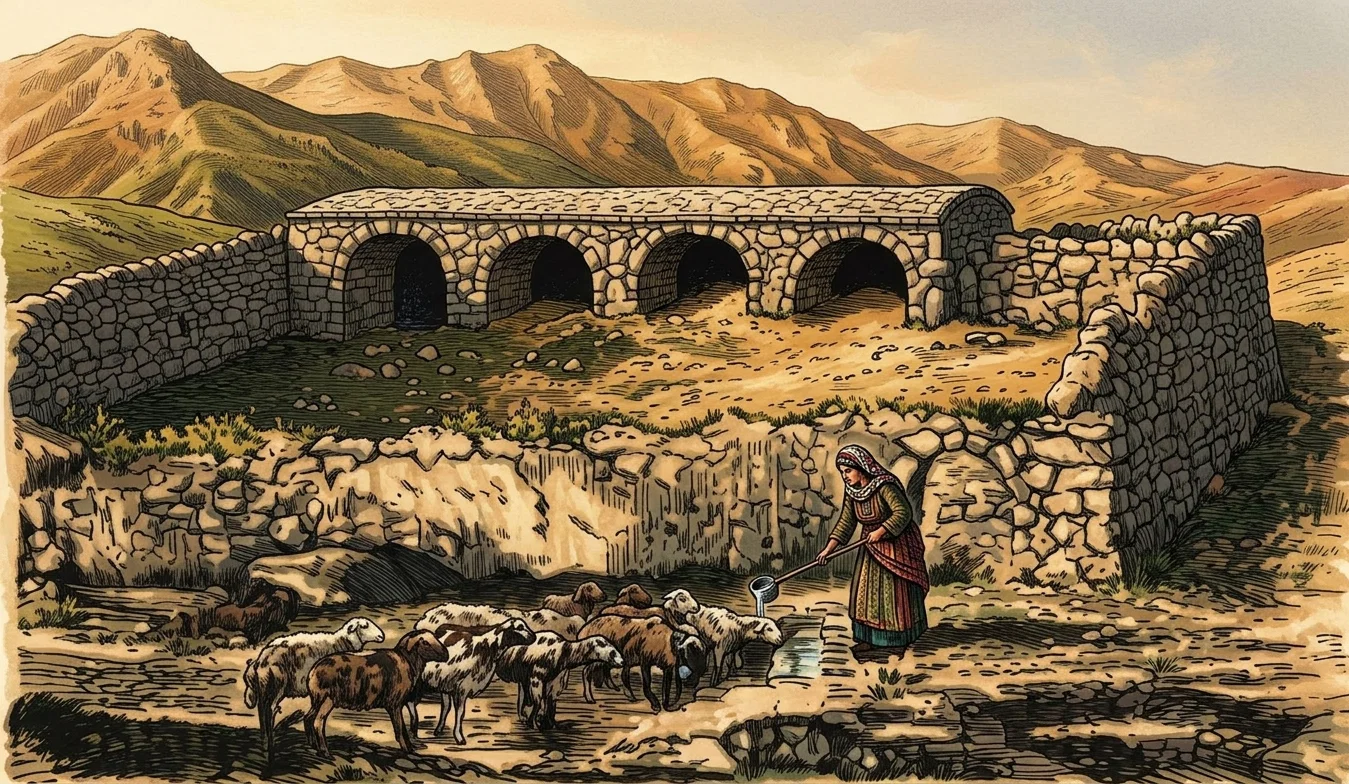
“I will surely assemble, O Jacob, all of thee; I will surely gather the remnant of Israel; I will put them together as the sheep of Bozrah, as the flock in the midst of their fold; they shall make great noise by reason of the multitude of men.”
Bozrah signifies not only a sheepfold, but also a place of slaughter, for in Isa. 63:1–3, dyed garments from Bozrah are shown to be garments sprinkled and stained with blood from the slaughter. So the remnant of Israel by this decree will be shut up, as it were, in a slaughter-pen. In this condition, with the multitudes against them, they will make a great noise, crying day and night for deliverance, and they shall be delivered, for in the following verse we read:—
“The breaker is come up before them; they have broken up, and have passed through the gate, and are gone out by it; and their King shall pass before them, and the Lord on the head of them.”
Here a strong one is represented as breaking the pen and letting out the sheep. So Christ, the mighty One, on whom God has laid help, will come, and, bursting the bars, will set free all the sheep of His fold, with those who are in the tomb, and those who are under the sentence of death; and, passing up before them, will lead them to a condition beyond the power of death.
“Then I cut asunder Mine other staff, even Bands, that I might break the brotherhood between Judah and Israel.” Verse 14.
After the revolt of the ten tribes, God’s people in the divided state were called Judah and Israel. Then these terms, as applied in the last days, represent the division of God’s people or Babylon. As we have shown, there is to be effected among them a brotherhood or union, and the power of this brotherhood is to be directed against God’s people. God will cut them off by the withdrawal of His Spirit, and the spirit of confusion will come in, and every man’s hand will be against his neighbor, and this brotherhood will thus be broken up for the deliverance of God’s children.
“Three shepherds also I cut off in one month; and My soul loathed them, and their soul also abhorred Me.” Verse 8.
The three powers leading and controlling the people of the world at the close of time are spoken of under the symbols of the dragon, beast, and false prophet. Rev. 16:13. A study of the preceding chapters will give the following interpretation; dragon, a symbol of Paganism; beast, a symbol of Papacy; false prophet, a symbol of apostate Protestantism. In a brief space of time just before the end, these shall be cut off, and the foolish shepherd will lead the deluded nations in person. This foolish shepherd is Satan himself, for whose coming Spiritualism is even now preparing the way. These points will be considered more fully in the study of the succeeding chapters.