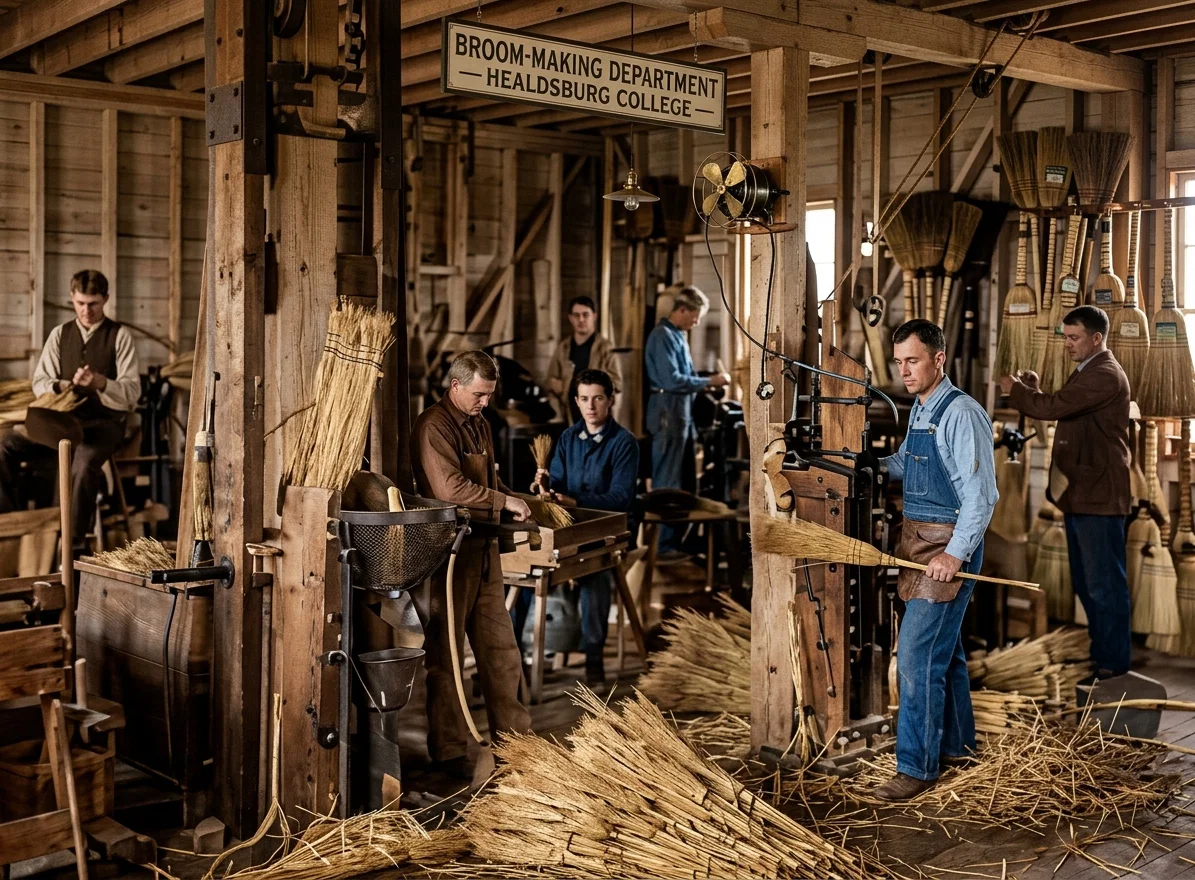
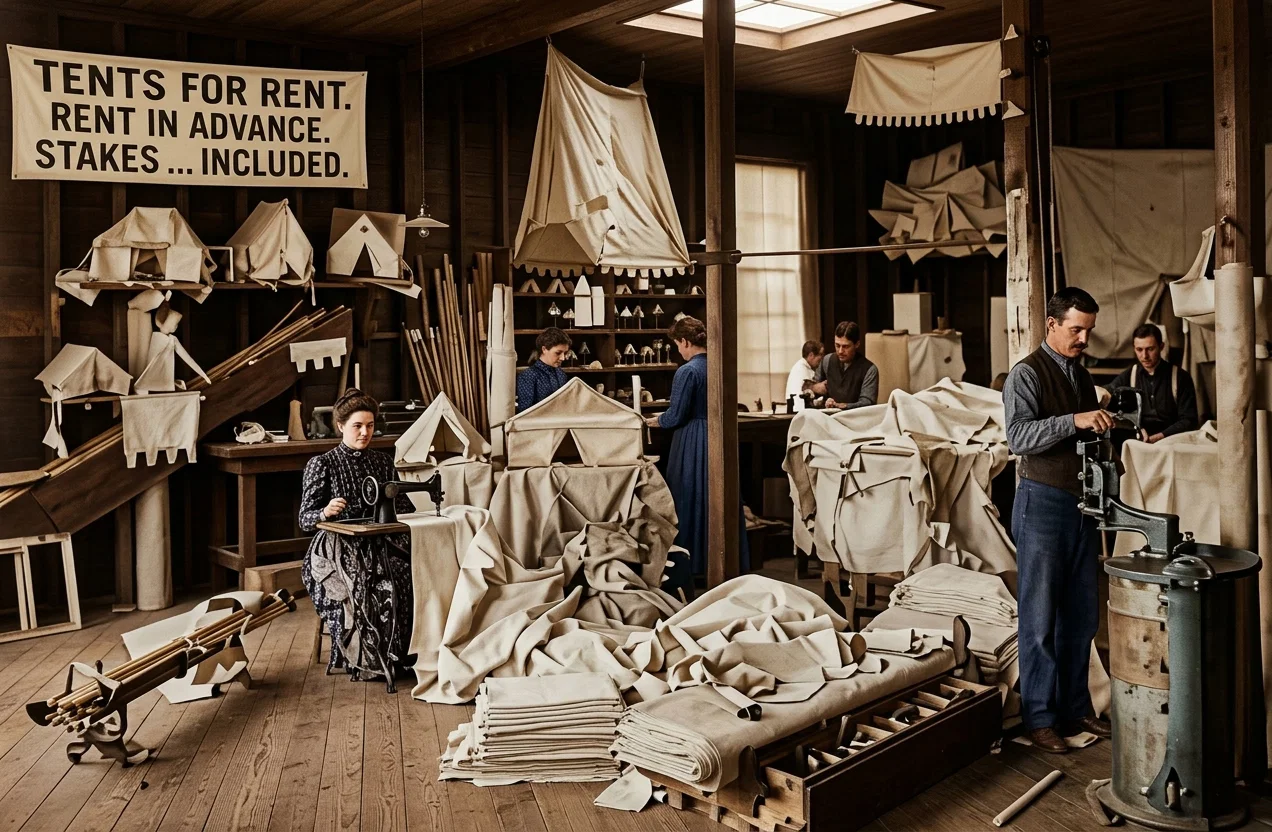
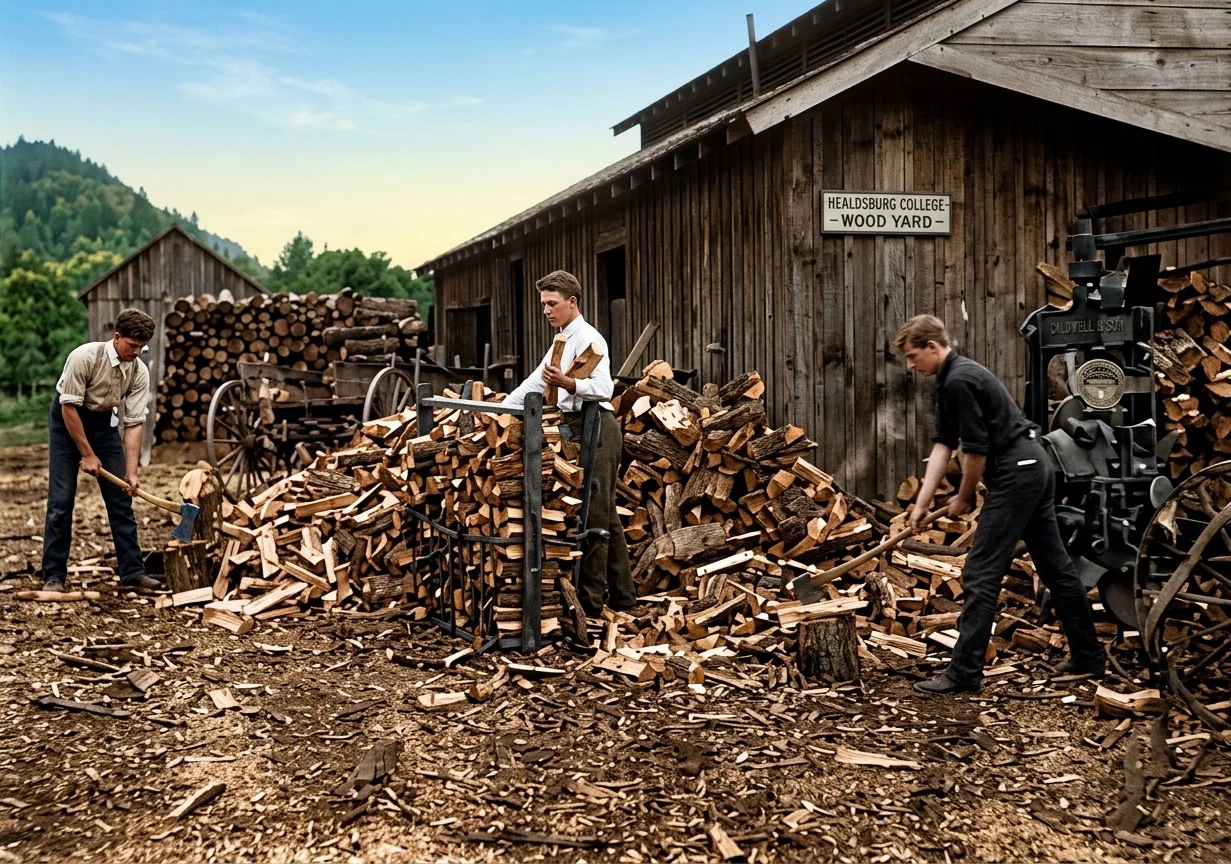
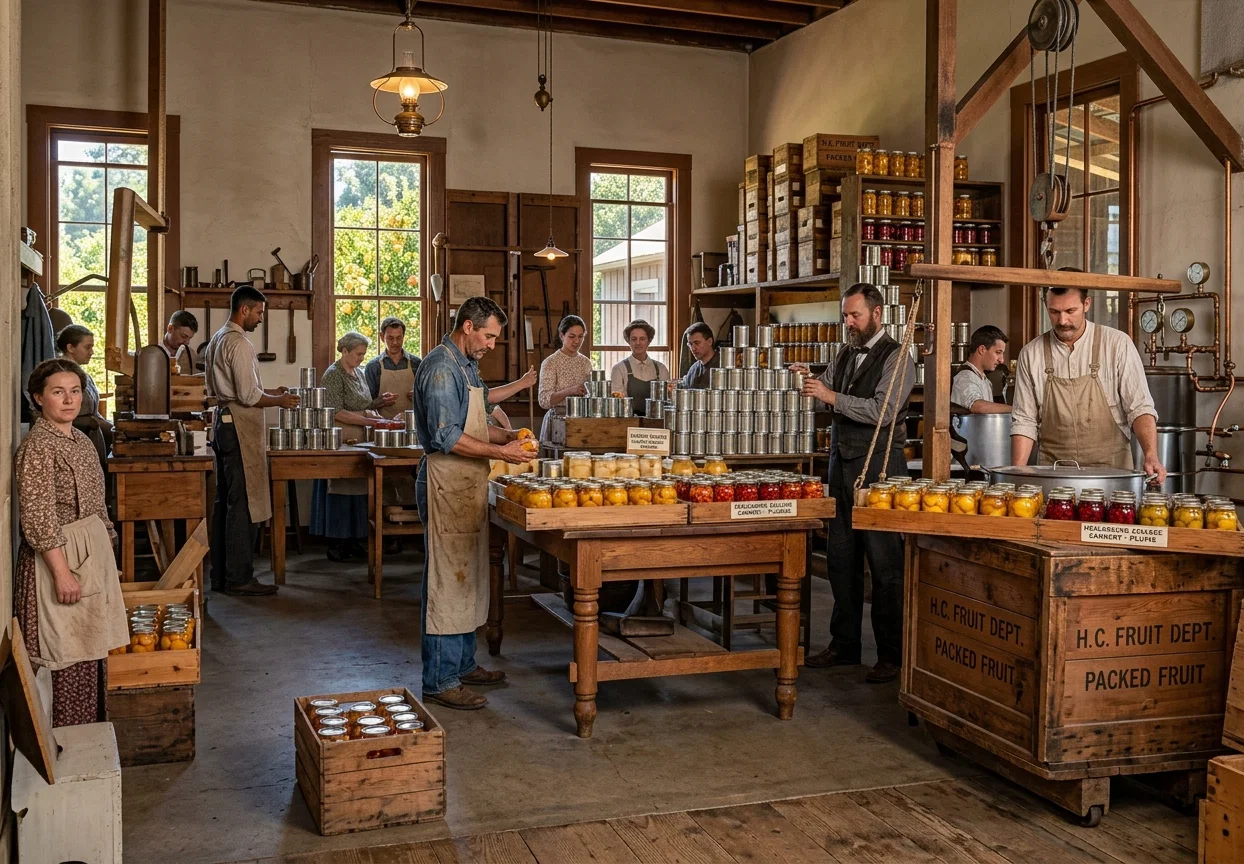
During the past three years special attention has been given to the development of the industrial lines in connection with Healdsburg College, so that at the present time the following industries are being taught: Broom-making, tent-making, printing, carpentry, upholstery, cooking, hydrotherapy, dressmaking, plumbing, blacksmithing, painting, freehand and mechanical drawing. In addition to this the College is operating the largest wood-yard in the city, and as soon as consistent, harness-making, shoe-making, agriculture, floriculture, and horticulture will be added to the list of industries.
Plans are now being made to have the students cut the wood in the forest as well as to operate the wood-yard in connection with the College. Fifteen or twenty young men will be sent out into the forest to saw and cut the wood for a portion of the day and the remaining portion of each day will be spent in study and recitations. One or more teachers will accompany the students to give instruction in the different lines of education. At the present time there are over fifty students who are studying trades in the different industrial departments of the College. Those who live in the College Home are required to take an industrial study as a part of their regular program. This is not required of resident students, because of their having work to do at their homes; but they have the privilege of doing so if they desire.
The students are divided into two classes: Regulars and Industrials. Regular students are those who have sufficient means to pay all their expenses in school. The industrial students are those who are limited in means, so that a part or all of their expenses are met by labor. A full industrial student pays his entire way by labor, working fifty hours per week. A part industrial student is one who pays from $50 to $75 down on entering the school, and meets the balance by working thirty-six hours per week. The regular students attend school during the day from 7:45 A. M. to 1:10 P. M. The industrial students work during the day beginning their work at 7:30 A. M. and closing at 4:30 P. M. Their session for study and recitation begins at 5 P. M. and closes at 9 P. M. Holding an evening school for these makes it possible to keep the shops open during the day, for the unhindered transaction of business.
One of the special reasons for connecting the industrial lines with Healdsburg College is that students may not only know what is contained in books, but that they may be able to perform the practical duties of life; also there is placed before students with limited means, the opportunities and privileges of school, which otherwise they could never enjoy. Below are given four special opportunities which make it possible for young men and women who have push and perseverance to obtain a Christian education, fitting them for Christian service, the only service worth the rendering—
Opportunity Number One.
FOR DAY SCHOOL STUDENTS.
1. On payment of $75.00 persons may enter the College as regular students, and pay the balance of their expenses (from $75.00 to $100.00, according to cost of board, room, and tuition) by working for the College during the summer months. 2. The $75.00 must be paid on entering the College, and this amount with the labor performed during the summer will cover the expense of board, room, tuition, light, heat, and plain laundry. The expense of books, clothing, and other incidentals must be met by the student. 3. That the College may be properly secured those availing themselves of this opportunity must secure some one as sponsor who will make up any deficit, in case the student should fail to fulfil the conditions.
Opportunity Number Two.
FOR EVENING SCHOOL STUDENTS.
Hours 5:00 to 9:00 P. M. On payment of $50.00, and the willing and faithful performance of thirty-six hours' labor per week, the student will be entitled to board, room, light, heat, plain laundry, and tuition during the College year ending June 2, 1903. The expense of books, clothing, and other incidentals must be met by the student.
Opportunity Number Three.
FOR EVENING SCHOOL STUDENTS.
Hours 5:00 to 9:00 P. M. A limited number of persons who are able-bodied, and love to work will be admitted to the College and given sufficient work to pay their expenses as far as board, room, light, heat, plain laundry, and tuition are concerned. Fifty hours' work per week will be required of students who enter under Opportunity Number Three. Overtime will be allowed so that students can earn sufficient means to meet the expense of books and working clothes.
Opportunity Number Four.
Fifteen or twenty able-bodied, willing-hearted young men are wanted at once to cut wood a few miles distant from the College. The students will work at wood-cutting forty-five hours per week and attend the evening school from 4:00 to 9:00 P. M. each day. One of the College teachers and his wife will live with the students and the school will be conducted on the place. Students in this school will have opportunity to enjoy the Sabbath privileges with the Healdsburg Church each Sabbath.
The work in the trades is not all physical exertion, but at times the hammer and saw and other working tools are laid aside and the teacher takes time to explain by drawings upon the blackboard, and by other illustrations, the principles underlying the work they have in hand. The students are required to be intelligent regarding the trades they are learning. The young man who is learning to be a blacksmith will be called upon to make drawings illustrating the anatomy of the horse's foot so that he will understand where to drive the nails in the foot, and the proper adjustment of the shoe. He will study the principles underlying the forge, the bellows and the welding of iron, thus becoming an intelligent blacksmith. So of printing, painting, horticulture, etc., etc. There will be combined in the learning of each of the trades the physical and intellectual capabilities of the student.
From time to time the students will be required to write essays on different phases of their work.
Monthly examinations will be given, and they will receive standings in the industrial studies as well as in the book studies in the Collegiate Department. We are glad to say that the prospect is bright for the development of the industrial side of the educational work at Healdsburg College, and we invite young men and women who are desirous of obtaining such an education as herein set forth, and who are willing to consecrate all power and strength thus attained to a life of Christian service, to become students of Healdsburg College. We also invite all who are interested in moral, mental, physical, and industrial education,—the all-round practical education which fits for the practical duties of life,—to contribute of their means to establish new industries in connection with the College, and to enlarge and strengthen those already started. This will enable the College to furnish more work to students whose means are limited, and who must of necessity exchange honest labor for an education. For College calendar and further information please address Healdsburg College, Healdsburg, Cal.