THE Bible is a book of types. The Lord has not mentioned by name the men and women, the nations and kings, the history and biography, the causes and effects, of the pregnant past in order to satisfy our curiosity or to make a readable story. Many times the human reason thinks that the story is incomplete, and the human curiosity wishes that fuller details had been given. It is not to satisfy either that the Lord has given us the Bible. The lesson is complete; the book meets the purpose for which it is given. All these records are types, are warnings, are instructions, are encouragements, for all the future. The histories of nations given are types of other nations. Apostasies recorded are types of later apostasies. Individual characters are types of other individual characters yet to come; and so it is that every nation, every church, every single soul may find in God’s Word the very thing he needs.
WHEN, therefore, God would give us instructions concerning His own church and its spiritual condition from the time of His first advent to the second, He takes seven churches in Asia, a fitting type of the world, to represent the entire career of His church in general. For that period of time when union of Church and State was coming in with rapid strides; when persecution had ceased and the world was seeking the favor of the church; when the ambitious bishop, assuming authority which God had not given over the flock, and the unscrupulous politician, began to feel that each was necessary to the other’s success; when pagan philosophy and practise were finding equal place in the nominal church with the Bible; when charms and amulets and relics and pilgrimages, and all the senseless superstitions of a dead religion had taken the place of faith in the living Word of God;—for that period God chose the church in Pergamum to represent His true church in the Roman kingdom, of which the city of Rome was the head, and the moulding power.
The Lord’s letter to the Pergamum state of the church is found in Rev. 2:12–17 and the scripture itself will be found in the following:—
Questions on the Text.
To which of the seven churches does the third letter apply?
“To the angel of the church in Pergamum write.”¹ Verse 12.
How does the Master reveal Himself?
“These things saith He that hath the sharp two-edged sword.”² Verse 12.
What is said of the character of the church’s surroundings?
“I know where thou dwellest, even where Satan’s throne is.”³ Verse 13.
How had the church borne her part?
“Thou holdest fast My name, and didst not deny My faith, even in the days of Antipas My witness, My faithful one, who was killed among you, where Satan dwelleth.”⁴ Verse 13.
In what had the church not been faithful?
“I have a few things against thee, because thou hast there some that hold the teaching of Balaam, who taught Balak to cast a stumbling-block before the children of Israel, to eat things sacrificed to idols, and to commit fornication. So hast thou also some that hold the teaching of the Nicolaitans in like manner.”⁵ Verses 14, 15.
What warning is given the church?
“Repent therefore; or else I come to thee quickly, and I will make war against them with the sword of My mouth.”⁶ Verse 16.
What promise is made to the overcomer?
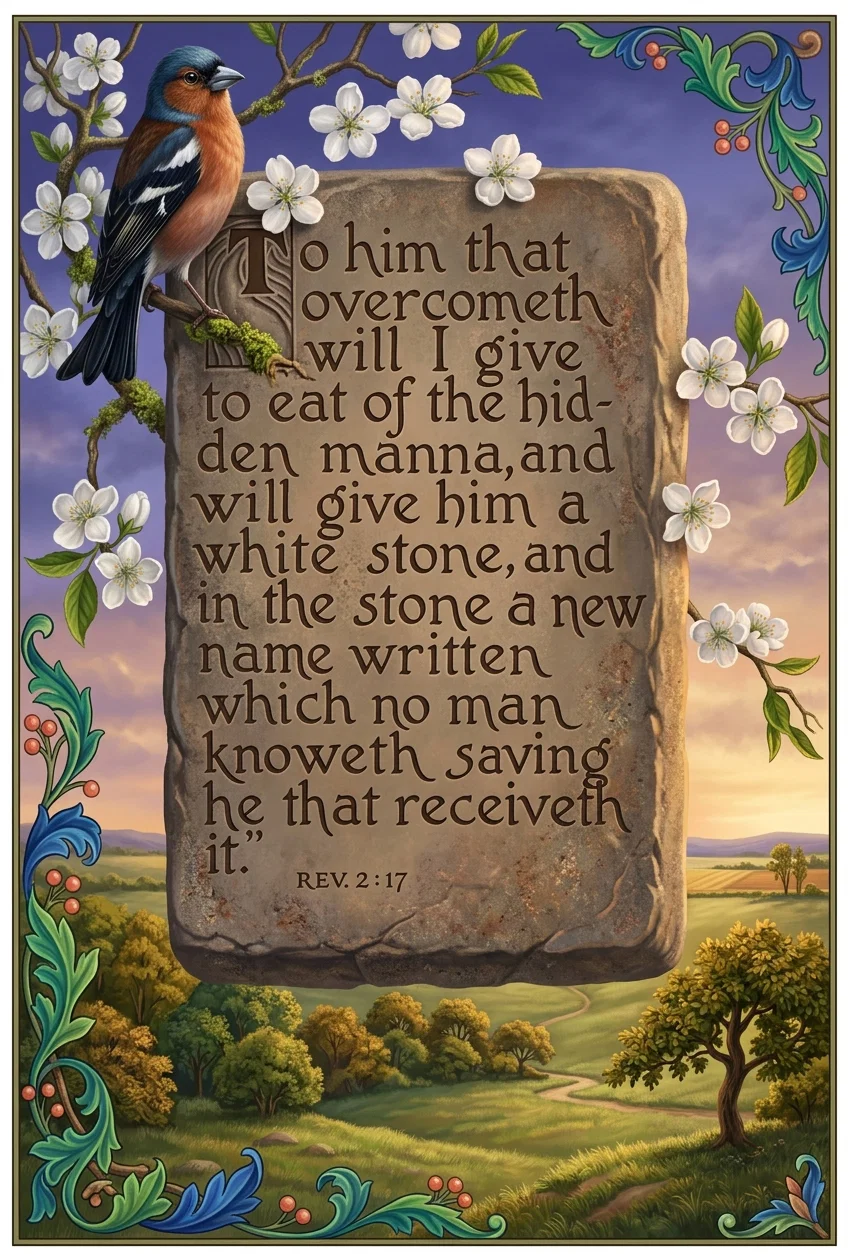
“He that hath an ear, let him hear what the Spirit saith to the churches. To him that overcometh, to him will I give of the hidden manna, and I will give him a white stone, and upon the stone a new name written, which no one knoweth but he that receiveth it.”⁷ Verse 17.2
1. “Church in Pergamum.”—Pergamum (or Pergamos) is said to have derived its name from Pergamus, the son of Pyrrhus, who settled there. Others connect it with the Greek pergos, tower, height, elevation, because of a hill in the city held sacred. The city was in western Asia Minor, about eighty miles north of Ephesus, twenty miles from the sea. It was at the time of John’s writing a rival of Ephesus, a pagan-cathedral city, a university town, having a library that rivaled the famous Alexandrian, and a royal residence of the Attalic kings. Here were temples to Jupiter, Minerva, Apollo, Bacchus, Venus, and Esculapius, the latter, the god of medicine, known by the name of the Pergamene god. He was given the title of “Saviour.” His characteristic emblem is the serpent. Truly it could be said to be a place where Satan dwelt, where his throne was, a fit emblem of the church of Christ during that period, when she became corrupted by contact and converse with the pagan world. The whole city was given up to the worship of sense, even as was the empire of Rome.
2. “The sharp two-edged sword.”—See 1:16. The sword is “the Word of God,” sharp, penetrating, living, mighty. “For the Word of God is living, and active, and sharper than any two-edged sword, and piercing even to the dividing of soul and spirit, of both joints and marrow, and quick to discern the thoughts and intents of the heart.” Heb. 4:12. Our Lord Himself is called “the Word of God” (Rev. 19:13; John 1:1–3), because He is the One through whom the Father has spoken to this world. And the word which He speaks is fitly likened to a sword cutting both ways. It is a flaming, burning sword, destroying and consuming sin, and all identified with it. 2 Thess. 2:8. That Word is the only weapon given to the Christian warrior, even as Christ is his only captain. By it the child of God can discern and destroy sin, and win souls to Christ.
3. “Where Satan’s throne is.”—God uses earthly agencies, so also does Satan, the great arch-enemy. But God’s throne is in the heaven, and His Kingdom ruleth over all. Satan was cast down to this earth, he and his angels. He has his army. His forces are organized. He has his headquarters—his throne. Where is that throne?—Obviously at the capital of the ruling power of earth. In the time of Babylon’s evil days the real “king of Babylon” was “Lucifer, the son of the morning.” Isa. 14:4, 12. In the days of Tyre’s supremacy the visible ruler was but “the prince of Tyre,” the real “king of Tyre” was the apostate covering cherub, Satan. Eze. 28:2, 11–16. It was Satan which gave the beast representing the apostate powers of earth its throne and great authority. Rev. 12:9; 13:2. In the days when the church was passing through the Pergamum stage, Rome was dominant among the powers of earth, and the bishop of Rome was under the influence of Constantine wielding the greatest worldly influence among the bishops, and assuming himself to be the head over all the holy churches. In Rome Satan ruled. The wicked pagan emperors were his agents. The backslidden and worldly church was eclipsing before the world the true church of Christ. But God regarded His own, He knew the fearful age, the overpowering influence of worldliness, popularity, and outward prosperity. The few were faithful to God, holding fast His name—His character, His righteousness—even under the strongest temptations.
4. “Antipas My witness.”—Antipas (another form of Antipater) is by some derived from anti, “against,” and pater, “father” or pope; that is, against popery. Antipas may have been the name of a martyr in Pergamum, and symbolical of those who were persecuted for opposing the rising power of the Papacy.
5. “The teachings of Balaam.”—(Num. 31:16; Josephus, Ant. 4:6:6.)—Balak invited the Israelites to a gormandizing, idolatrous, and licentious feast, given in honor of Moab’s gods. (See Numbers 25; Ps. 106:28–31.) So the early church was led away by men in the church who professed to be children of God, led away to the false doctrines of pagan philosophy regarding God and the soul and man’s duty to his Maker, and to commit fornication with the kings of the earth. (See Acts 20:29, 30; Gal. 4:8–10; 2 Thess. 2:2–7; 2 Peter 2:1–3.) It was the time of backsliding, and God’s best people were yielding to it, by tolerating the evil. To sacrifice to idols is to sacrifice to the dead; for the pagan deities were but deified dead heroes. But to sacrifice to the dead is to sacrifice to demons, for the supposed spirits of the dead are but demons in disguise. Compare Num. 25:2; Ps. 106:28; 1 Cor. 10:20. The ancient pagan belief meets its counterpart in the blinded Christian church in Mariolatry, adoration of saints, and modern Spiritism. In doing these things the church herself becomes a sacrifice on the pagan altars. The teaching of the Nicolaitans—licentiousness, fornication, physical and spiritual—which were hated in the Ephesus state of the church were tolerated in the Pergamum state of the church. “By beholding we become changed.” How true are the words of the poet:—
“Vice is a monster of so frightful mien
That to be hated needs but to be seen;
But seen too oft, familiar with his face.
We first endure, then pity, then embrace.”
6. “Repent therefore or else.”—It is not a threat; it is what God must do if the church proves false. She must turn for her own sake intrinsically; she is out of harmony with God. When God wars against men, woe be to them. When God permitted that union of Church and State, the compromising church fell before it, turned and was persecuted. The only safety, the only hope of a backslider is to “repent and do the first works,” whatever the conditions; for repenting is not a mere emotion, but a change of purpose, a right-about-face, a yielding to the will of God.
7. “The hidden manna.”—Christ Jesus, “the bread of God” “which cometh down out of heaven, and giveth life unto the world.” John 6:33. A portion of manna was placed in the most holy place of the sanctuary (Ex. 16:33, 34), where it was hidden from all observers. Jesus Christ has passed into the heavens, but the child of God can truly feed upon Him, tho He is invisible, even as He fed upon the bread from heaven (John 4:32). “A white stone”—“a new name.” White, the emblem of purity and righteousness, like the white diamond of the priest’s breastplate, through which God’s will was revealed. It is God’s reality opposed to the superstitious charms and amulets of that age. It is the pledge of divine guidance and fellowship between God and the faithful believer, the covenant token that on His part can never fail. “Name” is significant of character. By that fellowship of righteousness with Christ Jesus the child of faith is changed in character. In other words he is by the power of God in daily fellowship with Christ Jesus spelling out the new name of his new character. “Which no one knoweth.”—Every soul has its individuality, its own sins, sorrows, weaknesses, victories, experiences. No one can know them but he who has experienced them all. Hence the new name is unknown save to the Giver—who is with every soul in all its conflicts—and the receiver. The white stone and the new name represent, therefore, the glorious, blessed, secret experience between the believer and Christ Jesus our Lord.