THE TRANSVAAL

8%

Pacific Press Publishing Company · Oakland, California · Oct 22, 1902

FromSigns of the Times, Vol. 28, No. 43.

Read the full edition

Botanic Gardens, Cape Town.

THE TRANSVAAL.

THE journey of a thousand miles by rail from Cape Town to the Transvaal is even more monotonous than traveling a like distance through the desert regions of western America, for the reasons that much of the scenery is unattractive, the progress of the African train—it would be improper to say speed—is much slower than the American, and the comfort and equipment of the latter is incomparably superior to the former.
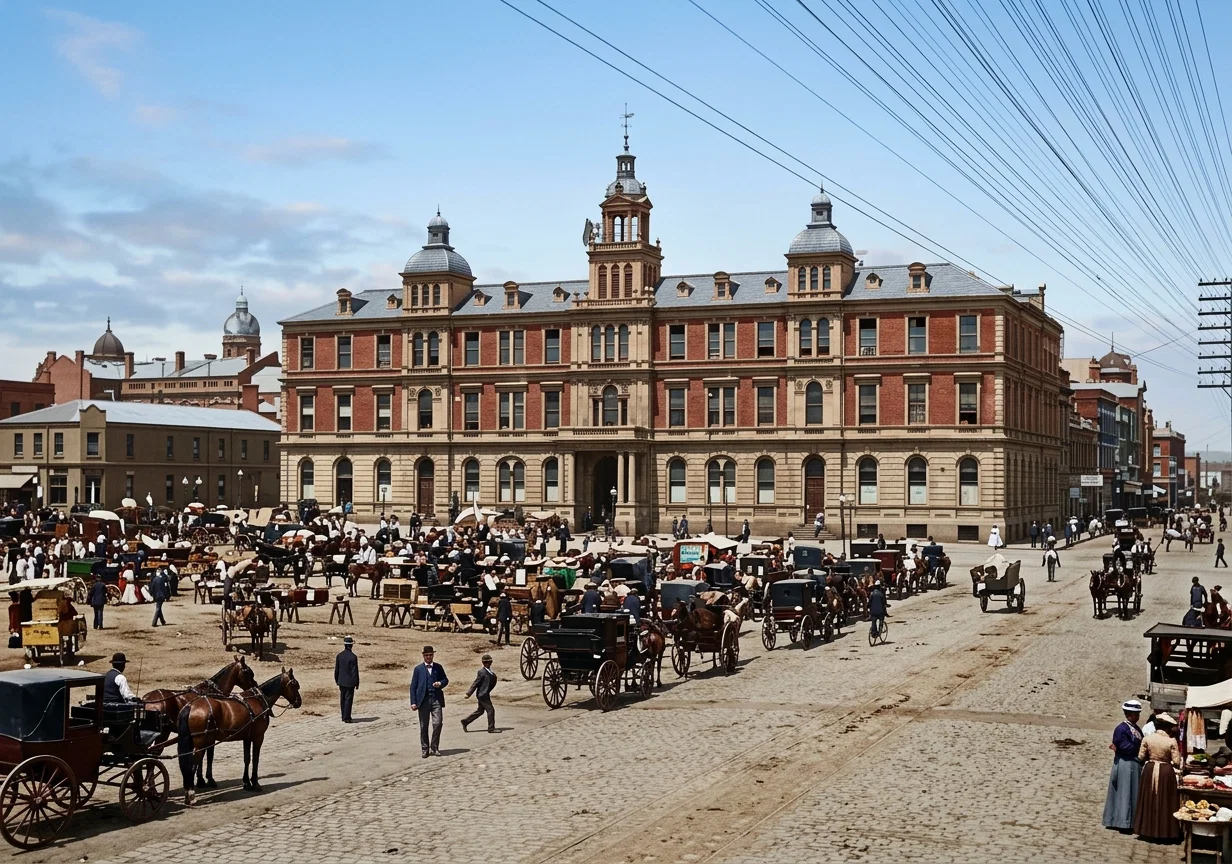
Post-office and Market Square, Johannesburg.
In an African passenger carriage one is shut up in a crowded compartment with from three to seven fellow-passengers, and altogether likely you are the only one of the party who considers tobacco smoking an unhealthful abomination; yet it would seem to the others to be extreme selfishness for one to politely plead for his right and privilege of breathing God-given, pure air, unadulterated by poisonous tobacco smoke, and thereby compel the other members of the company to deny, for the time being, the cravings of depraved appetites. So you perhaps hold your head out of the window till one of the smokers objects to the cold draught of air, or till, it may be, you feel that you are “taking cold” from exposure; then, closing the window, you sit and inhale the dense cloud of smoke till you feel that you are fairly pickled with the offensive odor. On all American trains there is a smoking carriage, where tobacco-users can burn incense to their god, to their “heart’s content,” without annoyance to their fellow-travelers; but in Africa, even a lady’s presence in a compartment of a railway carriage does not always deter the devotee of the “weed” from worshiping his idol.
There are exceptions to this general rule where such regulations are least needed, viz., in the local train service connecting the suburbs of the large cities with their centers, and where one would be on the cars but a few minutes before reaching his destination. Here the strong arm of the law takes the matter in hand and compels those who are determined to smoke to ride in a smoking carriage. But where you are making a journey which requires from a few hours to four or five days, the law leaves you to the tender mercies of the smoker. In this connection two questions may be worthy of consideration: First, can a man who smokes consistently claim to be a gentleman? Second, can a man be both a Christian and a smoker at the same time?
There are many things which break the monotony of a journey to Johannesburg, at this the beginning of a new epoch in the history of South Africa, and which furnish material for serious reflection. Chief among these are the long freight trains of open cars, such as are ordinarily used for the transportation of coal, now laden with soldiers going to the sea-board to take ship for home. As in this “high veldt” region bitter, biting frost makes nightly visits at this season of the year, one is impressed that there are many hardships in connection with the life of a soldier, and that, if never before, these will appreciate the cheerful firesides of Old England and the comfortable beds made ready by wives, mothers, and sisters, on their return.
Other scenes of interest which make one pensive are the desolated homes along the route of travel; the occasional Boer family, with the familiar “span” of eight yoke of oxen, “treking” back to lovely farms, now destitute of all life, except the wild birds, the jackal, or perhaps the family dog wandering, half-wild, over the once-cheerful estate; and on the other hand, the numerous groups of graves, whose occupants have been bitterly mourned in far-away Britain; and lastly, the ruins of once magnificent railway bridges, wrecked by their own builders, the Boers, in a vain attempt to stop the onward march of King Edward’s legions to the capital and strongholds of the Transvaal and Orange Free State.
The country across the Vaal River (which is the meaning of Transvaal), as well as that on the “Cape” side, now offers excellent opportunities for missionary farming, as the new government will compel the division of the many-thousand-acre farms which were in the possession of the Dutch farmers, by limiting ownership of land to the amount actually utilized in farming. This land, thus divided, will be offered at from $2.50 to $10.00 per acre, to actual settlers. In the old Transvaal there were a number of German missionaries who occupied farms, and gathered around them large numbers of natives, who became faithful in attending church services, and thus were brought under the influence of the Gospel. Christian farmers would find excellent fields for self-supporting missionary work at the present time in South Africa. The natives will settle in villages or “kraals” on the farms, if desired, and perform all kinds of farm labor for nominal wages, while at the same time the parents, and especially their children, can be given the “everlasting Gospel.” Some of them will develop into missionaries to their own people, thus preparing the way for that grand gathering of “every nation, kindred, tongue, and people,” before the throne. There is a degree of satisfaction in sowing seed in virgin soil that is not experienced in the cultivation of old and “weedy” land. The native who has never heard the Gospel of Christ frequently receives the “seed” sown, more readily and with more confidence in the Word of God than his better educated white brothers. He does not question the obligation as to keeping the true Sabbath, for God has spoken distinctly on that point; therefore his question is, “Why don’t all Christians obey God and keep the seventh day?” Is it possible that these natives of “darkest Africa” will rise up in judgment and, by their having obeyed the voice of God in Sabbath-keeping, condemn the more enlightened, who refuse to obey?
One of the extremely sad features of the outcome of the war, now happily past, is that many of the Boer people who before were a devout, church-going class, have thrown away their Bibles, ceased to attend church services, and become atheists, because of their disappointment at the outcome of the conflict. This result has come, at least partially, from basing their faith on certain scriptures which they believed taught that they would be victorious; and from failure to recognize that “the Most High ruleth in the kingdom of men, and giveth it to whomsoever He will.”
It seems to the writer to be a most favorable time to reach the Dutch people with the third angel’smessage. If they can first be shown wherein they misapplied the scriptures and thereby were buoyed up with false hopes of triumph in the war, their confidence may thus be restored in the Bible and in the Creator, and they be ready to receive additional light. Dutch workers are greatly needed to enter this field at once. We are praying the Lord of the harvest to raise up laborers to enter the ripening fields. Some are gladly responding to the voice of the Master saying, “Go work to-day in my vineyard.”
G. W. REASER.
Johannesburg, South Africa.