A CORRESPONDENT of the World's Crisis, who is a missionary in China, gives, in a letter to that paper, an interesting account of his return to his mission station, and the conditions prevalent there at the present time. We give a few extracts from this communication to show the faithfulness of the native converts, and the present attitude of the Chinese people there, the conditions there being similar to those of other localities to which the missionaries have returned. He says:—
City of Lao-Ho-Kean, China.
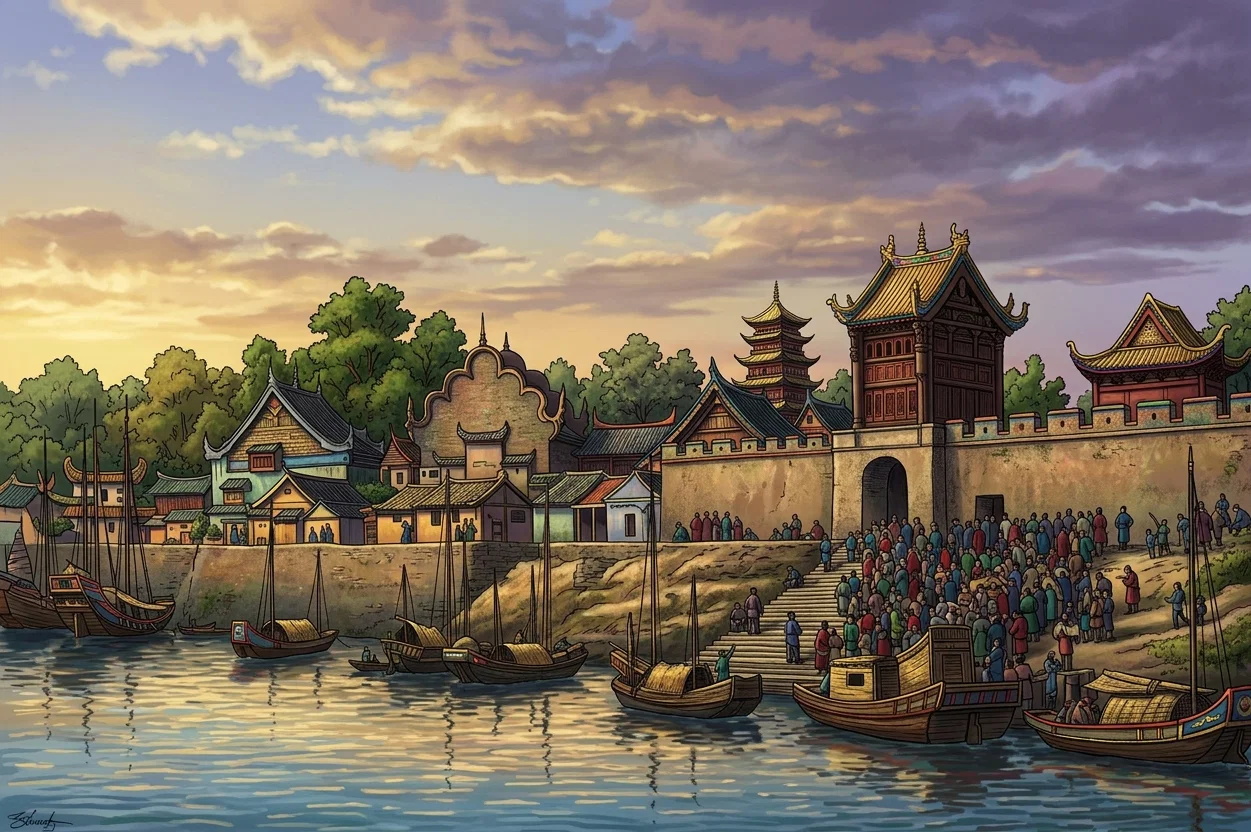
After meeting the Christians at Wuhu, and spending a few days with them, we felt we must visit Han-Shan—away in the interior—and see how our brethren fared there. So, on November 28, we started by native house-boat up a small river just north of Wuhu. We had a fine day for starting, and got along fairly well the first day, and reached Ri-ts'ao, a small town where the Methodists have a church. Here we stopped for the night, and the next morning, by daylight, we started again. We traveled all day, having light winds, and at eight o'clock in the evening we reached Tsin Tsi. This is as far as the boats can go in the winter months, so we got out and walked twelve miles to Han-Shan. It began to rain soon after we left the boat, and by the time we reached the house we were wet through.
We were met with a warm welcome from the members there, all of whom had stood true through all the bitter trials of last year. We had a special praise service, thanking God for our safe arrival in China, and for His kind and protecting care over them.
We found the house in fairly good repair. The official of the city sent around a watchman, when we left last year, who had stayed there ever since. We gave him a present, and he went away happy, turning over the place to us again.
Mr. Yen and wife went up with us to take charge. He will hold services there every day, and visit the inquirers and members.
We left Han-Shan, and came down through Tao-Kia to visit a member there, and look out a new preaching hall. We were royally entertained by a wealthy cloth-dealer. He and his family are all inquirers. They were so glad we visited them. They want a hall and school there badly, and we hope and pray they soon will have.
As you know, the Yang-Tsi river overflowed its banks in July, and drowned out their entire crop of rice. Hundreds have flocked into Wuhu, and the foreigners are doing all they can to keep them alive. They can do but little before April, and so they must receive help until then. Let us teach them we hold nothing against them as a nation, or as individuals, for the last two years' awful massacres, and that we are not seeking theirs, but them.
That practically the same kind of reception is met by missionaries of other denominations, is indicated by the following from the Missionary Herald:—
Reports from the several stations of our North China Mission indicate rapid progress in the work of restoration. The new buildings at Peking and Tung-cho are in an advanced state, and Dr. Arthur Smith writes that the sites, in each case, are all that could be desired, and are “a vast improvement on anything which could have been secured, but for the Boxers.” The mission is practically unanimous in the opinion that all the old stations should be reopened. A plan for co-operation in educational work between the London Mission, the American Presbyterian, Methodist, and the American Board Missions, is under consideration, with the promise of a successful issue. The details are not yet at hand, but we hope to be able to report before long a hearty agreement between the several societies laboring in North China, in maintaining jointly institutions for higher education.
This friendly reception which the missionaries are meeting in so many parts of China is indicative of an awakening from the sleep of centuries on the part of Chinese thinking men, a desire to burst the bonds of prejudice that have held them so long, and investigate what the missionaries have that will be for their good. This is seen also in the largely increased number of “inquiries” reported from the various mission stations. Some of the clear-headed Chinese are beginning to think upon the meaning of recent events, and to express their thoughts with a boldness hitherto unknown. Such a man recently spoke through the columns of the China Mail as follows:—
A great revolution is about to take place in China, a revolution that will shake the existing structure to its very foundation. China is teeming with men of talent. Chinese never will be slaves. Let Great Britain remain neutral and watchful in the coming struggle for supremacy. Let her support the New China Party in the grand struggle for liberty, and she will not regret the day she adopted such a policy. Friends in need are friends indeed. The new government will be constituted of the pick of our able men abroad and at home. The new government knows its work, and will guarantee the payment of existing loans. The country will be thrown open to trade, and laws will be framed with laws of the most progressive powers of the world as their basis. Great Britain must not repeat the Gordon incident, but should stand by the New China Party, with these Powers who support the “open door” policy in order to prevent the piratical interference of such selfish and avaricious powers as Russia and France.
“Quite recently,” says a missionary in Swatow, China, “a most advanced sentiment has been put forward. The occasion of it was a review of the book on reform issued by the noted Viceroy, Chang Chi Tung. Chang regards all the Chinese people as vassals of the throne. The will of the Dynasty is the one supreme law. His reviewer, evidently a scholar of great ability, in a long and exhaustive criticism, attacks Chang's position without mercy, and with a boldness of statement which could not be beaten by a radical American. ‘The people,’ he says, ‘do not exist for the government, but the government exists for the people. The right of the Dynasty is not founded on justice.’ Such views are being spread with remarkable fulness among the millions of Chinese students, and are sure to help on a revolution.”
What will be the result of this predicted revolution none can tell. That it will mean much for the Chinese nation is certain. It may mean partition among the powers. It may mean an entire change of the governing power, with China independent of western domination, but with doors open to the civilization and Christianizing efforts of missionary organizations. However these affairs may turn, it is evident that God is now preparing China to listen to the preaching of His Word. China, as well as the other nations of the earth, must have the Gospel preached within her boundaries “for a witness.” “This Gospel of the kingdom shall be preached in all the world for a witness unto all nations; and then shall the end come.” Matt. 24:14.