ALTHO recognized by the missionaries as a hard field, much has been accomplished within the past four years in the line of mission work. Missions have been established by the different denominations in all the principal cities, and many souls are rejoicing in the light of Protestantism as the result of the untiring efforts of noble men and women who have devoted themselves to this work.
In some places mission schools have met with success. Not until 1898 was the island opened to missionaries. Practical work was begun in December, 1898. Others have followed rapidly, and to-day the work of evangelizing Porto Rico is moving steadily along.
When we stop to think of the many difficulties in the way of the workers, we are glad for what has been accomplished, and expect it to make further advancement. Up to the present time, roughly estimated, there are about five or six thousand Protestants in this island.
The island has been set off in sections, the Congregationalists holding the eastern, the Methodists the southeastern and a portion of the northern central, the Christians and Independents the northern and a portion of the central, the Baptists the southern and the military road from San Juan to Ponce, and the Presbyterians the western. There are fifty mission stations, including outposts, with thirty-four male missionaries, twenty-six female, and several native helpers. The number of mission schools in Porto Rico is seven. Owing to good government schools and tuition, several other mission schools have been obliged to close.
Two orphan asylums have been established, four churches are under construction, and four others are being planned.
There are three converted priests engaged in missionary work here, one from another country and two residents. One of these is working independent of any denomination. As the people become more enlightened on the true principles of Protestantism, we expect to see many throwing off the bands of Romanism.
Since the island has come under American rule, much has been accomplished in the line of education. Schools under the supervision of good teachers, both Spanish and English, have been established all through the island. The demand for schools is great, so great already that the government can not meet the demand, because it is limited to $500,000 per annum for education. Nearly 50,000 children are being educated and the government plans soon to open two industrial schools. From an educational standpoint the prospects are bright indeed for this island.
When we stop to think that with education the mind expands, and we are more able to comprehend the Word of God, we do indeed rejoice to see such a bright future for Porto Rico. But with education come greater responsibilities, and we know that more will be required of those who receive this education.
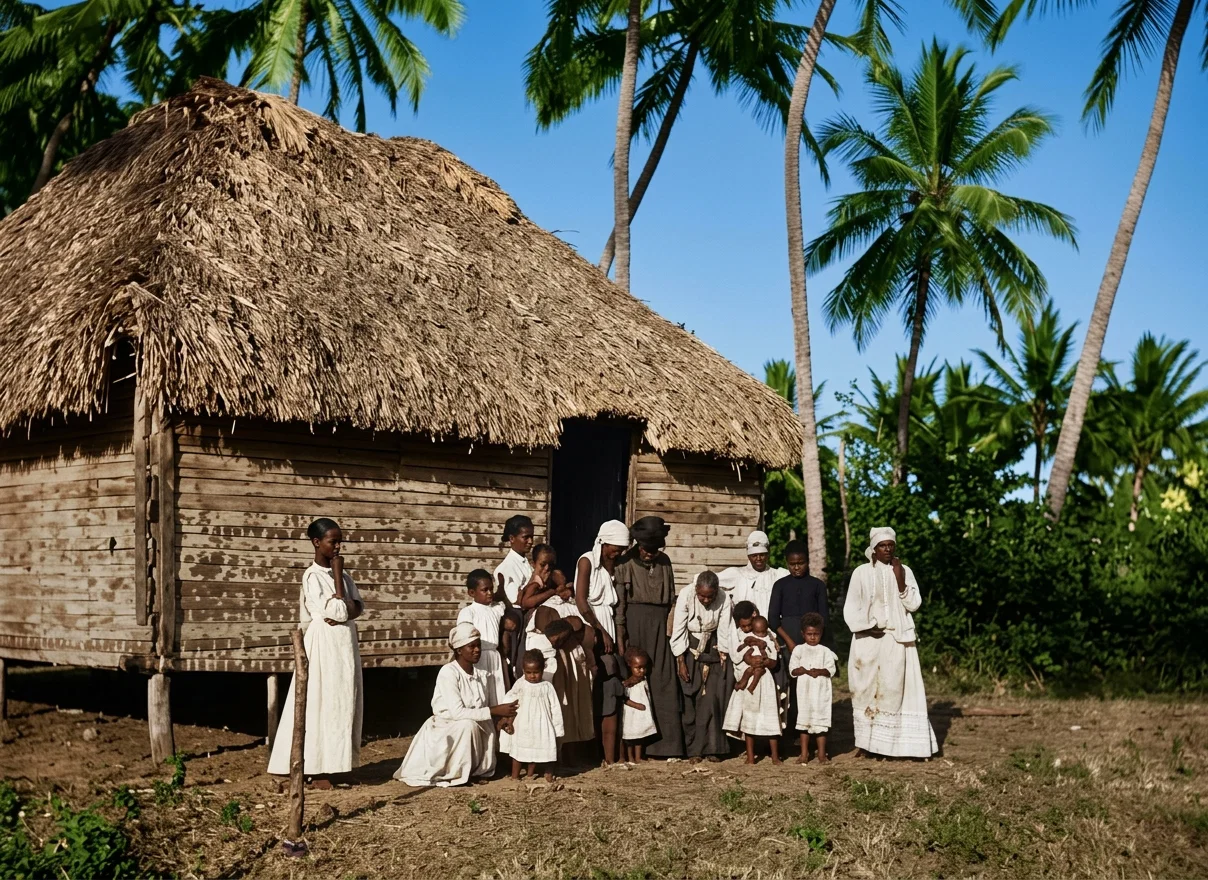
A Group of Native Porto Ricans of the Poorer Class.
As far as intellect and brightness is concerned, Porto Rico stands on an average with other civilized countries; all she needs is an opportunity to demonstrate her ability in the educational work.
I do not think that a kinder-hearted people ever lived than we find here. They will put themselves out of the way many times to do you a favor. Altho many unkind remarks have been made about them because of some of their customs and peculiarities, yet they seem to have the kindliest feelings toward us as a nation and as individuals.
While we Americans have made many mistakes in this direction, we are glad to see that there is an effort being made to rectify them; and many noble Americans are seeking to impress upon the minds of the people of Porto Rico that they have only their good at heart.
Wherever we go we have evil to contend with, and so it has been here. War brought its evil, its crime, and influence, but now that the island has been relieved of this, we look forward to an advancement of the light of the Gospel. This alone will fill the hearts and homes with peace.
Prosperity seems to exist in many of the coast towns, but it is claimed that poverty and starvation exist in the interior. Just how to adjust this state of affairs is a perplexing question indeed. Many are anxious to work if they can find work to do; but others do not care to work.
Those standing at the head of the government seem to be fair-minded men, and are evidently trying to work for the best interest of the people.
American laws are now in operation here, and there is an increasing desire on the part of the people for a knowledge of the English language.
Under the direction of competent men wonderful changes have been wrought in public school work, which has been for the advancement of educational work here. This the people appreciate much; the schools are crowded; and the children are learning rapidly. While we have many of the customs of Spain and the superstitions of Rome to contend with, yet Porto Rico, on the whole, is far in advance of many Spanish provinces, and is rapidly becoming Americanized.
We look forward to the time when earthly kingdoms will fall, and the God of heaven will set up His kingdom, a kingdom of righteousness and peace, where all nations will be represented and the Lord Himself will be king.