THE medicinal or curative properties of the oil of the olive, as well as the nutritive qualities of the berry, were more generally known and appreciated in the days of Jesus than at the present time. The olive tree is dignified in the Old and the New Testaments with remarkable frequency, as Bible readers are doubtless aware; and the oil which was used not only in ceremonials, but as a remedial agent for physical hurts, fills an equally important place in sacred history. Indeed, the olive tree is so closely and, in some instances, tragically associated with the life of Jesus and the utterances of the prophets, that it justly deserves a distinctive and distinguished place in church and Christian annals.
It may not be uninteresting to know that in Palestine, Spain, Italy, France, and California the berry of the olive tree is at its best just prior to and during the holiday season. (A most instructive exercise for young students of the Scriptures will be found in their efforts to accurately enumerate the number of times the names of the olive tree, the olive, and its oil appear on the pages of Holy Writ.)
The history of the olive tree in California is brief and quite well known. The Mission olive tree tells the story of its own transplanting, and serves to limit the period, so far as the past is concerned, during which an important industry has been added to the acquired resources of the State. The annual output of oil and ripe pickled olives is steadily increasing in California, and the plantations do not now, as they did up to twenty-five years ago, consist alone of Mission trees, but embrace scores of varieties indigenous to the soils of France, Spain, and Italy.
With the increase in the consumption of ripe olives, and the use of oil, both for table and cooking purposes, a knowledge, first, of how these two delightful and healthful edibles are correctly prepared for the consumer, and, second, of how the consumer should care for them after they have been added to his larder, will not, we hope, come amiss. At this point, the writer would add that the information written herein was acquired on an olive plantation in the foot-hills of Placer County, and that the oil output of this establishment, while not large, is famous, and has largely advertised, not only in the United States, but throughout Continental Europe, the excellence of California oils. The ripe olives prepared on this ranch are also considered the best in the market, and invariably fetch from fifteen cents to twenty-five cents per gallon more than any other ripe pickled olives sold in San Francisco. The writer has reason, therefore, to believe that the methods about to be briefly and generally described are of the best.
How Oil is Made.
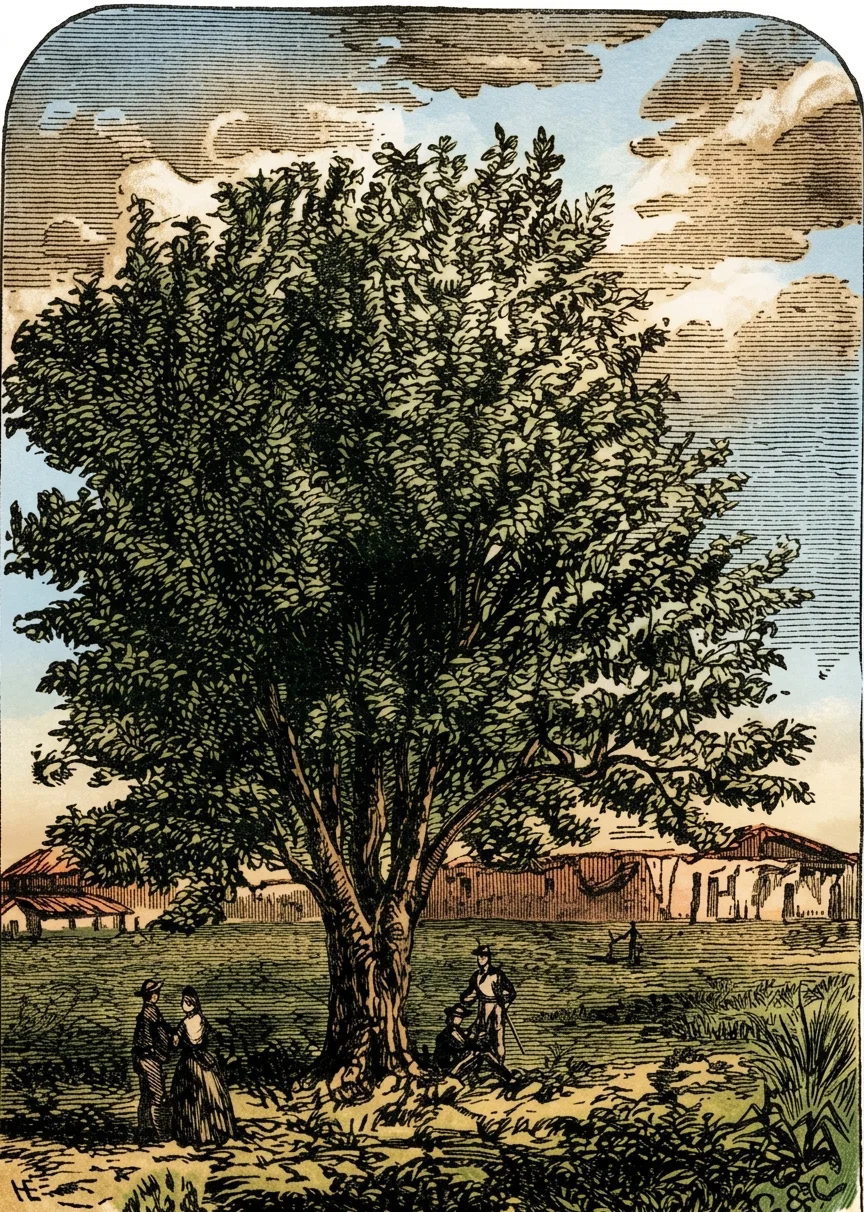
An Olive Tree.
Olives for oil are raked from the trees, knocked off with poles, or sometimes, when the tree is young and the crop light, picked by hand. The olive should of course be ripe before it is gathered, and, during the process of picking, it is allowed to fall upon canvass spread on the ground around and about the tree. The fruit is next taken to the warehouse, adjoining the oil room, where it is passed through a cleaner and relieved of clinging and loose leaves, twigs, and other foreign matter. The berries are then spread out in bins, where they are kept in a warm temperature until they begin to shrivel—a condition that evidences the evaporation of a part of the water of which they are largely composed. They are then, in lots of 250 pounds, placed beneath a huge stone similar in all respects to the great stones seen in flour mills, with this difference, that the oil stone stands on its edge. As the stone revolves in the circular basin in which the berries have been placed, it slowly crushes them, pit and all, into a pulpy mass, which looks very much like blackberry jam. The pulp is then placed by hand in circular mats of Italian grass, twenty inches in diameter. These mats have openings three inches in diameter, above and below, and are loosely woven. Into each fifty pounds of pulp are placed. When thus stuffed, they are called cheeses.
To make a pressing ten cheeses are taken to the oil room and placed one on top of the other in a metallic and circular pan some two and one-half feet in diameter. Upon the top of this stack of cheeses the end of a huge, wooden beam, mechanically geared, is slowly lowered until its weight holds the stack firmly, and additional power is given the beam until the pressure it exerts equals 7,500 pounds to the square inch of the surface resting upon the top of the stack, and the work of expressing the oil has begun. As the pulp grows more compact, the oil streams through the interstices of the mats—the beam meanwhile following the stack as the latter shortens. It requires from two to two and one-half hours to express the oil from a single stack; and when the operation has ended, the pulp in the mats is nearly if not quite as hard as sun-baked clay. The beam is then raised, the mats removed, and emptied of their contents. The dry pulp is used as food for pigs, and chickens, for fuel, and often goes back to the olive tree as a valuable fertilizer.
When the oil pours from the mats it passes from the holding-pan through a pipe to the first settling vat. There it is allowed to stand for twelve hours, at the end of which time it is skimmed. The residuum consists chiefly of water, and is stored in other reservoirs. It is allowed to stand thus for two days, and is then, in small quantities, filtered through blue litmus paper, literally a drop at a time. The oil is next bottled, neatly wrapped and packed, and is ready for market.
How to Tell Good Oil.
The following simple rules may prove of some service to users of bottled olive oil:—
Never purchase a bottle of oil that has been exposed to the light on the shelves of your grocer. Ask him to give you a wrapped bottle, and see that it is taken from the case.
When not in use, keep the oil well covered in the dark in a pantry or room of even temperature. Your oil will then retain its delicate flavor until consumed.
How to Pickle Olives.
Ripe olives are carefully picked by hand and immersed in cold water for a period of six to eight hours. They are then put in a bath of lye and water, and are allowed to remain four hours. The lye extracts the bitter essence of the berry known as olivite, and deposits itself in the berry instead. To separate the lye from the olive, the berry is kept submerged in cold water, the bath being changed every four or five hours, day and night, for three days, twice a day for a week, and once a day for another week. It is then placed in a mild solution of salt and water, and allowed to swim there for still another week. It is now ready for shipment, and, having been put in commercial packages, the kegs and barrels containing the fruit are filled sufficiently to float the berries with a strong brine—the water having first been sterilized.
Suggestions and Information for Consumers.
To keep ripe olives firm and prevent disintegration, the consumer should always, on taking his purchase home, no matter how large or how small, place the olives in a thoroughly cleansed wooden vessel or crock, and wash them gently and carefully in cold water. Let them stand over night before using, and in the morning one will find their salty flavor almost gone. Then mix a fresh brine and replace the olives. It will not take them more than an hour to absorb the salt, and thus one may “salt them” to suit the taste just as he would an egg.
Never permit ripe olives to stand in the same brine longer than a week, and never fail to thoroughly cleanse the vessel containing them once a week. Keep them in a cool, dark room, and loosely covered, so as not to interfere with the natural evaporation of the bath. Take as good care of your olives as you do of your highest-price butter, and it will repay you.
Moreover, remember that the ignorance and neglect of the shop-keepers who retail ripe olives is doing more, not only to spoil the olive itself, but to injure its reputation abroad, than any other known agency.
If you can not plainly taste the oil in a pickled olive, do not purchase it—for the reason that the lye used in its preparation has destroyed the oil. A pickled berry so prepared has no more flavor than sawdust, has no nutritive qualities, and will rapidly spoil.
Do not think a brown or light-colored olive is not a ripe olive. A black-ripe olive, owing to the action of the lye, will often assume a chocolate brown or even a lighter color.