A CRUEL TRADE

8%

Pacific Press Publishing Company · Oakland, California · Aug 27, 1902

FromSigns of the Times, Vol. 28, No. 35.

Read the full edition

A CRUEL TRADE.

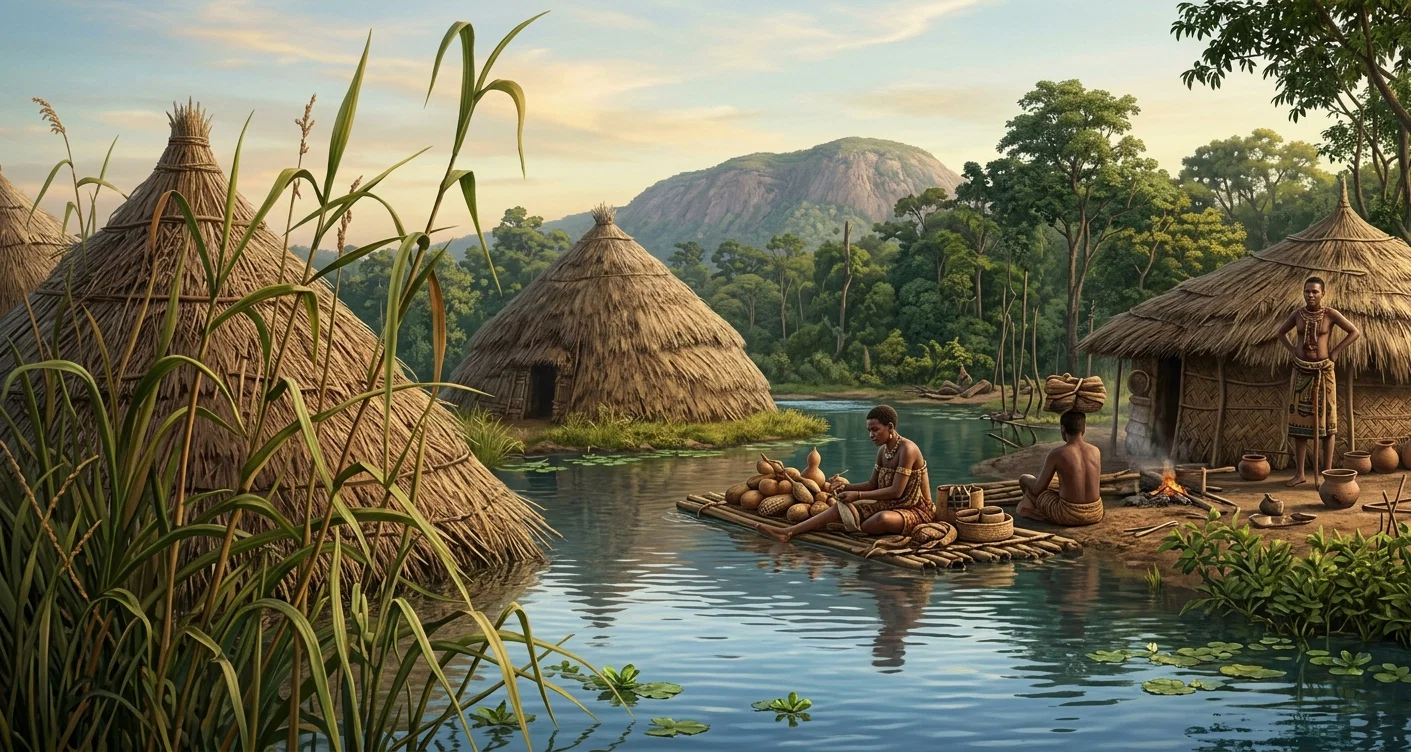
An African Village, Makabon, Kongo.
THE regions of Africa lying south of the Sahara, the home of the negro, have long been a vast slave-hunting ground. Before slaves were brought to America, negroes were stolen to supply the markets in the central and northern States of Africa, and in Turkey and other Mohammedan countries; but with the settlement of European colonies in America and the West Indies, the demand for slaves greatly increased, and the horrors of the trade were aggravated.
The great center of the export trade to America and the adjacent islands was that part of the coast of Guinea still frequently designated “the Slave Coast.” Each year thousands upon thousands of helpless human beings were dragged to this coast, packed in suffocating holds, and borne over seas, to toil out weary lives far from their home-land. It has been estimated that between the years 1680 and 1786, 2,130,000 slaves were imported into the British colonies of America and the West Indies; but these figures do not indicate the whole number stolen, for only about four-fifths of those who left Africa lived long enough to be sold to the planters.
As the cruelties connected with the traffic became known, opposition was excited; and early in the nineteenth century measures were taken that checked the trade. But it is still carried on by Arabs, the slaves being sold in Moslem countries of Asia and Africa. Large numbers from the western and central parts of the Soudan are taken across the desert, and “distributed to the northern and eastern Mediterranean coasts.” It is said that one who did not know the caravan route from Kuka in Soudan to Fezzan, “would have only to follow the bones which lie right and left of the track.” The depredations of the slave-traders are extended into the Nile Valley, the Lake region, and into parts of the Kongo Free State. From the eastern hunting-grounds slaves are “smuggled into Egypt or sent by the Red Sea to Turkey.”
Stanley tells of a party of slave-stealing Arabs that he encountered while sailing up the Kongo in 1883. The Arabs were three hundred strong, and had been engaged in their work of carnage sixteen months. They had desolated a region 34,570 square miles in extent, destroying 118 villages with a population of not less than 118,000. When Mr. Stanley met them, they had just wiped out the village of Mawembe on the Kongo. They had with them “a wretched, ragged, and starving crowd of 2,300 women and children, with not one grown up man among them. . . . On an average, six persons had been killed to obtain each puny child in the encampment. The slaves were fettered in groups of twenty chained together; and such fruits as could be found were thrown down before each gang, to fight for as they might. The odors and abominations of the crowded camp were simply horrible.”
The process of slave-capture is thus described:—
The Arab steals up stealthily at midnight through the darkness to the doomed town. No sound save the chirping of insects disturbs the sleepers, till suddenly the torch is applied on all sides, and in the light of the flames of the grass roofs of the houses, the deadly musket shoots down the men as they appear. Many succeed in reaching the shelter of the woods; but the women and children are seized and carried off.
Rev. J. A. Bain, a missionary at a station thirty-five miles northwest of Lake Nyassa, in the Missionary Review of the World, 1889, gives the following account of a slave raid that he witnessed:—
At daybreak, March 15, we were awakened by a number of shots fired in rapid succession, and we were told that it was Mereri with two bands of Arabs. The surprise was complete. More than thirty women with babes and several girls were captured. The men, only half awake, tried to defend their wives and children, but were driven back by the murderous firing. The next move of the Arabs was to entrench themselves, with their captives, in a bamboo stockade, which became the scene of indescribable revels. Two children, who disturbed the orgies by weeping over the dead bodies of their mothers, were flung into the flames of a burning house. The two following days were spent in plundering and destroying.
Other incidents might be given of this cruel trade in human flesh and human souls,—the cruelest trade that man's greed of gold has ever devised; but surely these are enough to awaken the sympathies of any Christian heart.
Missionary effort has done much for Africa's degraded and helpless sons and daughters; but there is still here a large and needy field. A few years ago Seventh-day Adventist laborers entered the Gold Coast, just west of the Slave Coast. The country is the home of a deadly malaria, and soon had to be abandoned; but some there accepted Christ, and still remain faithful. They are now calling earnestly for help to emancipate them from being “slaves to Satan.” This, after all, is the worst bondage; for it includes everything that is oppressive and degrading. The Gold Coast can be made an important center. From it native laborers, after being trained and educated, can be sent into a wide extent of country, including “the heart of the Soudan,” a country where missionary effort has been greatly hindered by the predominating Moslem influence.
O that in all our hearts there was a deeper and more self-sacrificing missionary spirit,—a spirit that would lead us to work and pray for the helpless and oppressed, and for “the slaves to Satan,” wherever found. E. J. BURNHAM.