Similar Phenomena to that of Martinique—A Race with a Torrent of Mud.
THE Dixie left Fort de France on the night of May 22, and arrived at Kingstown the next morning. Kingstown was not in need, except for the relief of sufferers at Georgetown and other places about twenty-five miles away. We learned that a great deal of damage had been caused at Georgetown and vicinity, and on the 23rd, in company with two other photographers, I rode to that point.
From Georgetown we had a good view of Mount Soufriere. Its appearance in eruption was similar to that of Mount Pelee, except that there were no fissures exuding steam. A thick volume of smoke came from the crater, however, accompanied by a dull roar, more pronounced even than that of Pelee. The Soufriere eruption was in itself a catastrophe that would have startled the world, but it has paled into comparative insignificance beside that of Pelee, altho a close inspection showed that its devastating force—
Was Quite as Violent.
Altho several miles from Soufriere, Georgetown had seriously felt the force of its eruption. There was not a whole pane of glass in any window of the place. These had all been broken by a shower of what looked to be small pumice stones. The people had also suffered terribly from the effects of the sulphureted hydrogen, and the place would, in all probability, have been swept from the face of the earth as effectually as was St. Pierre, if this gas had ignited, as it did at Mount Pelee. Georgetown furnished uncontrovertible evidence of the effects of the disaster in the surrounding country, too. Survivors from the villages near Soufriere had flocked to it for medical assistance and food, and were being generously supplied as we passed through the place. In the temporary hospitals about fifty badly-burned patients were being treated.
Early on the morning of the 24th we left Georgetown, and soon afterward came to a place called King's Hill, on the road to Mount Soufriere. A man named Porter had had a large sugar plantation and factory there. The entire village was destroyed. A hail of lava-stones and an avalanche of boiling mud changed the entire aspect of the countryside.
Similar to Martinique.
The scene was a replica, on a small scale, of what we had already witnessed at St. Pierre. Its desolation was emphasized by the only moving figures in the picture—a few negroes carrying some articles of household utensils to Georgetown. We pushed on to Overland, two miles farther, a little village which was also totally destroyed. Here, as at King's Hill, a large number of persons had been killed by the eruption, and buried under the ashes. Just ahead of us was La Soufriere, smoking away like a huge chimney, and occasionally giving forth a dull, jarring rumble, which told more plainly than words can describe of the awful pressure concealed behind its lava walls.
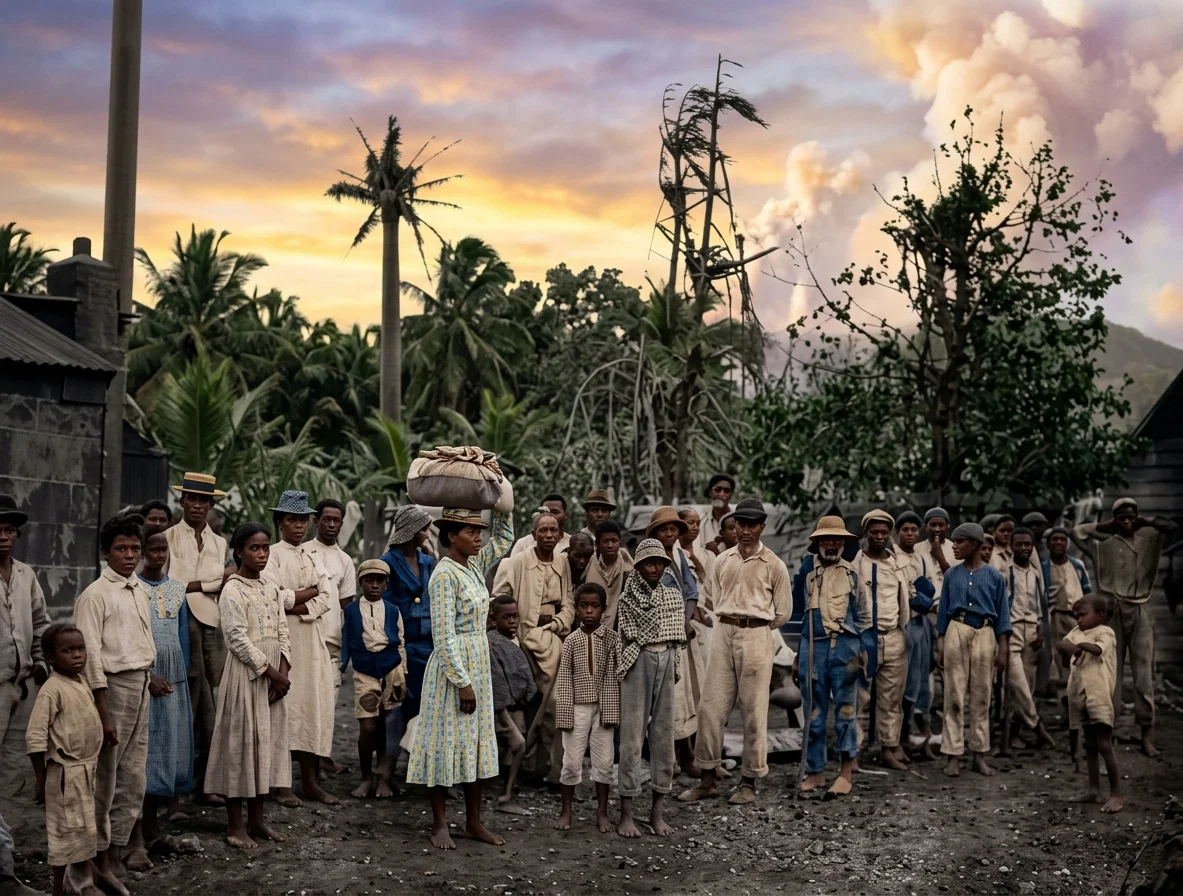
We had grown so accustomed to this noise during our trip, however, that we paid very little attention to it, until I started to take a photograph of three negro women whom we discovered amid the ruins of the place, collecting such truck as they could readily gather. They were standing on the hillside, and I had induced them to remain there while I got a picture, when my scheme was destroyed in a most remarkable manner. La Soufriere suddenly belched forth an unusual quantity of black smoke, and, to add to the difficulty, it began to rain in torrents. The women dropped everything, and ran into the ruins, where they attempted to secrete themselves in some of the subterranean cavities, before I had a chance to expose my plate.
On our way out from Georgetown we rode across several river-beds. They had contained water not long before the eruption, apparently, but at the time of our passage they were dry. Looking up one of these sharp depressions or river-beds, we saw a quantity of brown mud coming down the mountainside and entering it. It approached us with the speed of a racehorse, and without delay we turned our nags, and began a race with this mud torrent. It speedily outstripped us, but we felt compelled to keep up an unequal contest. Even if the torrent did not rise above the steep bank, and over-run the country, we were in grave danger; for, if we could not cross at the fords, over which we had so recently passed dryshod, we would be as hopelessly imprisoned as if we were behind the bars of a dungeon, and would be compelled to await the falling of the river, and perhaps to starve. When we reached the first ford, the brown torrent had gained that point ahead of us. It was running like a millrace, but it was not very deep,—not more than two feet,—and we dashed through it without taking any account of consequences. It looked like a river of chocolate into which a generous quantity of milk had been poured. After a struggle we reached the opposite bank. At the next ford, which was through another river-bed running parallel with the first, the muddy solution was deeper, and at the third it was so high that our horses got across only by adding vigorous swimming to their accomplishments.
Group of Careless Colored Refugees, Georgetown, St. Vincent.
We managed to reach Georgetown in safety, and as the force of the combination of rainstorm and new eruption was not felt so far away, we were out of immediate danger. As Soufriere threatened to continue this eruption or to repeat it at any moment, we deemed it wise to abandon, or at least postpone, any further attempt to scale its sides, and started without delay for Kingstown, where we found the Dixie awaiting us.
The scientists of our party say that these eruptions differ from those of Vesuvius, for the reason that no lava has been discharged. Moreover, the eruption of Pelee was not from the old crater, which erupted in 1851, but from a new one farther down the mountain-side. The principal element of destruction appears to have been the discharge of gas,—sulphureted hydrogen, according to the scientific men.
This gas ignited and caused the explosion which demolished the city, and instantly killed all the inhabitants.
There is opportunity for months of scientific work there, if the old volcano again becomes quiescent, but on this point some doubts were expressed. Some of the scientific men said it would not be surprising if the whole island, being of volcanic origin, might continue to burn until it should wear itself away, and return to the bed of the ocean, from which it arose in some mighty concussion of the past.