STRAWBERRIES

3%

Pacific Press Publishing Company · Oakland, California · Jun 4, 1902

FromSigns of the Times, Vol. 28, No. 23.

Read the full edition

STRAWBERRIES

TEDDY SMITH breathed a deep sigh of relief as he put back his ledger, drew on his coat, and took his hat from the rack behind the office door, preparatory to leaving the dark, dismal office after a hard day’s work. He was all used up. The long columns of figures had a habit of dancing all over the pages, and cutting up all kinds of antics, as he tried to foot up the long rows daily. Teddy often wished the inventor of book-keeping had all the balancing to do, or had invented some other method of earning one’s daily bread.
Teddy was out of sorts. The hot office had affected his nerves. He was disgusted with life, his own in particular; and in his haste to leave the office, with its never-ceasing grind, nearly ran over his little yellow dog, that, at the sound of her master’s footsteps, crept out of her hiding-place under the steps. Now this very yellow dog was another thorn in his flesh, for he utterly despised a yellow dog; but this particular specimen was not to be shaken off. She took up with Teddy, not Teddy with her.
“Yaller Dawg” was her name, and yellow she was, of the most sickening shade,—thin, mangy, sneaky, and hang-dog in appearance, yet she showed such faithfulness to Teddy that he could not heartlessly ill-use her. Teddy called her “Yaller Dawg,” and she never seemed to object, and would follow him back and forth daily, much to his annoyance at times.
One thing “Yaller Dawg” did refuse to do, and that was to follow her master into a saloon.
On this particular afternoon, Teddy felt out of humor; and “Yaller Dawg” appeared to share his mood; for she held her head down, dropped her tail, and slid around the corner, as if almost ashamed of Teddy’s company, yet too faithful to forsake him entirely.
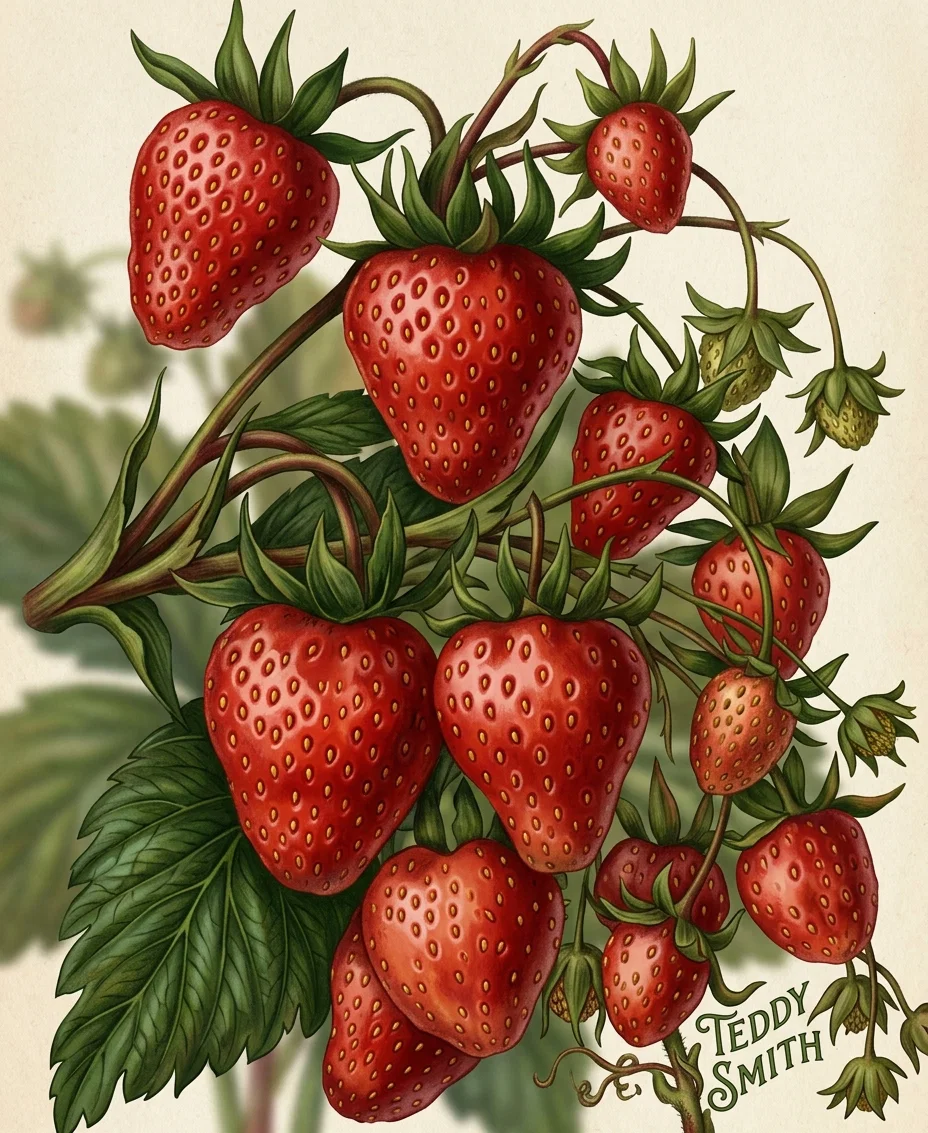
Teddy approached a fruit-stand, where he paused before entering the “corner” to refresh (?) the inner man. This very corner was the cause of Teddy’s ill humor generally, also of a big hole in his week’s earnings. Strange indeed a man can run a weekly beer bill, when the other fellow won’t credit him for the necessaries of life. The Cuban in charge of the fruit-stand had on this occasion arranged his tempting fruits even more attractively than usual; and in the very center were great boxes of the most delicious strawberries, the first of the season. They were such juicy berries as only Florida can produce. Teddy felt thirsty, hot, tired; and the strong perfume of the berries came to his nostrils like odors of heavenly manna. Unthinkingly he reached over and picked up one of the finest berries in the basket. O the beauty of its rosy ripeness, the juicy richness of its perfume. Unconsciously he raised it to his mouth; but alas! the Cuban was too quick for him. Catching Teddy’s arm, he cried, “No, ye don’t; berry cost money. Ye can’t eat mine; buy ye own strawberry.”
Teddy dropped the fruit almost paralyzed with astonishment. The richness was just as tempting; but the man’s words awakened something in his inmost being that brought a peculiar feeling to his sleeping senses.
“How much?” he inquired.
“Forty cents,” replied the Cuban; “rich, ripe, fine berry; want to buy?”
Alas, poor Teddy! Forty cents was too much for him just then,—forty cents, so small a sum, yet twice as much as he then possessed; yet only that very morning he had paid out many times that amount at the “corner” for his last week’s beer bill. Instinctively he put his hand into his pocket, then, remembering its emptiness, shook his head. “Ye don’t like berry maybe?” inquired the Cuban. “Ye got strawberry enough on ye nose, ha! ha!” And he laughed sneeringly, evidently enjoying his little joke.
Poor Teddy, had it really come to that? Surely not; yet even the fruit-stand man could not but notice his frequent visits at the “corner,” and the blooming bud on his once aristocratic nose.
Teddy hurriedly left the fruit-stand, too angry even to notice the enticing music at the “corner,” or to stop for his usual beer. On he rushed until he reached the river, where, utterly overcome, he sat down on the bridge. “Yaller Dawg” crept along too, as if in sympathy with her master, yet half ashamed to approach too near, and finally curled herself up in a mossy nook near the bending oaks.
Teddy felt insulted that even a common uneducated Cuban should sneer at him. He wondered if all the Cuban said could be true. Was his nose really and truly assuming a strawberry appearance? He bent down thoughtfully to catch a glimpse of himself in the mirror-like waters beneath. Alas! it was only too evident. He saw reflected not only a strawberry tint, but a full-fledged, blooming berry, and a very seedy strawberry at that. Heartily disgusted at the vision, he hastily raised his eyes. Slowly the great truth began to dawn upon him. He slipped his fingers into his pockets, and began pulling out the varied contents,—shoe strings, horn-buttons, one brass buckle, two nickels, nine pennies, a bit of tobacco, and the receipted bill for last week’s beer,—not a very inviting array, to be sure, not much to show for a man earning a fair salary. “Thank goodness,” whispered Teddy, “the beer bill is paid. It is bad enough to have a beer bill, but worse if it is not paid. It’s a bad bill at best,—good, honest, hard-earned dollars gone to enrich the other fellow. I’ll bet he buys strawberries, and I am the victim. It’s as plain as the strawberry on my nose that with these dollars, I too could buy strawberries.”
Was he to blame? Was it the fault of the saloon-keeper? Was it the crime of the government, or what? It was not often that Teddy brought himself to task in this manner. Manlike, he considered himself fully able to row his own boat, free to obey the impulses of his own heart. To-day the world appeared different; life took on another aspect; the usual events seemed changed. Yes, Teddy was surely degenerating, and he was waking up to the fact.
There were others, he thought,—others who had sunk much lower in the mire than he; others who wore shabbier clothes, who had lost homes through drink, who abused their wives and children, and at last sank into the gutter, perhaps to fill a dishonored pauper’s grave. What was the cause? Was it not beer, rum, whisky, cards, tobacco, evil associations and environments? Nothing could be plainer. He had not fallen beyond recall yet. Thanks to the strawberry man, he saw the road that he was traveling. He thought of home, wife, and babies. As yet they had shelter, food, and clothing, perhaps not the best, but enough; but would it continue if he imbibed the poison? Thought came with lightning rapidity; reminiscences crowded upon him. There were Brown and Jones, both boyhood chums, gone to the dogs in a really disgraceful way; and all on account of drink. And there were Judge Gray and Colonel White, other schoolmates, now leaders of the best society in town. Why?—Surely because they shunned the beer-gardens.
Teddy saw that the ruby cup was but a snare leading down to everlasting woe and destruction, bringing sorrow, suffering, hard labor, and every kind of ill, and finally disgrace. Surely Teddy was just wise enough to envy those who were making a success of life, and to make a strong resolution to escape from the clanking endless chain of drink which was threatening to wind its deadly links around his future, and drag him to eternal despair and degradation. Teddy was no fool. Now was the time to stop—to-day; to-morrow would be too late.
The question came home to Teddy. Why do men who call themselves honest vote to license the making of drunkards, the opening of rumshops, where poison is sold which undermines the very life of humanity; which breaks mother’s hearts, brings utter despair upon sisters, wives, and innocent babies, destroys happy homes, and wrecks the soul eternally? Why, after licensing so deadly an evil, provide for the arrest and punishment of the victim? Why open the trap, bait the hook, and entice through stained windows, mystic music, screened portals, and evil associations, then, at the expense of the country, operate great prisons to punish and confine the tempted, wrecked humanity? Would it not save trouble, money, heartaches, and hangings to prohibit the manufacture of this soul-polluting poison?
Careful inquiry shows that 97,000,000 gallons of spirits, 30,000,000 gallons of wine, and 1,220,000,000 gallons of malt liquors, are sold annually in this country,—a total of 347 millions of gallons of misery, crime, body-and-soul destruction poured down human throats every year. Think of it, Teddy, old fellow, seventeen gallons to each man, woman, and child in this broad land. Is it really “the land of the free and the home of the brave”?
Teddy smiled, as he said with decision, “No, sir, no more for me; not Teddy Smith’s name to add to the list of those who waste money, make blighted lives, blasted reputations, broken homes, and ruined characters.” Yes, he saw the wrong, saw the great dark precipice upon whose brink he tottered, but yet in time to evade its deepening chasm. No more beer, no more drink, no more roof-gardens, no more cards, and no more tobacco. It must be a clean sweep or nothing—no use of half-way, happy-go-lucky endeavors. It must be a stop, sure, sudden, and forever.
“Yaller Dawg,” he called, and “Yaller Dawg” lifted her ears and wagged her tail in recognition of her master’s voice. “Yaller Dawg, come here; see, old girl, smell this,” and Teddy placed before her the remnant of his pile of tobacco; but “Yaller Dawg” only sniffed, turned up her nose and dropped her tail in evident disgust, as much as to say, “Even a yellow dog has dog sense.”
“Ah, miss, you don’t like my tobacco; more brute reason than your master. Well, here goes;” and Teddy threw the poisoning weed far out into the dark waters of the rushing torrent, where even the very fishes darted away in their mad endeavor to escape from the filthy stuff; but “Yaller Dawg” joyously wagged her mangy tail in approbation of the act.
Teddy was in earnest. He was on the right track at last, the path that leads to a better life. Strawberries, or rather the want of them, had been the last straw that broke the camel’s back.
Teddy knew that in human strength man can do but little. He remembered his dear old mother’s prayer, and even here he felt that the Great Ruler above was the only one to give him the needed strength to resist the tempter. He pledged himself, with God’s help, to overcome evil with good. Somehow in the lifting up of that heartfelt, silent plea to his Maker, he felt better, stronger, braver, and happier, and he rose up to hasten homeward, whistling to his dog inmerry strains, all clouds of gloom fading away, and the rosy light of a glorious future before him.
  • *
A week passed. Again Teddy and “Yaller Dawg” came down the street and stopped at the fruit-stand. The Cuban thought he knew his customer, but he didn’t. Teddy was not a looker-on this time; the jingle of silver in his pocket bespoke his ability to pay for what he wanted. Again the delicious odor of the strawberries was wafted on the air, again Teddy pointed to the tempting boxes and inquired, “How much?”
“Forty-five cents,” replied the man; “berry gone up; cool spell; berry no ripen; berry scarce.”
“Never mind,” Teddy said; “give me two of your finest baskets. They come in nicely when one intends to celebrate. We are going to eat strawberries with powdered sugar and whipped cream at our house for breakfast to-morrow.”
The man only grunted out a reply; nevertheless he quickly tied up the berries, and handed them to Teddy, who hurried homeward, not even looking in at the sound of music that was wafted out on the evening air from the saloon at the corner. Suddenly a hand was placed upon his arm and a voice said thickly, “Say, Teddy, old pard, what’s the matter? You never come round here with the boys any more; got the croup up at your house?”
“O, no!” and Teddy smiled; “nothing so fatal as that; but I’ve got the dearest little wife in the world and five little tots who like strawberries. A man can’t buy beer and buy berries; I’ve found that out, and I’ve decided on the berries—see?” And Teddy laughed merrily, and passed on whistling “There’s no place like home,” to the utter astonishment of his fellow.
It is only too true, reader; berries and beer won’t mix, any more than oil and sulphur water; try it and see.
O the sweet kisses that met Teddy on his return home. O, heaven’s best gift to man—wife, the twin half of self! O, the innocent hands of little children, the joyous peeping into papa’s purchases, and the happy dreams of berries, rich, ripe, sweet, and juicy, that would grace the table at breakfast time. And after five pair of tired hands were quiet, the eyelids kissed down by fond parents, and five weary forms were tucked in safe for the night, Teddy drew his dear little wife down beside the pine-knot fire in their cozy sitting-room, and together they talked of what the future would bring to them since beer had been discarded, and reveled in visions of happiness yet to come into their lives and those of their children.
  • *
Several years have passed away. Smith is called “Teddy” only by a few. To the general public he is known as Honorable Theodore Smith, a title he well deserves, and he gives many a falling man a lesson in life, and aids humanity in the effort to do better.
His home is in a beautiful part of the city, surrounded with a tastily-kept lawn. Near by is the strawberry patch, the joy and pride of Mr. Smith’s heart. Many a basket of his rich, juicy berries is sent to the sick, the needy, and the aged. “Verily it is better to give than to receive.”
Mr. Smith is now a gentleman in the broadest sense, kind, loving, and generous. His wife has grown younger as the years have rolled by, the atmosphere of love bringing all happiness to her heart and life. Gay, laughing children scamper over the lawn, while under the tall oaks beside the babbling brook a festival is being held, and Theodore Smith’s ripest berries are being served with the richest of Jersey cream from his own dairy. The “colonel,” as he is called, is there, the very picture of health, happiness, and prosperity. No strawberry seedy nose is visible now, but the flush upon his smooth cheek is caused by romping with the children, as he is led here and there by the gay bands, who are bent upon making “papa” enjoy himself.
And “Yaller Dawg” has also improved. She is no longer sneaky and mangy and dirty yellow, but sleek, clean, fat, and a fine golden brown in color. The gospel in strawberries can elevate dogs as well as men.
Tampa, Fla.
MRS. LULA K. LEVISON.