THE ROMAN PANTHEON

10%

Pacific Press Publishing Company · Oakland, California · May 28, 1902

FromSigns of the Times, Vol. 28, No. 22.

Read the full edition

THE ROMAN PANTHEON.

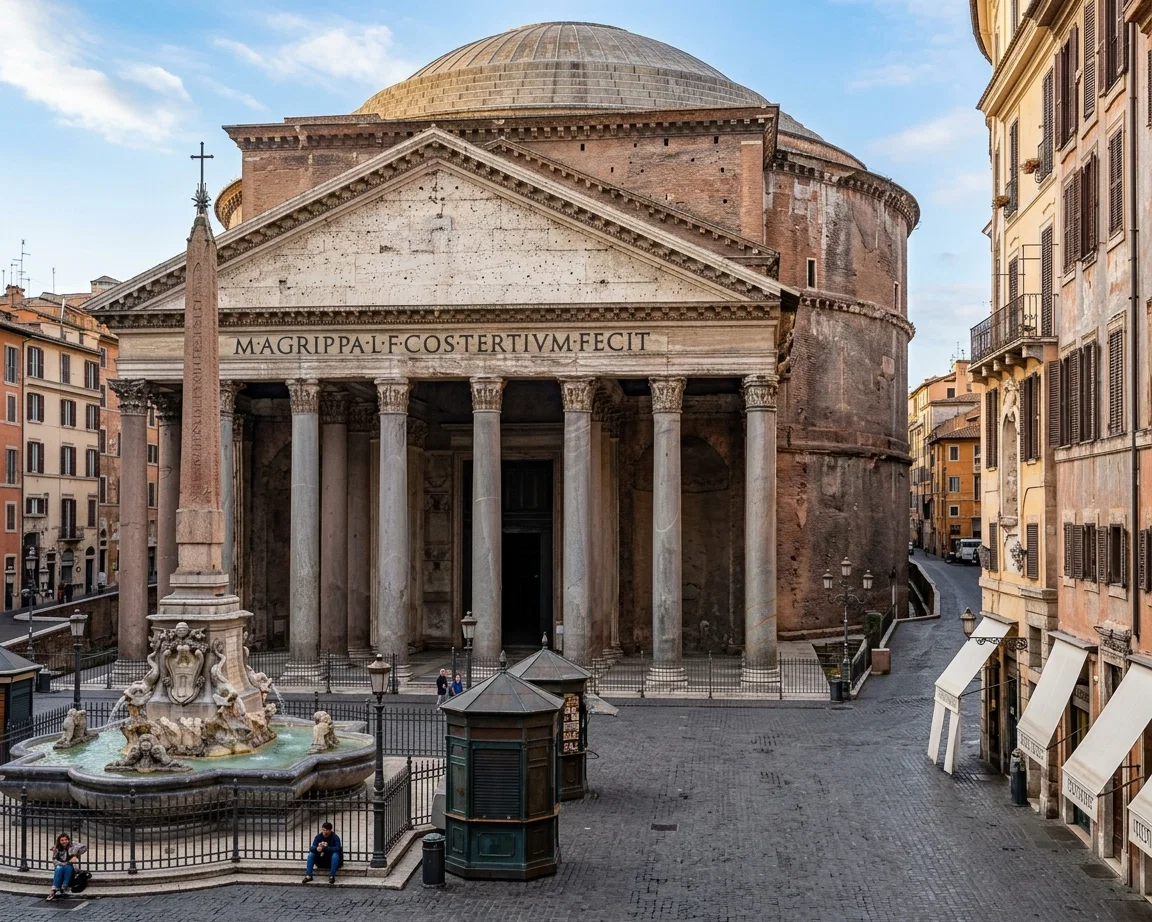
One of the most noted of surviving examples of the architecture of ancient times, is shown in the accompanying illustration. It stands on the Campus Martius in Rome, a cylindrical building one hundred forty-two and one half feet in interior diameter, surmounted by a hemispherical dome reaching to an equal height above the floor. Its name, the Pantheon, signifies the temple dedicated to all the gods. Before the door, upon a portico supported by eight columns, is an inscription which tells that the building was constructed by Marcus Aggrippa, a Roman Consul, and son-in-law to the Emperor Augustus, in the year 27 B.C. Another inscription in the building attests that it was restored by Severus and Caracalla, A.D. 202.
THE PANTHEON.
THE PANTHEON.
In the walls of the building within, which are about twenty feet in thickness, are alternating square and semicircular niches, seven in number, in which were placed the statues of Roman gods. These statues were long since removed, and even their names have not been preserved. In their places stand to-day altars dedicated to Roman Catholic “saints;” for the edifice is now used as a Roman Catholic place of worship. Pope Boniface IV., in the year A.D. 608, converted this heathen temple into a “Christian” church, by dedicating it to “the Virgin Mary and all the saints;” and this dedication to “all the saints” is a fact that remains conspicuous in the worship conducted within it at the present time. One may see there, we are informed, different services going on at different altars at the same time, with distinct congregations around them, according as inclination leads the people to the worship of one “saint” or another. As objects of worship, there is of course little to choose between “all the gods” and “all the saints;” so that the exchange of the one for the other did not affect the character of this temple in any essential way. It remained a place of pagan worship.
The Pantheon is noted as being the best preserved of any of the remaining structures of ancient Rome. But whatever purpose it may serve in modern Rome, it is as a relic of ancient Rome that it is most interesting to the beholder. It is from ancient Rome that it brings its message to the modern world; for it brings a message, one which, tho silent, is none the less plain and impressive. It speaks to us of a system of belief which has been weighed in the balances of time, and found wanting; a system which has filled the world with relics and crumbling ruins; a system which, tho professing to connect the soul with immortality, was itself destitute of inherent life; a system which by its whole history is plainly marked for extinction at the end of time. Such a system is paganism, which held sway over the great kingdoms of antiquity, and still dominates in its modern forms the greater portion of the human race. In striking contrast with such a religion is Christianity, the religion of life, springing from thedivine Fountain of life, and imparting life to all things. It is the life-giving power of Christianity that proclaims it to be the one divine religion, the revelation of the true God.
The true God is the God of life. His name, “I AM,” signifies the One that is self-existent. “As the Father hath life in Himself,” said Jesus, “so hath He given to the Son to have life in Himself.” John 5:26. Lofty temples, dazzling display, imposing forms and ceremonies, constitute no sign of the true religion. It is not these things that bring men to the knowledge of the true God. It is life, life alone, that testifies of Him who is the Life-giver. And so of Jesus, who came to reveal God to the world, it is written, “In Him was life; and the life was the light of men.” John 1:4. Jesus went about imparting life, spiritual and physical, to all the people. He came “that they [mankind] might have life, and that they might have it more abundantly.” To John, in prison, He sent the message, “The blind receive their sight, and the lame walk, the lepers are cleansed, and the deaf hear, the dead are raised up, and the poor have the Gospel preached to them.” This was the evidence of His Messiahship.
Would that men to-day might read, understand, and take to heart the lessons written upon the ruins of the once-proud temples of heathen worship. Would that men would be admonished by the experiences of the past, by the mistakes of those who have built their hopes upon a perishing foundation, and would cease to cling to that which has no life. Traditions, customs, forms and ceremonies, ritual and creed, abound in the worship of to-day, and are a false foundation for the hopes of multitudes who profess to be followers of Christ. These things are not Christianity; they can not connect the soul with the world to come. The soul is connected with God only through life,—the life that God imparts to the believer, who through faith becomes a channel for the outflowing of the river of life from God’s throne. Christianity is life itself, and the life is made manifest by activity in conveying the healing power of God to a death-stricken world. Christianity is “the power of an endless life.”
The worship of “all the gods” did not cease with the passing away of the Roman empire. The throne of the true God is still usurped by Mammon in the natural heart. There is an invisible pantheon, the counterpart of that reared amid the temples of ancient Rome; and the earth to-day is filled with the worshipers at this invisible shrine, in which there are gods many and lords many. Some of these gods are respectable; others are disreputable; but all belong together by virtue of their opposition to Him who commands, “Thou shalt have no other gods before Me.” The man who does not worship the one true God in His heavenly temple, goes naturally to this other temple of “all the gods,” where the truth of God is changed into a lie, and the creature is worshiped and served in place of the Creator. Here men cling to that in which there is no salvation,—to that which draws them only further away from life and nearer to the brink of final ruin. Here are those “whose god is their belly,” who eat and drink that which ministers disease and death, rather than life, to their mortal bodies. Here are those who worship Mammon, who wear out their lives in laying up treasure on the earth, dying as candidates for heaven’s poorhouse, if such an institution might be supposed. Here are those who worship “science,” placing human reason above revelation, and bringing the Word of God to the bar of their own finite judgment. Here are those who look to man in the place of God, who make void the commandments of God through human traditions, and allow the words of priest or pastor to serve as the guide of conscience. Here are all that vast number who make a god of self, who put some selfish interest uppermost in their hearts, where God has His rightful throne. Many are the gods, and legion are the worshipers, in this great world temple.
A message of reform is now going to all nations, pointing men to the true temple of God which “was opened in heaven,” to His testament seen therein, and which is calling them to worship Him who made heaven and earth, the sea, and the fountains of waters. May this work be hastened in the earth.
L. A. Smith.