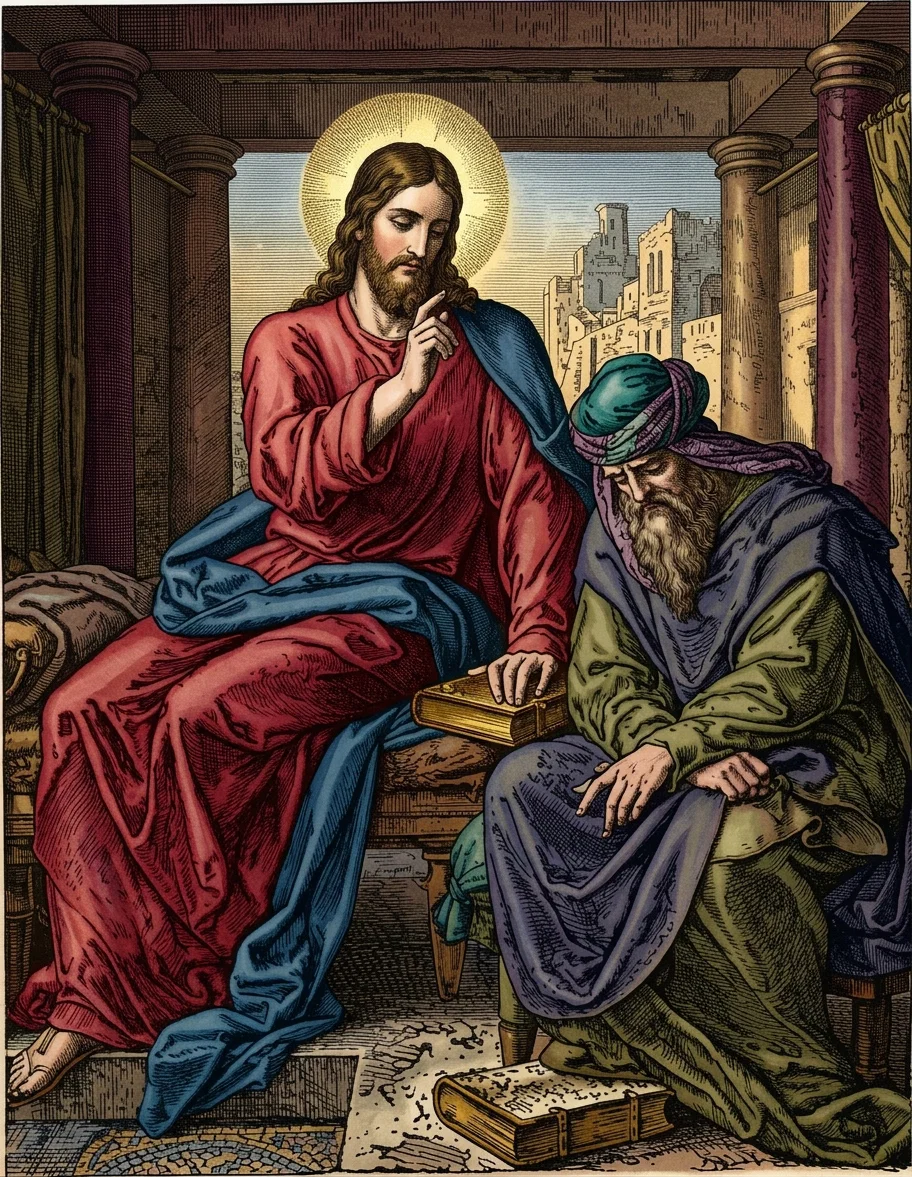
To the questioning lawyer who asked, “Master, which is the great commandment in the law?” Jesus replied, “Thou shalt love the Lord thy God with all thy heart, and with all thy soul, and with all thy mind. This is the first and great commandment. And the second is like unto it, Thou shalt love thy neighbor as thyself.”
It is impossible that the Decalogue should be done away with, for its principles are divine and eternal.
GEORGE W. RINE
About six months ago I contributed to the Signs of the Times an article under the title, “The Unchangeable Sabbath.” Dr. G. F. Storing of Austin, Minnesota, is one of the many thousands who have read the article. In a letter addressed to the editors he declares that he can not agree to the conclusions of the article. With his letter he inclosed a lengthy “thesis,” purporting to be a justification of his disagreement. His principal contention is that the law of Ten Commandments and the law regulating the ritual and typical services of the ancient Jewish tabernacle, and later of the temple at Jerusalem, constituted one and the same law, one legal code. From this, as a premise, he naturally concludes that when the ritual was abolished by the atoning death of Christ on the cross, the Decalogue (the Ten Commandments), as a component part of the same law, was abolished at the same time.
But it is Dr. Storing’s premise, namely, that the Decalogue is identified with the law of rites and ceremonies, and therefore with the first or old covenant, that is Scripturally untenable; in short, erroneous. If his premise were true, it would, as we shall see, prove the Bible, by not a few lines of demonstration, to be a mass of contradictions. On the other hand, by accepting the repeated testimony of Holy Writ to the effect that the Decalogue is, in its very nature, inviolable and of perpetual force, we prove the absolute consistency of every phase of Bible teaching with every other phase.
BIBLE TERM “COVENANT” OF VARYING IMPORT
It is true that the Decalogue is, in the Bible, a number of times called covenant. In Exodus 34:28 it is expressly so named. The two tables of stone, on which the Decalogue was “written with the finger of God,” are, in Hebrews 9:4, designated “tables of the covenant.” In Deuteronomy 9:11 those tables are given exactly the same title. But the Ten Commandments are never, in themselves, called either the old or the new covenant. The word “covenant” is used variously in the Scriptures. In Isaiah 28:18 the Lord declares to His apostate people that their “covenant with death shall be disannulled.” In Numbers 25:12, 13 the Lord promises to give to Phinehas “the covenant of an everlasting priesthood.” We must not forget that the Ten Commandments are Scripturally known by many titles; as, testimonies, judgments, precepts, statutes, the law, et cetera. Devout students of the Bible often refer to the Decalogue as the “covenant commanded.” (See Deuteronomy 4:13; Psalm 111:9, etc.)
INSEPARABLE FROM THE NEW COVENANT
That the Decalogue is not the old covenant, and therefore not abolished with it at the cross, is made absolutely and eternally certain by the fact that the Lord declares categorically that the new or everlasting covenant consists in writing His law, by His Spirit in the “minds” and “hearts” of believers. (See Jeremiah 31:31-34; Hebrews 8:8-12; 2 Corinthians 3.) Observe that the passage in Hebrews 8 is a free quotation of the passage cited from Jeremiah 31; and remember, too, that the book of Hebrews was written thirty-three years after the abrogation of the old covenant at Calvary. Is it thinkable that God would write in the hearts of His people an obsolete law, a dead law?
Every time a sinner experiences genuine conversion there is instilled, by the Spirit of God, into his inmost heart and mind the living law of the living God. When the Holy Spirit incited holy men of God to write the Bible passages cited above, could He (the Spirit) have erred? One shudders at the very question. The process of having God’s law inscribed in your heart, makes you to that extent like Jesus; for when He came into our world as the Lamb of God, He declared to the Father: “I delight to do Thy will, O My God: yea, Thy law is within My heart.” Psalm 40:8. (This prophecy is applied to Christ in Hebrews 10.) We see, then, that the Lord’s testimony respecting the vital place which His law fills in the gospel covenant, the covenant validated by the blood of Christ (Matthew 26:26-28), and the dogma declaring that the law expired at the cross, stand, each to the other, in hopeless contradiction. Can it be that Inspiration was mistaken?
Jesus and His apostles taught nothing more clearly than the unique fact that God’s law expresses itself in love, and that His love fulfills itself in law. To abolish one is to abolish the other. The annulling of love means the annulling of God (if that were thinkable), for “God is love.” 1 John 4:8. To abolish the law of God is as impossible as to abolish the love of God. For divine love expresses itself in lawfulness; that is, in fulfilling divine law, for “love is the fulfilling of the law.” Romans 13:10.
Let us observe now how beautifully and impressively Jesus enunciates the same marvelous truth. A lawyer once asked Him, “Master, which is the great commandment in the law?” Jesus answered: “Thou shalt love the Lord thy God with all thy heart, and with all thy soul, and with all thy mind. This is the first and great commandment. And the second is like unto it, Thou shalt love thy neighbor as thyself. On these two commandments hang all the law and the prophets.” Matthew 22:35-40. To love God supremely and our neighbor as ourselves is to obey God not only through the many specific precepts of the prophetic books proper, but also through the all-comprehensive precepts that constitute His law, the Ten Commandments.
With what exquisite nicety this instruction from the Master fits into the structure of the Decalogue! To obey from the heart the first four commandments is, as we all know, to fulfill our duty to God, and to obey the latter six is to fulfill our duty to our fellow men. Of course the obedient keeping of the first four precepts implies the keeping of all, and the converse is just as necessarily true. Now, let me ask the reader, Is it conceivable that, in loving God and man, as Jesus here indicates, we fulfill or keep a law that no longer exists? You can no more separate divine law from divine love than you can separate the sun from light or light from the sun.
How tersely the Holy Spirit, through the apostle John, predicates this interpervasion of law and love: “For this is the love of God, that we keep His commandments: and His commandments are not grievous” (“not irksome,” Weymouth). 1 John 5:3. No, God’s commandments are not irksome when prompted by divine love shed abroad in the heart. (Romans 5:5.) The love of God filling and pervading my heart constrains me to cry with my Lord—“I delight to do Thy will, O my God: yea, Thy law is within My heart.” The Holy Spirit sheds God’s love abroad in my heart, and thus writes His law there. He writes His law in my heart, and thus sheds abroad His love therein. Love issues in obedience; obedience springs from love. Dr. G. C. Morgan aptly says: “Every breach of the Decalogue is a violation of love. . . . Every breach of law is due to lack of love.”
LAW AND SIN
In Romans 5:12 we have this suggestive statement: “Wherefore, as by one man sin entered into the world, and death by sin; and so death passed upon all men, for that all have sinned.” Of course that “one man” was Adam, the head of the race. By him, Inspiration declares, sin entered our world. “But sin is not imputed where there is no law.” Verse 13, latter part. In verse 14 we find the phrase, “Adam’s transgression.” Sin, then, was imputed to him. Hence, in keeping with verse 13, Adam must have had and known a law when he sinned. In committing that first human sin, what law did Adam transgress? We shall find the answer clear and full in the Scriptures. “WhosoeverFivecommitteth sin,” declares the apostle of love, “transgresseth also the law: for sin is the transgression of the law.” 1 John 3:4.
Now if other scriptures did not clearly identify the law that Adam transgressed, we should naturally conclude that it is the law of God, the Ten Commandments. But we need not infer or conclude in a matter so vital and momentous; we may and should know: “What shall we say then? Is the law sin? God forbid. Nay, I had not known sin, but by the law: for I had not known lust, except the law had said, Thou shalt not covet.” Romans 7:7. It was by the law which forbids coveting that Paul had recognized himself a sinner. We all know, of course, that it is the tenth precept of the Decalogue which contains the imperative, “Thou shalt not covet.” Unmistakably, then, the law, the transgression of which John declares to be sin, is the Decalogue, which every child reared in a Christian family knows as the Ten Commandments.
Let us now briefly note a few statements found in James 2. In verse 9 James asserts, “But if ye have respect to persons, ye commit sin, and are convinced of the law as transgressors.” When one commits sin, by what law is he brought under conviction of being a transgressor? The words of verse 11 answer this question so simply and pointedly as to render misunderstanding impossible. “For He that said, Do not commit adultery, said also, Do not kill. Now if thou commit no adultery, yet if thou kill, thou art become a transgressor of the law.” Of what law, James? Can an honest mind mistake his answer? Of course, the law that forbids the commission of adultery and murder. The veriest tyro in Bible knowledge knows that law to be the law of Ten Commandments.
The inspired Paul declares that “where no law is, there is no transgression.” Romans 4:15. In verse 14 of chapter 5 we read, however, of “Adam’s transgression.” The conclusion is inescapable that Adam knew the law of God forbidding covetousness, adultery, and murder—in short, the Ten Commandments. Do men commit sin to-day? The question answers itself. “But,” says Paul, “I had not known sin, but by the law.” Men know themselves to be sinners to-day only because the Holy Spirit, through the law of God, flashes that conviction into their hearts. Is God’s law dead? I ask again.
Our friend of Austin, Minnesota, declares that the law proclaimed in awful majesty and glory by the voice of the Most High was annihilated at the cross with the old typical covenant and its typical laws. God’s law abolished? As well might you think of abolishing His government. In his lectures on preaching, Bishop Simpson long ago declared: “Our congregations should be gathered as around the base of Mount Sinai, while from its summit is heard the voice of God in those commandments which are unalterable and eternal in their character.”
“Do we then make void the law through faith? God forbid: yea, we establish the law.” Romans 3:31.