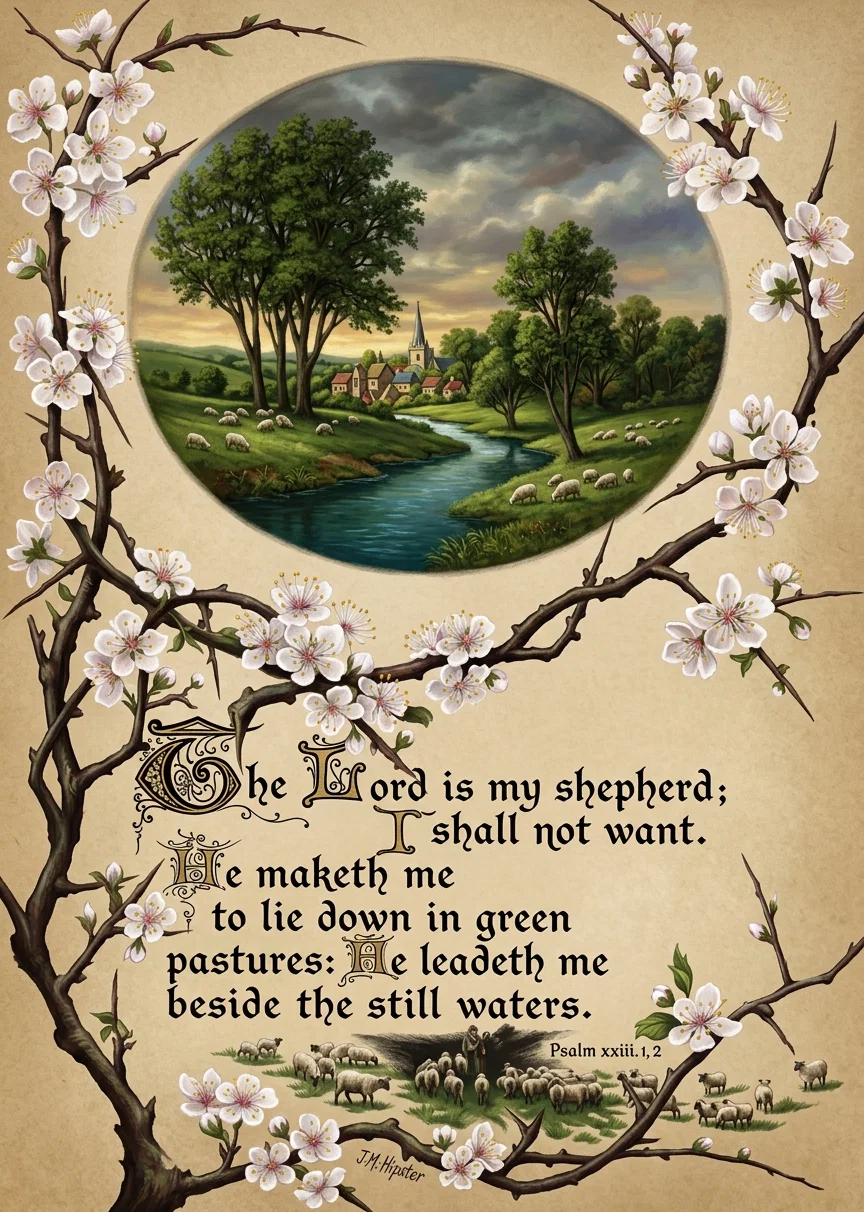
THE SHEPHERD'S CALLING

8%

Pacific Press Publishing Company · Oakland, California · Jan 8, 1902

FromSigns of the Times, Vol. 28, No. 2.

Read the full edition

THE SHEPHERD'S CALLING.

No ordinary calling has been so signally honored by the Lord as that of the shepherd. No secular occupation or industry has been so prominently employed by Him as a preparatory school for fitting men to engage in His service, especially those whom He would qualify as leaders of His people. There are some features of the shepherd's life, and some qualifications for success, that are worthy of note. It is a lonely life, with no temptation to display of dress or sumptuous living. It takes one away from the centers of art and commerce to the contemplation of the works of nature, away from communication with men to the grandest opportunities for unmolested communion with God.
The qualifications of a successful shepherd are humility of spirit—a willingness to be isolated from the companionship and common enjoyments of men in society; patience, self-denial, watchfulness, courage, endurance, sympathy for the flock, and care for the interest of the employer.
Examples of faithfulness to God on the part of men following the shepherd's calling hold a prominent place in Biblical history. Abel was a keeper of sheep, and no doubt his connection with them, learning their meek, innocent disposition, especially of the lambs, would help him to appreciate the fitness of the lamb as a type of the promised Saviour, and thus to make his offering by faith.
ABRAHAM, chosen as “the friend of God” to be the “father of all them that believe,” was a shepherd. Isaac, to whom were given all the promises previously made to his father Abraham, was a shepherd. Jacob, the son of Isaac, who likewise inherited the same promises, was a shepherd. Moreover he was for twenty years hired to a most avaricious, exacting man, who took every possible advantage of him in the matter of wages. This experience was instrumental in changing the character of Jacob. Formerly a shrewd intriguer and exacter, he became meek and submissive to God under unjust treatment. When at last the Lord, who had witnessed all of Laban's acts toward Jacob, told his servant to return to Canaan, and Laban tried to restrain him, Jacob reminded his father-in-law and former master of the faithfulness of his service. This reminder gives us a good idea of the character of the shepherd's office, as well as of Laban's injustice. When Laban followed Jacob, and would have compelled him to return but for the Lord's interference, Jacob said to him: “This twenty years have I been with thee; thy ewes and thy she goats have not cast their young, and the rams of thy flock have I not eaten. That which was torn of beasts I brought not unto thee. I bare the loss of it; of my hand didst thou require it, whether stolen by day, or stolen by night. Thus I was; in the day the drought consumed me, and the frost by night; and my sleep departed from mine eyes.” Gen. 31: 38-40.
JOSEPH, altho sold into Egypt at an early age (about seventeen years) had had some experience with his father's flocks. And when his father and brethren followed him to Egypt, they rendered good service to the king in the capacity of shepherds and herdsmen. Moses also, who after his failure to deliver Israel in his own way, was compelled to flee because of his indiscretion, found occupation as a shepherd in the land of Midian. After an experience of forty years in this humble calling, and in communion with God, he was fitted to become a leader of the Lord's people. He had learned the lessons that the shepherd's calling was so well designed to teach.
WHEN the Lord would place a more worthy man on the throne of Israel to supersede the apostate Saul, he chose a young shepherd, David, the son of Jesse, of Bethlehem. Of the dauntless courage of this young man, we have testimony in his slaying the Philistine giant, Goliath, with a stone from his simple sling. This courage and skill, and faith in God, had been acquired in his youthful experience as a shepherd. When questioned by Saul as to his ability to go out against the giant single-handed, David said: “Thy servant kept his father's sheep; and when there came a lion or a bear, and took a lamb out of the flock, I went out after him, and smote him, and delivered it out of his mouth; and when he arose against me, Icaught him by his beard, and smote him, and slew him. Thy servant smote both the lion and the bear; and this uncircumcised Philistine shall be as one of them, seeing he hath defied the armies of the living God.” 1 Sam. 17: 34-36, R.V.
THE humility and faith of the young shepherd is shown in his giving the credit to the Lord. He continued: “The Lord that delivered me out of the paw of the lion, and out of the paw of the bear, He will deliver me out of the hand of this Philistine.” In after years the Lord reminded David, by the prophet Nathan, “I took thee from the sheep-cote, even from following the sheep, that thou shouldst be ruler over My people Israel.” 1 Chron. 17: 7.
CHRIST, our Lord, takes to Himself the title of shepherd, saying, “I am the good Shepherd; the good Shepherd giveth His life for the sheep.” And He has surely manifested all the qualifications and characteristics of a good shepherd in a pre-eminent degree. It was therefore fitting that the announcement of His humble birth should be made to and through the shepherds of Bethlehem, who were keeping their vigils in the fields at night.
It is also fitting that those who are leaders of His flock in the earth should have the characteristics, the Spirit, of the great Shepherd, out of whose hand no enemy is able to pluck the sheep. John 10: 27, 28. So Paul instructed the elders of the church at Ephesus: “Take heed therefore unto yourselves, and to all the flock, over the which the Holy Ghost hath made you overseers, to feed the church of God, which He hath purchased with His own blood.” Acts 20: 28.
TO THIS it is pertinent to add the testimony of Peter, both of which are as applicable to the elders of churches to-day as in the times when they were uttered: “The elders which are among you I exhort, who am also an elder. Feed the flock of God which is among you, taking the oversight thereof not by constraint, but willingly; not for filthy lucre, but of a ready mind; neither as being lords over God's heritage, but being ensamples to the flock. And when the chief Shepherd shall appear, ye shall receive a crown of glory that fadeth not away.” 1 Peter 5: 1-4. G.