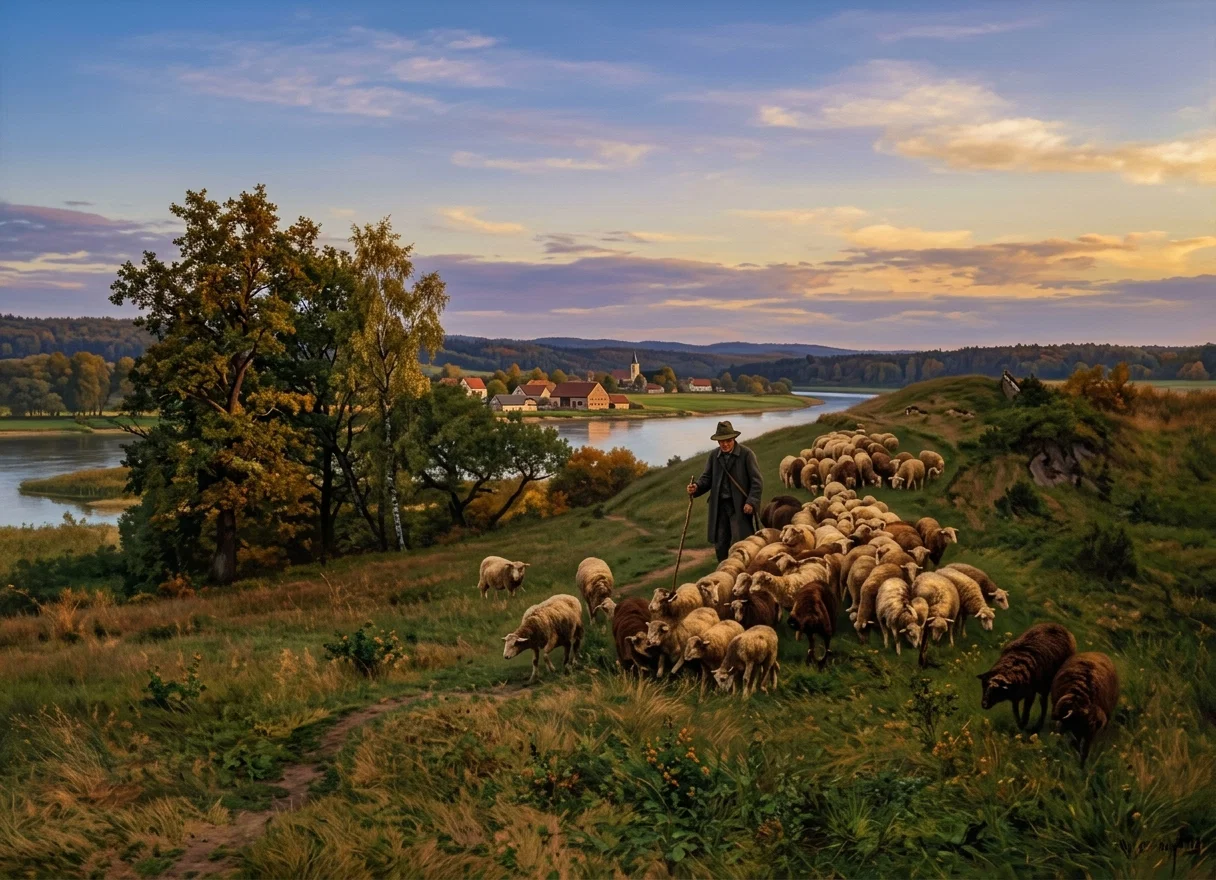
MY SHEPHERD

10%

Pacific Press Publishing Company · Oakland, California · Dec 4, 1901

FromSigns of the Times, Vol. 27, No. 49.

Read the full edition

MY SHEPHERD.

JEHOVAH is my Shepherd,” chants “the sweet singer of Israel.” “I am the Good Shepherd,” says Jesus. There is no contradiction, no clashing of interest, no jealousy of feeling; for there is no rivalry between the Father and the Son. Was not that Son’s name among the angels, before He came to this world, Michael, “who is like God”? Did not Jehovah declare, “My name is in Him”? Ex. 23:21. Not alone did He bear the name, but He possessed the character which demanded the name. The name was in Him. Were not His “goings forth” “from of old, from the days of eternity”? Micah 5:2, margin. Did not the Father say, “This is My beloved Son, in whom I am well pleased”? And did not Jesus say, “I and My Father are one”?
THE tender Shepherd’s love and care and sacrifice belong alike to both. God is love. That is His nature. All that Jesus did when there on earth was to manifest to the world the love of the Father. All He said, all He did, even to His death upon the cross, said to humanity, “God loves you, see how much He loves you.” As a mother He loves you. As a shepherd his sheep, He loves and cares for you. He perils His own life that He may save His sheep. He laid down that life that His sheep might all be brought home to His fold. He is the Good Shepherd.
THE words, “The Lord is my Shepherd,” are those of David. He knew the shepherd’s life, knew its days and nights of anxiety; knew the dangers from bold, wandering thieves; knew the perils of wild beasts. He himself tells us: “Thy servant kept his father’s ‘sheep; and when there came a lion, or a bear, and took a lamb out of ‘the flock, I went out after him, and smote him, and delivered it out ‘of his mouth.” 1 Sam. 17:34, 35, R.V. Whenever the beast of prey came, the shepherd was ready to defend the flock with his life. He knew in a human way what it meant in sacrifice, tenderness, bravery, and peril to be a true shepherd. No human at his best could serve for him; “Jehovah is my Shepherd.”
PRE-EMINENTLY the words of David are Christ’s words. He it was who spoke through the psalmist. In their fulness the psalms express the experience of our Lord. He was a sheep that He might be a shepherd. He met the fiercest enmity of the fiercest beasts of prey that he might know the experience of the mighty Shepherd’s helpings. And the beautiful Twenty-third Psalm is the expression of the faith of Jesus and of every soul who possesses the same faith.
“THE LORD is my Shepherd; I shall not want.” (Let us make personal application, as one of “the sheep of His pasture.”) How could we want? He is the Creator of all things. He possesses all power, all wisdom, all knowledge. “Nothing is too hard” for Jehovah; and His great heart of infinite love will keep back nothing that His sheep need, whether safely folded, or sick, bruised, and weary on the cold moorlands or mountains. Truly each can say, “I shall not want.”
“HE maketh me to lie down in green pastures: He leadeth me ‘beside the still waters.’ The sheep lies down when it has eaten sufficiently. ‘The pastures of tender grass’ (Hebrew, margin) furnish the food. The gently flowing river, or placid pool of living water, along whose bank the pathway runs, furnishes the drink. Here, on the sweet, rich food of God’s Word, drinking in the water of life, is the soul restored, or stored again, replenished, built up anew for the trial and task. The Christian, to live, must feed on the words of life, counting them more than daily food. He must drink of God’s waters of rest, not of the stagnant lagoons of superstition, tradition, or formalism. God gives it; it is all ours; eat and drink freely.
BUT not always can we lie in the sweet, green pastures; not always does our path run by the waters of quietness. But always “He leadeth me in the paths of righteousness for His name’s sake.” The pathways may be among the pitfalls of earth’s temptations; they may be through tangled thorns and briars that “wound and trip the ‘unheeding feet;’” they may be up ways steep and rugged and rough, bruising the tender feet on their sharp stones; they may be through the miasmatic morass; they may be in “the valley of the shadow of death;” but everywhere, in all places, at all seasons, they are the “pathways of righteousness.” God’s highway of righteousness is His holy law. “Blessed are the undefiled in the way, who walk in the ‘Law of the Lord.’” So the Shepherd speaks. “I will run the ‘way of Thy commandments;” “I have rejoiced in the way of Thy ‘testimonies;” “Teach me, O Lord, the way of Thy statutes, and I ‘shall keep it unto the end,” answer the faithful of the flock. The Master, the Shepherd, goes with us. He goes before us; “He leadeth me.” His nail-pierced footprints have trodden every step of the way and glorified it. Men who know not God may scoff at His law, but Jesus Christ, my Shepherd, has magnified it and made it honorable. Isa. 42:21.
SURELY when He is with me all the way, “I will fear no evil.” His rod of correction and guidance, His staff of succor and stay, comfort in the thought that He is bound to keep me in the way, if I am willing. When mine enemies are rejoicing in their seeming final triumph over me, He turns their rejoicing to lamentation by spreading His bounteous board and entertaining me as His honored guest. He brings forth the holy oil and consecrates me to His service; He fills my cup so full that I must give to others of its glorious fulness. And in view of it all, all His gentle, tender, faithful dealings, what other words can a soul say than these: “Surely goodness and mercy shall ‘follow me all the days of my life; and I will dwell in the house of the ‘Lord forever.’”