It is the purpose of this series of science studies to cover in an exceedingly brief way the field of science, and to offer a few suggestions as to nature studies in the home. I do not know but I should say that I am not writing these articles directly for the children, but for them through the parents, tho I hope some things that I may say at times may be of direct interest to them. Many mothers and, for that matter, teachers, feel themselves incompetent to teach nature studies. Such should remember that the basis of all learning is observation—seeing. Memorizing is far too often considered the highest form of learning, when, as a matter of fact, it is quite the lowest. Observation leads to comparison, which is thinking; and all original thinking is learning. Now, one who has eyes can see. I grant that eyes which have been trained see more than those that are yet untrained. But the way to train the eyes to see is to see, to look closely.
So no matter what may have been the previous training and education of parents, or how old they may be, the eye may yet be trained to see and the mind to think—and keenly and intelligently, too—about the works of God, or nature. Let such parents begin with their children, asking and answering questions. The children can ask questions which will make the wisest of men search for the true answer. A little child shall lead them—such parents—into fields of thought far above the sordid cares of life. I well know that nearly every father and mother who will follow these studies is very busy. They are anxious to help their children, and to be helped, to a better understanding of the works—wonderful works—of God. I am very anxious to say something to assist these busy parents in this very work. But the field of science is so very broad that no one could cover it fully, did he live ten lives. So, in the brief space of these articles, all I can hope to do is to impress the necessity of using one's own eyes and brains. To this end I can call attention to only a few facts in each branch or science, which may serve to illustrate something of the nature of the study in that particular field. Not that I regard these which I use as the most important, for it would be exceedingly difficult to say what were the most important. I have been asked by some of my readers to give an outline of studies in nature. But this has been done by others far better, undoubtedly, than I could do. However, I do not think that what is most needed is outlines, but the habit of observation. So this is what I have confined myself to emphasizing. I believe in reading books on nature, but they should be made secondary to seeing. I do want to enforce the idea, however, of the use of the Book. There are but few things in nature that are not mentioned in the Word of God. By aid of the concordance these words can be found, and they throw great light upon the works. So upon busy parents I can only urge the necessity of a systematic study of the Word and works with the children, even if but for a few minutes each day. This study will lighten the day's duties and brighten its hours.
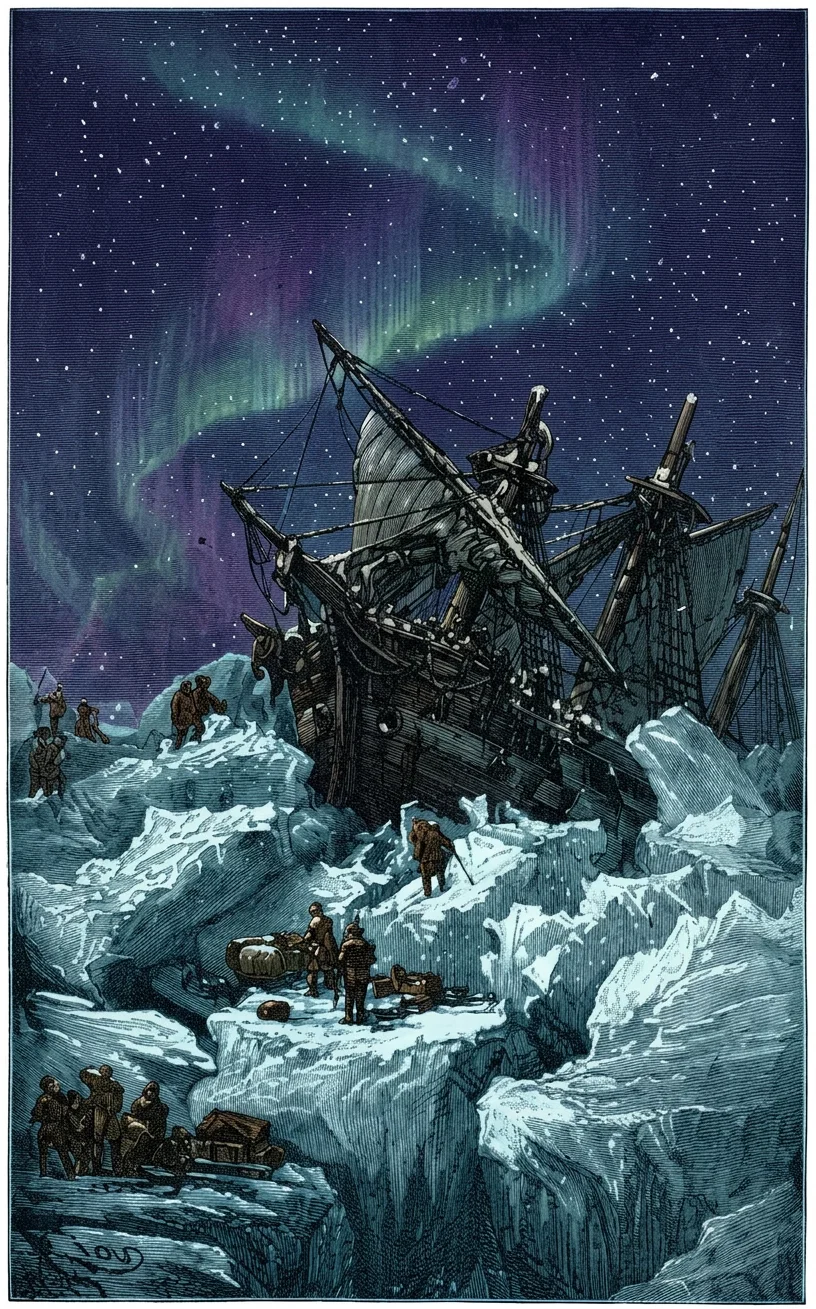
What the forces of nature are doing now in the Frigid Zones.
But to come to the direct study of this article. There are but two great forces in nature,—physical and chemical. We speak of the study of the physical forces as physics, and of the chemical forces as chemistry. Chemical forces are seen in the changes in the composition of an object, as, for instance, when, by fermentation, alcohol enters cider; or when common salt or sugar dissolves in water.
Physical changes or forces are illustrated by the action of frost, heat, light, snow, dew, etc. The most important conception for a child to gain of these forces is that under God they have a direct relation to his existence. So close is this relation that his life is, to a great measure, conditioned by them. By many the idea is often entertained that the child is not interested in a study of these forces, but prefers animals or plants. This is a mistaken idea.
Quite a little of the study of these forces involves experiments. This will take the time of busy parents, but the long evenings of winter can be most profitably spent in this way. Expensive apparatus for these experiments is not necessary. In fact, it often hinders more than it helps; for the mind of the child is taken from the experiment to the apparatus, and the lesson is quite lost. It does not take much ingenuity readily to construct the apparatus necessary for nearly all experiments.
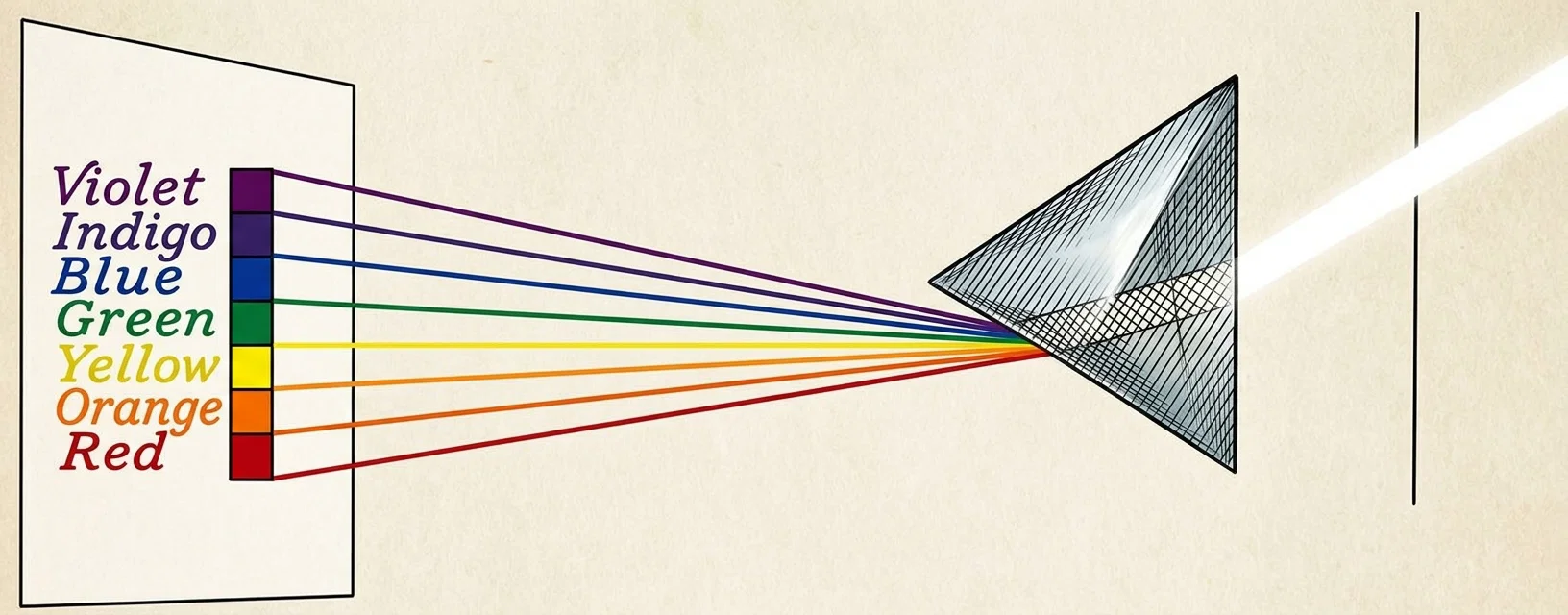
To illustrate what I have been saying about the study of the forces of nature, and the apparatus often necessary for their study, I wish to speak of the study of light, and the making of a prism for its study. A prism is usually a transparent body with three rectangular sides. It is not always necessarily this, however, but for the study of light, should be. To make a prism, take three pieces of window-glass of equal size, say one inch wide by four long. Take a triangular piece of tin larger than the prism formed by the three pieces of glass; bend up the sides so that a bottom for the prism will be formed, into which the three pieces of glass will just fit. Seal up all seams with common sealing-wax, fill with clear water, and a prism is made. This is a far better one than one of solid glass, which has been bought—not in itself, but because our hands made it. The lesson of learning to make for ourselves is most valuable.
In a window, where the direct sunlight will strike it, place the prism. Between the prism and the sun place a piece of cardboard, in which there has been cut a small slit. Let the sunlight pass through this opening and strike the prism. Note the changes which the prism makes in the sunlight. How many changes can be seen? Put a piece of white paper in the different rays. What color does it appear to be? Are the colored rays in a straight line with the sunlight that enters the prism? Which rays are nearest and which farthest from a straight line with the sunlight? Many ideas will be observed other than these I have suggested.
Light is, perhaps, the greatest of physical forces. A study of the first chapter of the Bible will reveal that the Spirit of God was the light that was in the earth before the sun was created. The light of the sun can be but one manifestation of the Spirit of God. God's Spirit is life. This is how the light of the sun can give life. This idea of the connection of light and life follows throughout the Bible. For instance, we find John saying of Christ, in the opening of his Gospel, “In Him was life, and the life was the light of men.” The light of the sun is as much the life of God as is the life which comes at the second or spiritual birth, and continues throughout the life of the “new man.” It is, however, an entirely different manifestation of His life, and in a different degree; but it is all the Spirit of our heavenly Father—the Spirit of life—no matter in what form manifested.