A CHARACTERISTIC evidence of departing from the true way of the cross and losing the power of the Spirit of life, is manifest reverence and adoration for the material things of the past. It is not even necessary that these “sacred relics” should be proved to be genuine; it is sufficient that the claim be made, that this claim be traced back for a century or more, and that an alleged miracle or so be wrought to substantiate the tradition.
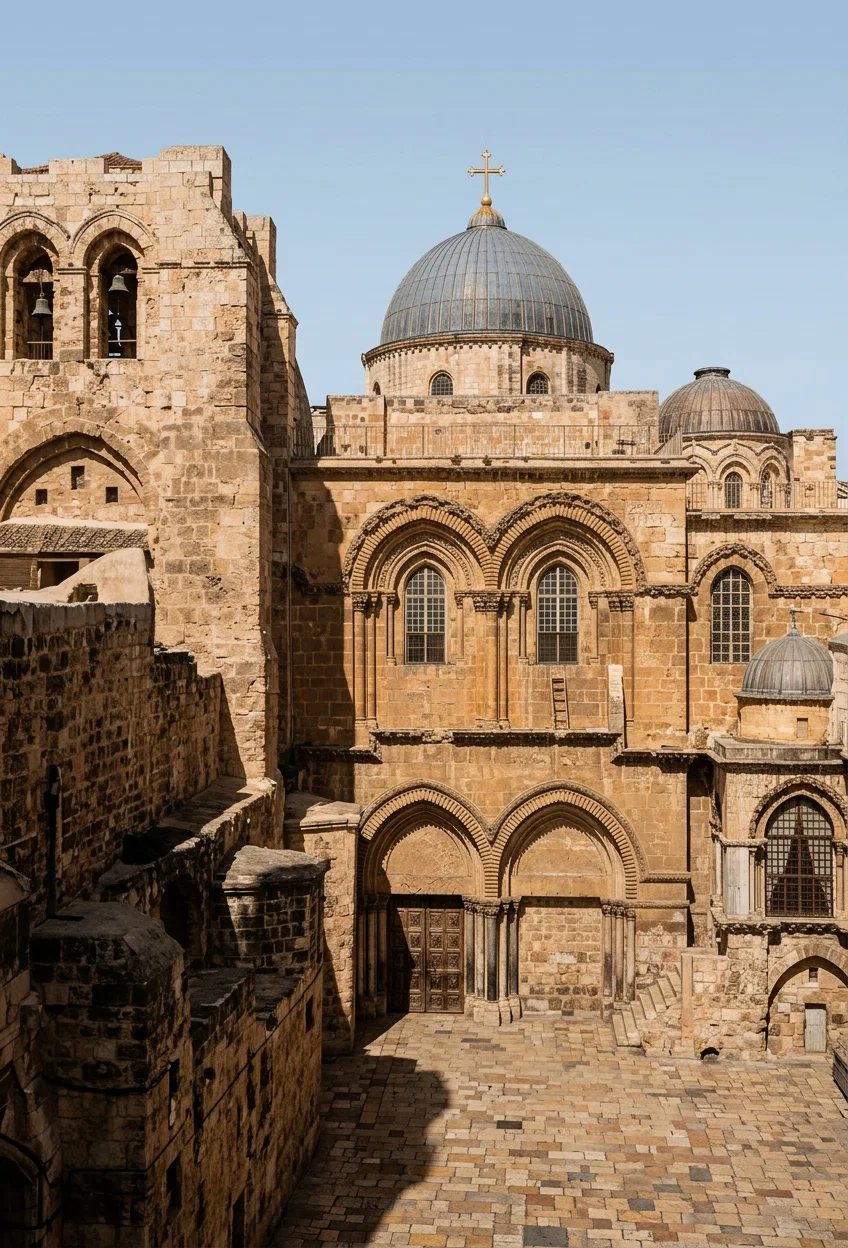
The Church of the Holy Sepulcher, Jerusalem.
THE early church evidently knew where our Lord was buried. One of their number owned the sepulcher. Several others were present at His burial, and visited the spot after His resurrection. But they left us no record of the place, they uttered no word as to its holiness. It was not until the power of the Gospel of life had departed from the church that people began to seek for virtue to the places which had witnessed the presence and power of the Son of God or His devoted servants.
IT was the corrupt, cruel, half-pagan emperor Constantine who built the first church of the Holy Sepulcher, and on ground within Jerusalem, where our Lord was certainly not buried; for “He suffered ‘without the gate,’ and “in the place where He was crucified there ‘was a garden, and in the garden a new sepulcher. . . . There ‘laid they Jesus.” Heb. 13:12; John 19:17, 41, 42. But there was no word in the Scriptures of Truth as to its holiness. Constantine, in true pagan way, wishing perhaps to atone for some of his evil deeds and to ingratiate himself with the then superstitious church, erected a rotunda over the supposed tomb, and close by, on the supposed spot of the crucifixion, a magnificent basilica was built, and consecrated in 336. These were burned in 614, when Chosroes II. invaded the Holy Land. In 626 new buildings—three in number—were finished, begun ten years before by the abbot Modestus. These the Mohammedans burned in 936; they were rebuilt in 1048. These stood till 1808, when they were burned in the great conflagration of that year. The present buildings were begun by the Greeks and Armenians in 1810, planned by a Greek architect, Komnenos Kalfa, of Constantinople.
FOR more than a century and a half—1096 to 1250—the European crusaders sought to wrest the Holy Sepulcher and other places from the hated Moslem. Their great waves, filled with religious enthusiasm and the drift-wood of superstition, greed, hatred, avarice, lust, and fanaticism, beat on the shores of little Palestina or lost themselves in the hostile regions between; sometimes victorious at the expense of myriads of lives, but ending at last in the froth of defeat, with Jerusalem still in the hand of the hated followers of Mahomet, the armed soldiers of the prophet still keeping peace between the factions of professed Christians, who know not the power of Christ Jesus, and are vainly seeking it where He is not.
WHERE lies the difference between the early church and that which for long centuries has builded and garnished the sepulchers of the holy? The secret of both is revealed in the Gospel. The angel said to the women as they came to the empty tomb on that morning of the resurrection: “I know that ye ‘seek Jesus, which hath been crucified. He is not here; for He is risen, ‘even as He said. . . . He goeth before you into Galilee; there ‘shall ye see Him.” Here are the secrets of both actions.
UNBELIEF grasps the material, and looks to the past. It walks2by sight, not faith; by sense, not the principles of divine truth. It saw the sepulcher; it saw Jesus laid there; it helped to enwathe Him in aromatics and place Him there; it saw the stone rolled to the door; it returned there to find a dead body, a crucified Lord. Such has always been the case. Forgetting God’s living, present word, men turn to the past. Forgetting what Christ “had said,” the hearts of His disciples were still in the empty sepulcher. Backslidden, unbelieving Israel hoped while transgressing God’s law to be saved by the ark in which the dead cold letters of the law were enclosed. They fell to worshiping the serpent of brass centuries after Moses made it. The same want of faith, the same sensuous religion, seeks virtue and help in charms, in amulets, in relics, in bones, in pieces of wood “of the ‘true [?] cross,” in empty tombs, in places once hallowed by the presence of the Holy, in empty forms and empty prayers, in once effectual methods of work, fitted for the lame and blind, but now inadequate and unadaptable, in outworn creeds and constitutions of men’s devising, in a thousand other things which physical eyes can see and physical hands can grasp, things once associated with Power from on High, but of themselves nothing. All their worth in the past has been their use by those who looked beyond them and grasped the ever-living truth, the ever out-flowing life of God.
“HE is not here,” making an abiding place in the past. He is not dead in Joseph’s tomb. “He is risen;” He is “alive forevermore.” He goes before, out beyond Jerusalem; out beyond the little center of the past, where the children met; out beyond the constant Gospel-hearer, Gospel-hardened, to the great needy “Galilee of ‘the nations.’” “THERE shall ye find HIM.” By the sick-beds, by the prisoner’s side, at the widow’s cot, before the sin-sick souls, ministering to all of His abounding grace—“There shall ye find Him.” He does not love to dwell in the cold rock, when there are warm hearts longing for Him. Above all temples wherein He delights to dwell is “the upright heart and pure.”
THE longing, the seeking, the struggle, for power is not over. Still Jerusalem is greater among the “holy cities” than Rome. The Church of the Holy Sepulcher is to be preferred to St. Peter’s. To place there the head of ritual religion, there will be crusades enlisting organized armies instead of mad, half-famished hordes. And when that is done, in one form or another, many will be deceived. But then the true church, obedient to every known truth of God, following in the footsteps of Jesus Christ, will draw from Him “the light and life ‘and love of heaven.” Their blameless regenerated life will be the mightiest witness to the world that “Christ is risen indeed.”