GOD THE PRESERVER

3%

Pacific Press Publishing Company · Oakland, California · Oct 30, 1901

FromSigns of the Times, Vol. 27, No. 44.

Read the full edition

GOD THE PRESERVER.

The Mighty Power of Faith.
BABYLON, great Babylon, “the glory of kingdoms, the beauty of the Chaldeans’ pride,” the mighty city that, by her religion and education and influence, had, for fifteen centuries or more, molded the world,—Babylon, that had brought under her wondrous spell civilizations Hamitic and Semitic, friend and foe, conqueror and conquered, had at last fallen. Hamitic civilization put forth mighty endeavor to rule the world, and had failed. The children of Shem followed, and were dominant for many centuries. Now the children of Japheth, in the nations of Media and Persia, are given the throne. Babylon’s mighty walls, supported only by weak, effeminate, luxury-loving men, were insufficient to protect her from the clearer-thinking, hardier, more frugal Medes and Persians.
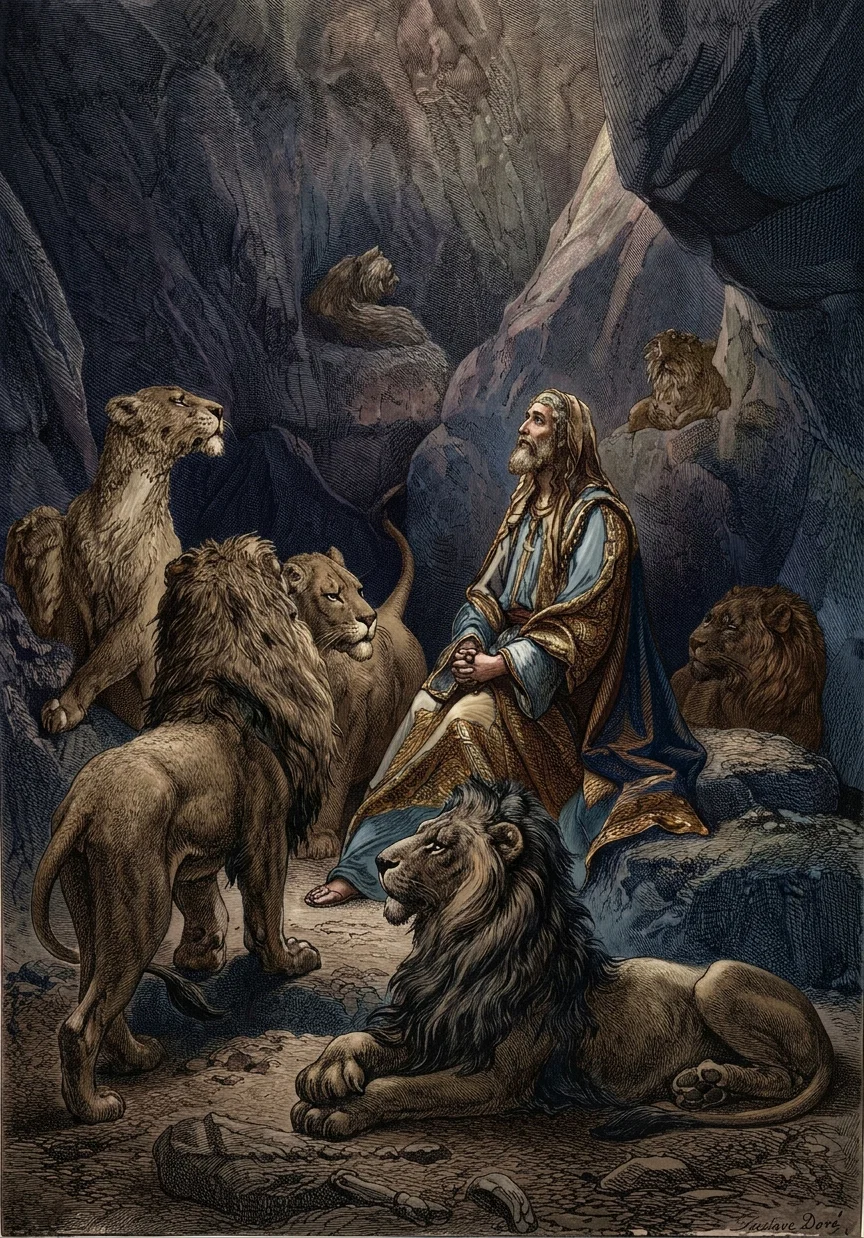
“My God hath sent His angel, and hath shut the lions’ mouths.”
Over the Medo-Persian forces was Cyrus, the virtual monarch of both peoples; but with rare forethought and wise policy he allayed the suspicions of the conquered Medes by placing one of their own nation upon the throne,—the probable son of Astyages, Cyaxares II. He may have been one of the cousins of Cyrus. At any rate he was a Median, and known to the Jews as Darius the Mede, the term Darius meaning “coercer,” “conservator,”—a title rather than name, the same as Pharaoh.
The character of Darius the Mede, as shown in Daniel 6, is, like that of most other men, a blending of weakness and strength. His large division of the responsibility of his empire showed wisdom, and his choice of a prime-minister revealed sagacity. But he was susceptible of one of the greatest temptations a ruler has to meet,—flattery from those seeking favors,—and he yielded to it, to his own discomfiture and disgrace.

Daniel the Faithful.

One character shines out in this chapter above all others,—that of Daniel the captive. He was an old man now. He had kept through all the years his purpose not to be defiled by the corruptions of Babylon, not alone in his eating and drinking, but in all his life.
He had stood as prime-minister under the reign of Nebuchadnezzar, uncontaminated by court life, untouched by bribery. God was with him. To him had the Revealer of Secrets opened the future. His knowledge, drawn from the great Storehouse of God, had been demonstrated to be greater than that of magician or Chaldean. His wisdom, drawn from the great Fountain, exceeded that of all the wise men of the greatest empire of earth, enriched (?) by the traditions of centuries. In the business of the kingdom he was without a rival.
With such a record, knowledge of which must have extended to every kingdom with which Babylon had had to do, it is not wonderful that Darius chose him as one of the three presidents; not the first, as in the common version, but “one” of the three, as in the Revision, Septuagint, and others. The king would not at first thus exalt him; that was to come later, as Daniel’s wisdom and merit were demonstrated in counsel. Thus the record reads: “Then this Daniel was ‘distinguished above the ‘presidents and the ‘satraps, because an excellent spirit was in him; ‘and the king thought ‘to set him over the ‘whole realm.’” The Septuagint declares that this was done, and following verses show this to be the fact. Daniel was made the prime-minister, the chief of the cabinet of three, the representative of the king.

Envy and Its Fruit.

The result of the king’s preference was soon manifest. Never was merit exalted but it aroused envy in the hearts of the selfish; envy that is ever pained at the seemingly equal or greater prosperity of another. Here is the record:—
“Then the presidents and the satraps sought to find occasion against Daniel as touching the kingdom; but they could find none occasion nor fault; forasmuch as he was faithful, neither was there any error or fault found in him. Then said these men, We shall not find any occasion against this Daniel, except we find it against him concerning the law of his God. Then these presidents and satraps assembled together to the king, and said thus unto him: King Darius, live forever. All the presidents of the kingdom, the deputies and the satraps, the counselors and the governors, have consulted together to establish a royal statute, and to make a strong interdict, that whosoever shall ask a petitionof any god or man for thirty days, save of thee, O king, he shall be cast into the den of lions. Now, O king, establish the interdict, and sign the writing, that it be not changed, according to the law of the Medes and Persians, which altereth not. Wherefore King Darius signed the writing and the interdict.”
1. Note the remarkable record of Daniel. Was there ever a politician in America against whom some charge of evil-doing or mistake, wrought sometime in his public career, could not be brought? Sometime he had slipped, committed some sin, made some egregious blunder (worse than sin in a politician’s estimation), and so marred his life. But this was not the case with Daniel. The presidents and satraps, one hundred and twenty-two in number, set themselves to find some occasion against Daniel in his public work. They searched the records of State, looked over Daniel’s books, cross-examined his private secretary—if he had one—interviewed his enemies; but after all the searching and prying, “they could find none occasion nor fault; forasmuch as ‘he was faithful, neither was there any error or fault found in him.’” It was a remarkable record.
2. Then they tried another tack. Our only hope, said they, is to find some occasion “against him concerning the law of his God.” Envy would condemn him for his very virtues.
3. Then the whole number of the presidents and princes came to the king,—“came tumultuously,”—with great enthusiasm telling the king that he was divine, and worthy of worship, and that all his officers had agreed that his worship should be firmly established by royal decree. Thirty days was to be given to this, during which time no one was to ask any petition of any god or man save the king.
4. The king, blinded by the “poisoned flattery,” yielded, and signed the decree. Little did he know what it meant. Hannah More well says:—
“No adulation; ’tis the death of virtue; Who flatters is of all mankind the lowest, Save he who courts the flattery.”
5. Daniel knew what they were about, but it did not change his purpose. Character was more precious in his estimation than wealth and honor and position combined; aye, even than life. Duty must be done. He did not even counsel with his companions. He knew what was right in the premises. He did not appeal to the king to change the law; he knew this would be futile in view of the purpose of those who framed it. They had perverted the God-given authority of the kingdom to destroy him; the faithful servant would leave his case with his beloved Master. To yield to the law meant destruction of character; more than this, it meant dishonor to God, whose representative he was. Better death a thousand times than loss of character or falsity to his trust. The king and all Medo-Persia were but for a time; God and His kingdom were eternal. He would stand for God.
The worth of a purpose is shown, not in sweet sunshine and pleasant paths, surrounded by friends; but it is revealed when the sky is dark, the path rugged and uninviting, beset by temptations and snares, and there is no one to help save God, and He seen only by the eye of faith. Daniel’s purpose was not for a sunshiny day and on easy paths, but for life, in whatever paths it led; and therefore, when he “knew ‘that the writing was signed, he went into his house (now his windows ‘were open in his chamber toward Jerusalem); and he kneeled upon his ‘knees three times a day, and prayed, and gave thanks before his God, ‘as he did aforetime.’”
There was no spirit of braggadocio in Daniel. He did not defy the law. If the law contravened the righteous purpose of his life, his solemn duty to God, that was only incidental; it was not a principle to mold or change his steadfast purpose. He continued to do as he had ever done. Neither did the man of God yield to human fear. He might have argued that discretion was the better part of valor; that it would be more politic to close his windows and pray in secret for the next thirty days. But he did nothing of the kind. His windows were usually open toward his beloved Zion; he would leave them so. He had his regular seasons of devotion, tho doubtless the busiest man in the empire; he would not depart from this duty and privilege. And his enemies knew that he would not. They assembled at the stated time, “and found Daniel making petition and supplication before his ‘God.’” They expected to find him there. He prayed as beforetime, and doubtless for the very men that were plotting his destruction; for did he not serve God? and had not God said, “Seek the peace of the ‘city whither I have caused you to be carried away captives, and pray ‘unto the Lord for it’?” Daniel also gave thanks to God. He knew that his prayer was heard; that it would be all well whatever came.

Report to the King.

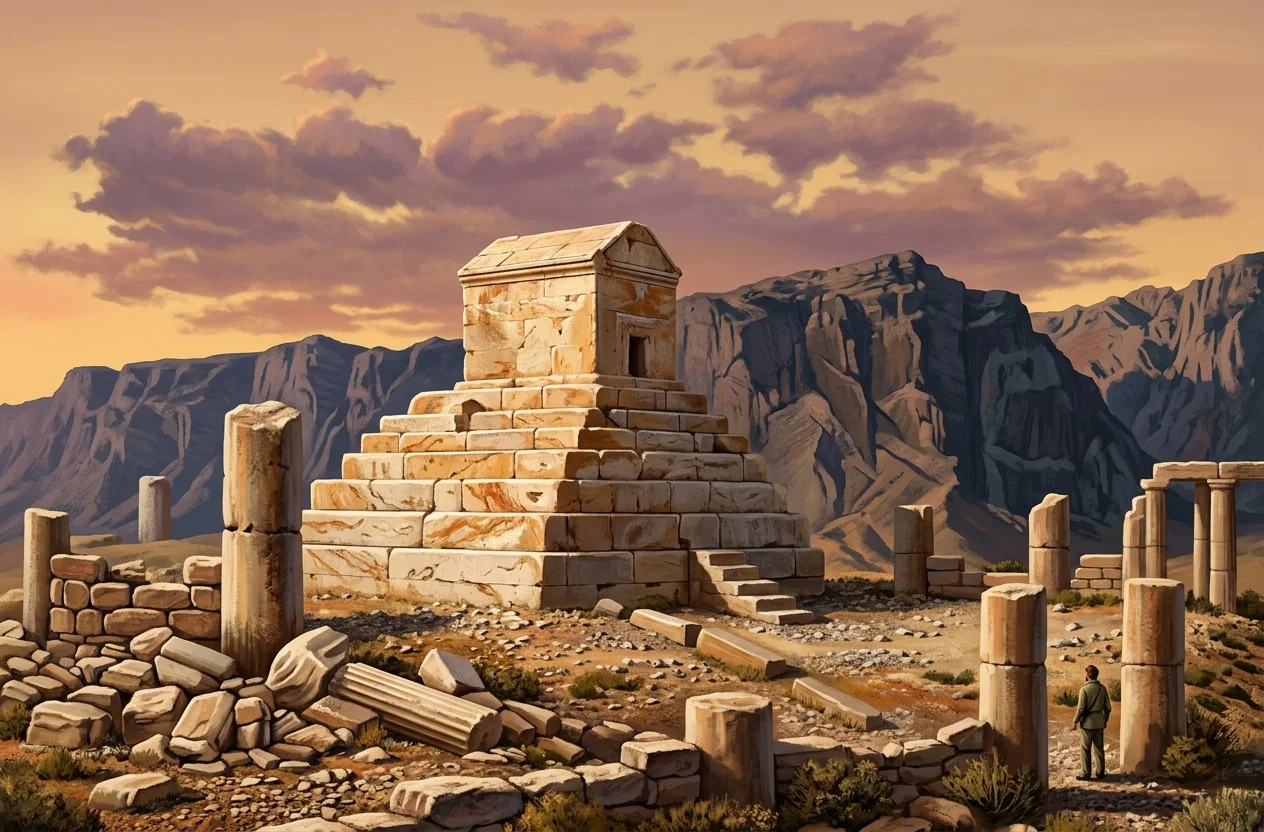
Tomb of Cyrus, Murgab, or Pasagardae, the ancient capital of Persia.
Then the spies report to the king. They approach him by reminding him of the recent law of worship; and the king declared it true and unalterable. Then they present their charge against “that ‘Daniel,’ the Judean captive, even he, O king, ‘regardeth not thee.’”
Too late the king saw his folly, and was “sore displeased with ‘himself, and set his heart on Daniel to deliver him; and he labored ‘till the going down of the sun to deliver him.” He doubtless plead with his officers to change the decree, with Daniel to yield to it, but his efforts were futile. How easy it is for man to bind with chains which he can not sunder! how easy to fetter the soul and body with shackles of sin that no human power can break. O, it is well for a human to be thoughtful. Each present moment is big with eternal possibilities. The king found himself powerless; his own law bound him; he was held through it by the plotters against the good of his realm. “Know, O king, that it is a law of the Medes and Persians, that no ‘interdict nor statute which the king established may be changed.’”
Then at the king’s enforced command, Daniel was cast into the den of the fierce lions, the king expressing his own hungry hope, and endeavoring to cheer Daniel, in the words: “Thy God whom thou ‘servest continually, He will deliver thee.” It expressed the dawning of a faith which we are fain to hope was perfected, and it was a royal certificate of Daniel’s faithfulness.
Then the king closed the den, and sealed the stone, that no mortal interference might occur to deliver the criminal; and then he retired to his palace and spent the night in praying and fasting. In the early morning, after a sleepless night, with mind alternating between hope and fear, he hastes to the den of lions, and cries with a lamentable voice, “O Daniel, servant of the living God, is thy God, whom thou ‘servest continually, able to deliver thee from the lions?” And Daniel is able to reply, prefaced with the courtesy due, “My God hath sent ‘His angel, and hath shut the lions’ mouths, and they have not hurt ‘me; forasmuch as before Him innocency was found in me; and also ‘before thee, O king, have I done no hurt.’”
It was a double lesson to the king. It showed to him, even as God taught it to Babylon, that there was one Ruler who could make of no effect the puny laws of men. It revealed to him that the God who could make and preserve character in the corrupt court of Babylon, could deliver from all physical ills. It bears the same lesson to plotters, politicians, statesmen, rulers, to-day. Jehovah is the living God, and rules above men.

Kept by the Power of Faith.

Daniel was taken from the den of lions, “and no manner of hurt ‘was found upon him, because he had trusted in his God.” He was kept by the power of faith; not that his faith furnished the power. Faith was the arm that reached up and made connection with the throne. It is like the pipe that taps the great fountain. It is like the trolley that reaches up and taps the live wire. The power of God flows forever from the Great Fountain; faith opens heart and life to receive it. It was faith that brought, in the beginning, cleansing and power to Daniel. It was because he believed God that he formed in the beginning his noble purpose. It was faith that kept his character unstained, untarnished, through all the years of his public service. It was faith that led him to devote time to the service and worship and Word of God,—time all gained, because these things made him what he was. And it was wholly because of what faith had done for him morally that God could consistently deliver him physically. What a testimony is here left the young, aspiring men of the world and the church! There is as great need now as of old for Daniels. God is as able to make them. Where are the men who are willing to be what God wants to make them?
The king was convinced, but not then converted. He visited upon those who plotted against Daniel’s life the same doom they planned for the Hebrew. Then he made a decree, commendable enough, indeed, for a heathen coming to the light; but no criterion for any ruler. It had this, however, that was indeed favorable, and thatwas the proclamation of the Gospel, the power of the true God to deliver. Here it is:—
“Then King Darius wrote unto all the peoples, nations, and languages, that dwell in all the earth: Peace be multiplied unto you. I make a decree, that in all the dominion of my kingdom men tremble and fear before the God of Daniel: for He is the living God, and steadfast forever, and His kingdom that which shall not be destroyed, and His dominion shall be even unto the end. He delivereth and rescueth, and He worketh signs and wonders in heaven and in earth, who hath delivered Daniel from the power of the lions.”
The decree is foolish—that men tremble and fear before God. This may be their duty; it is not in man’s power to enforce it. But the reasons why men should fear God are indeed ample. “He is the ‘living God,’ the self-existent One. Note how in this chapter the law of the Medes and Persians which altereth not is set in contrast with the living God,—steadfast forever, and His overruling kingdom enduring to the end. Note how man’s purpose to destroy is set over against God’s power to rescue and deliver. Happy he who can say, This God is our God, even forever and ever.
This chapter closes with: “So this Daniel prospered in the reign ‘of Darius, and in the reign of Cyrus the Persian.” Surely he was the “Grand Old Man” of the kingdom, simply and solely because he was, a few years before, the youth of a steadfast purpose. Steadfast toward God, he found God just what He eternally is,—steadfast in faithfulness and power to him. So will all find God who will trust Him.