THE LATEST CONCERNING PITCAIRN ISLAND AND ITS PEOPLE.
[The following is from the London (England) correspondent of the New York Sun. It might be well to say that the defective speech mentioned is probably inherited from the Tahitian mothers. We do not know for certain, but we believe it to be true that there has been improvement in pronunciation rather than otherwise. We know this; the language of the Pitcairn Islanders is much purer than in many of the shires of England. The history of Pitcairn Island, written by a native, Miss Rosa Young, will speak for itself. Our readers will be interested in this last news from the island.]
THE unique community of Pitcairn Island is threatened by the restless reforming eye of Mr. Joseph Chamberlain. He finds that they need an overhauling before they can be brought into line with the general pace of an empire marching on a business basis. They are not very anxious to trade or consort with their neighbors dotted about in their region of the Pacific. To learn the reason of this the colonial secretary called upon the British Government’s high commissioner for the Western Pacific for a report. The reply is remarkably instructive to any one attracted by the little side histories of those human oddments who leave the track of their neighbors, and at vast distances contrive to maintain through several generations an ordered community of their own devising.
This official report finds that these descendants of the mutineers of the British ship Bounty are temperate, healthy, and industrious. After a century of acclimatizing and social self-adjustment, they display on a microscopic scale the features of similar groups who, in other parts of the earth, have elected to live ‘apart,’ “the world forgetting, by the world forgot.” Against certain attractive developments, comforting to those who are optimists in the matter of human nature, there appears in the story of Pitcairn Island the phenomenon, so regularly noticed elsewhere, that when a small fraction wrenches itself free from the main body, and hopes to live on as a self-sufficient unit, it succumbs to a habit which makes its growth tend downward.
The naval officer who sends the report of his personal association with the islanders to the high commissioner, speaks very highly of the mode of life of the few hundred dwellers on Pitcairn; but he notes “a tendency growing among the islanders to make use of a sort of language of their own, which, I am ‘told, is a clipping of English words, and which is ‘at the best a species of pigeon English. This ‘shows signs already of making some of them slow ‘of comprehension when addressed in English.’” This officer, Commander Knowling, of the British cruiser Icarus, gives this pithy account of his visit to them:—
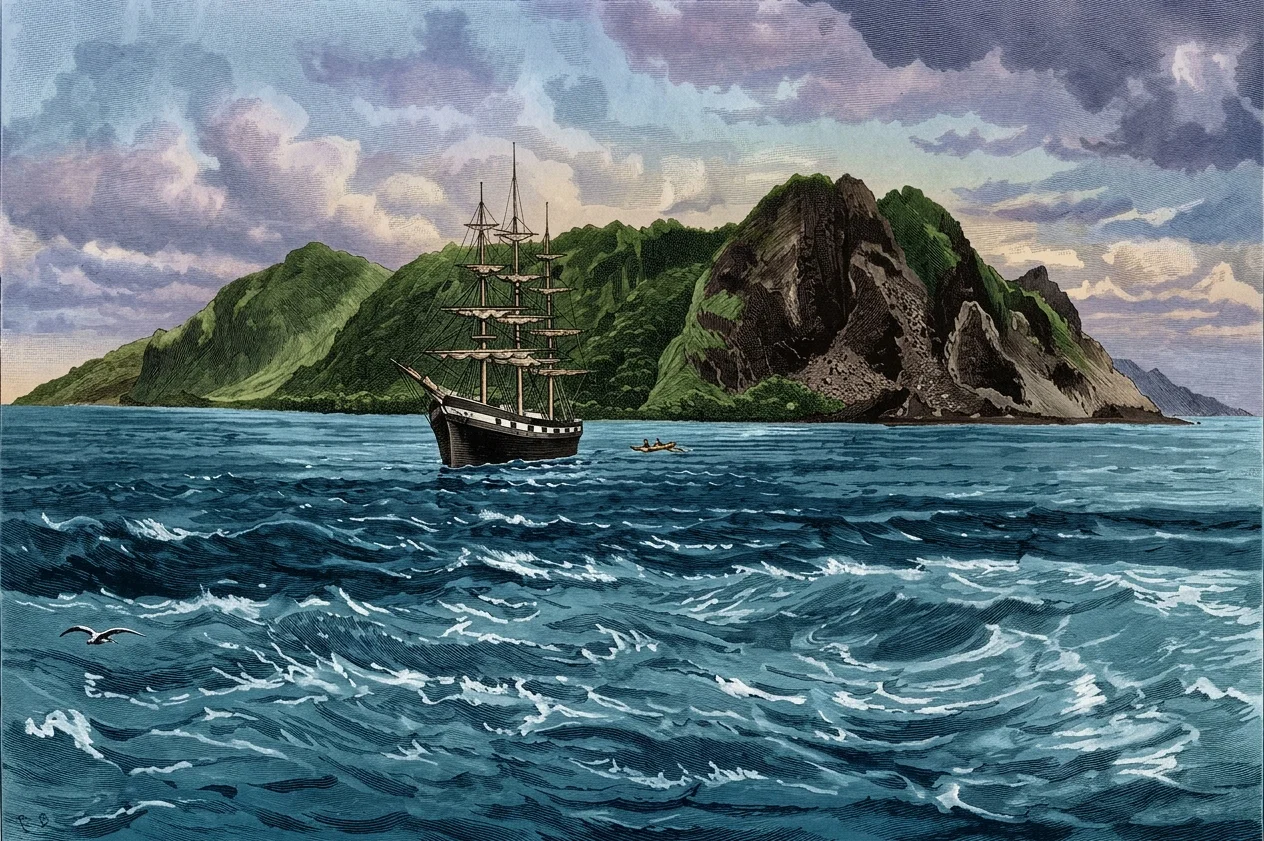
PITCAIRN ISLAND.
I arrived in Bounty Bay at 5 P.M. on February 21, 1901. A boatload of islanders (men) came off, but in view of there still being several cases of dengue fever in the ship, I only allowed Mr. James R. McCoy, the chief magistrate, on board. He reported all well in health, 126 people on the island, the women being rather in excess of the men. Arranged to land next day, and then proceeded to northwest anchorage, where there was less swell. Anchored there—losing an anchor which was afterward recovered—for the night, and landed at Bounty Bay the next morning. After this I communicated with the island each day, myself and a few officers landing; but by the surgeon’s advice no islanders were allowed on board. The swell continued more or less heavy in both anchorages, so we stood off and on, or lay too off the island, during the remainder of our stay. Mr. McCoy has only recently returned to the island; he having very pluckily piloted a burning ship to Mangareva, beaching her there rather than agree to her captain running her, as he wished to do, onto the coast of Pitcairn.
The soil and temperature are all that could be wished for, and there is scarcely a wholesome root or fruit that does not grow most readily. Commander Knowling proceeds:—
During the last four years thirty-five vessels on an average have called at the island each year, but the islanders generally seem to see very little of the crews of merchant vessels. In most cases the master only of the vessel lands for a short time, the ships scarcely ever anchoring. During his stay last month in Mangareva (Gambier Islands), Mr. McCoy endeavored to arrange something in the way of a regular trade between the two islands, and one of their vessels has since called at Pitcairn, taking away large quantities of bananas, pumpkins, and arrowroot. The leading men here think that they will be able to maintain this trade.
The men have to give all their labor during the early part of the day—viz., from after an early breakfast at 5 A.M. until 2 P.M.—to work for the public good, directed by the local parliament of seven. At the present time twenty-nine men are available, and their labor is divided between building a new church adjoining the present school-room, a new whaler, and the necessary boat work, shooting of goats, etc. Two o’clock is the dinner hour, and the remainder of the day the people employ themselves about their own business of gardening, etc. The women of the family do all the housework, and many of them smooth and paint coconuts, plait and decorate mat bags, etc.
Disease appears to be still almost unknown. The typhoid of 1894 was brought here by a shipwrecked crew, and no other epidemic has touched the island since. The leading people prefer to continue, as hitherto, without medicines of any sort. One small boy has been recently killed by a fall while chasing goats on the cliffs. Thursday October Christian, son of a man of the same name and grandson of Fletcher Christian, master’s mate of the Bounty, is the oldest man on the island, aged now 83; two other men are over 75, and the oldest woman is 72. None of these old people suffer from anything beyond the weakness of old age, and all seem thoroughly contented and happy.
The early loss of the front teeth in the upper jaw continues among many of the islanders; but the teeth of numbers of adults, as well as of the children, are without a flaw. Some families, in which up to the present there has been practically no intermarriage, still suffer from this loss of teeth. No one smokes or uses intoxicating liquor. Men, women, and children seem without exception in robust health and full of vigor. Thanks to the care of the elected parliament—consisting of seven members, with Mr. McCoy as president—full employment is found for every one. The discipline seems to be all it should be, the islanders contented, and the day’s work often, to my knowledge, such as would astonish many a British laborer, as it astonished, on more than one occasion, myself and the ship’s company. Their religion remains that of the Seventh-day Adventists. The Saturday services are well conducted, and the strong religious feeling which was once so marked a characteristic of the islanders appears—after the check it received some few years ago—to have again gathered strength.
After paying an admiring tribute to Mr. McCoy’s administrative sagacity, Commander Knowling proceeds to the difficulties which the island has to face. First, he places the absence among the men of early middle age of a fitting successor to their present chief magistrate. Then there is the surplus of women in the present and rising generation, a difficulty, naturally accentuated in a small and secluded community. Any arrangement which would include the removal and care of some of these young women—of whom some of the grown ones would now willingly leave—he thinks would be a work of useful philanthropy. He mentions the tendency to clip English words which is growing, but he feels that the islanders are an interesting community.
The colonial secretary’s grievance is that they will not come out and trade with their neighbors. The high commissioner replies with the opinion that they will not be got readily to go into the export business, and that “some new enterprise is essential to the moral and physical well being of the ‘people.’” The mission of the Seventh-day Adventists, to which denomination the islanders belong, is about to take their condition in hand. He reports that “the mission, whose vessel has recently called ‘at Pitcairn and Tahiti, has offered to give employ- ‘ment on their plantations at Raiatea, and at this ‘island, to a few young men of Pitcairn, in order ‘that they may obtain a knowledge of the cultivation ‘and preparation of those productions most suitable ‘for trade purposes, and that the missionaries of the ‘sect to which the Pitcairn people belong are them- ‘selves giving some attention to the question of open- ‘ing up the desired communication by way of Rara- ‘tonga and other of their missionary stations in this ‘region. Whether anything will ultimately be done ‘in the matter is difficult to determine at this juncture; but there can be no doubt that steps in this13direction have already been taken, and that if funds can be found, and the sanction of the missionary board obtained, the service will be established within the next twelve months by vessels sailing under the American flag.”
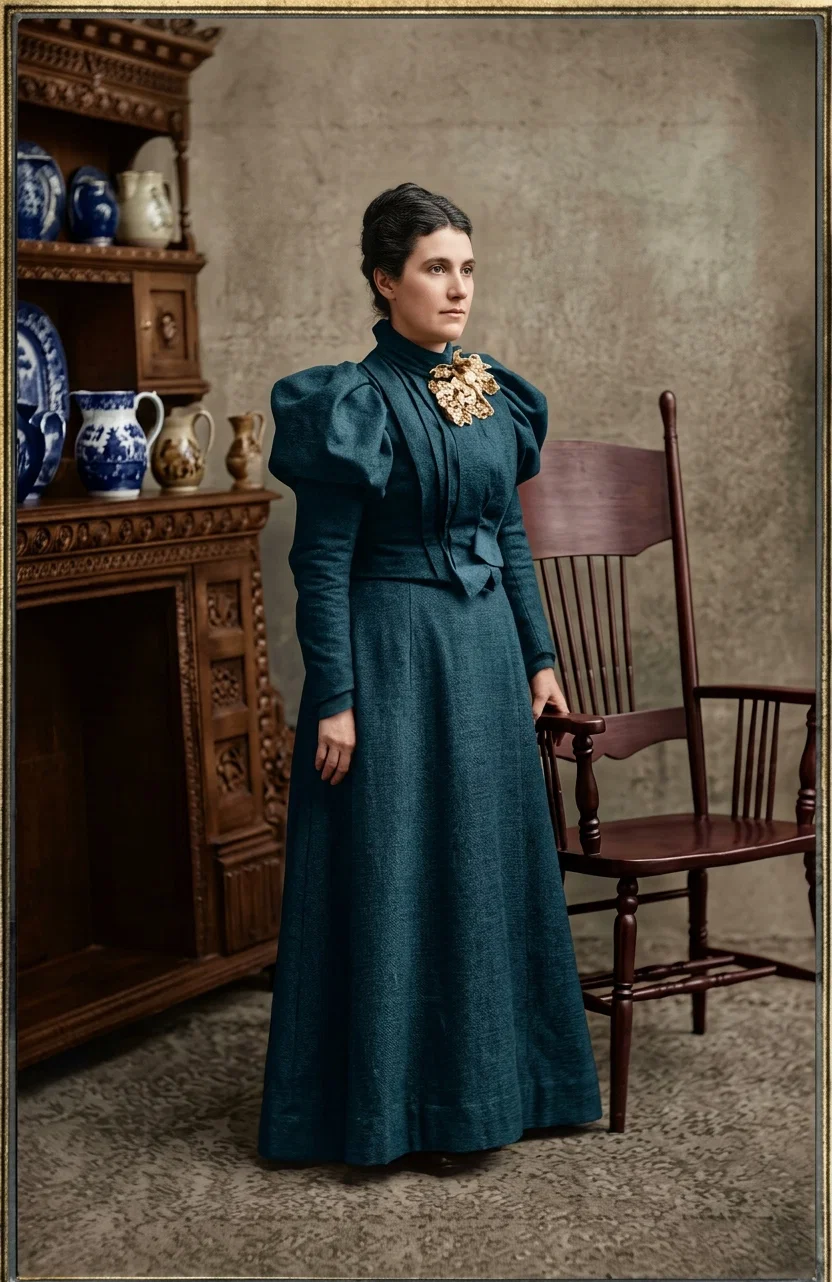
MISS ROSA YOUNG, a native of Pitcairn Island, author of "The Story of Pitcairn."