THE POOL OF SILOAM

8%

Pacific Press Publishing Company · Oakland, California · Oct 2, 1901

FromSigns of the Times, Vol. 27, No. 40.

Read the full edition

THE POOL OF SILOAM.

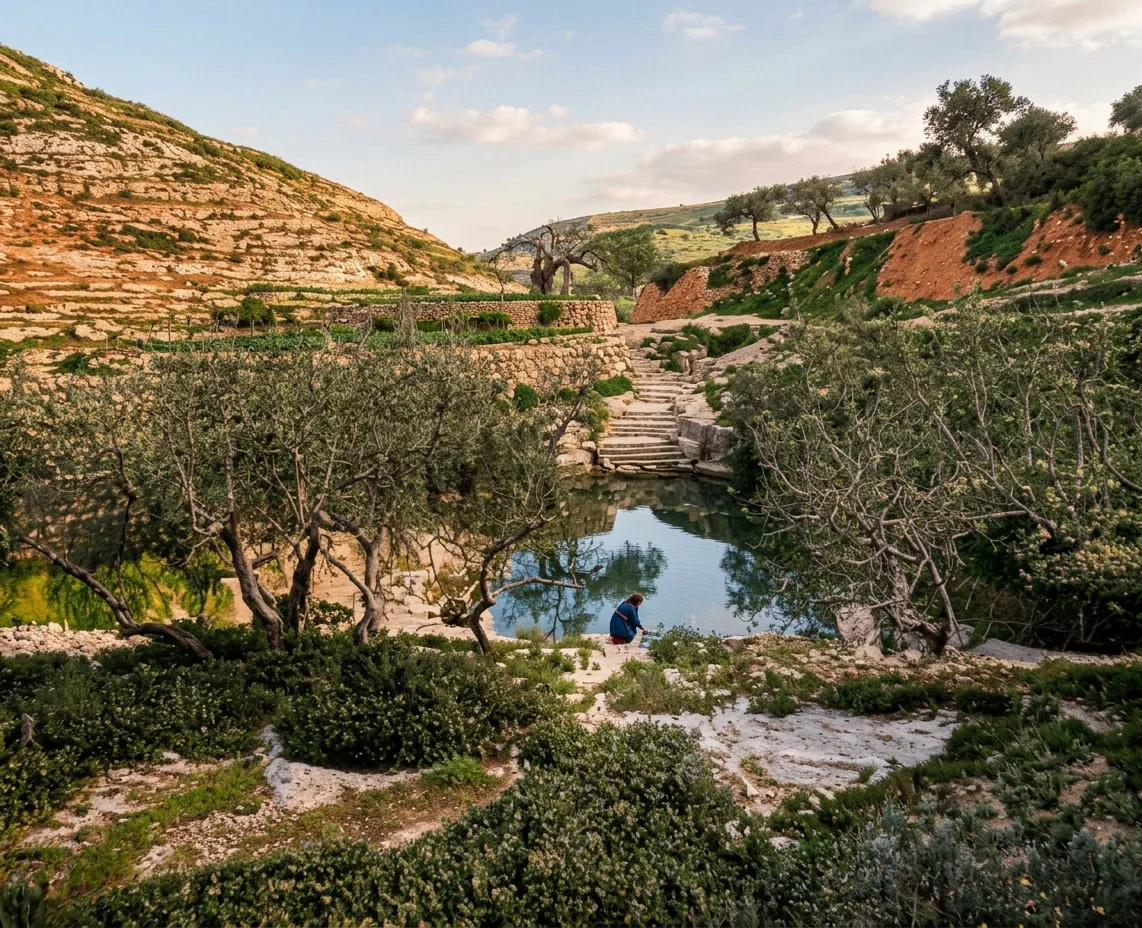
THIS is one of the landmarks of ancient Jerusalem whose location is certainly known. Different authorities speak of the locality as undisputed. It still retains its old name in the Arabic modification, Silwân. Josephus locates it at the mouth of the valley of Tyropœon, and with this Kitto’s Cyclopædia agrees, and adds: “The water flows out of a small artificial basin under the cliff, the entrance to which is excavated in the form of an arch, and is immediately received into a larger reservoir, fifty-three feet in length by eighteen feet in width. A flight of steps leads down to the bottom of the reservoir, which is nineteen feet deep. This large receptacle is faced with a wall of stone.” As the water runs out of the pool, it is utilized in irrigating several gardens in the valley of Jehoshaphat.
SILOAM is the New Testament form, Siloah, or Shiloah, being the Hebrew or Old Testament word, meaning “sent,” or “sending forth.” When the wall of Jerusalem was being repaired by Nehemiah, portions were placed in charge of certain individuals. “The gate of the fountain repaired Shallun the son of Colhozeh, the ruler of part of Mizpah; he built it, and covered it, and set up the doors thereof, the locks thereof, and the bars thereof, and the wall of the pool of Siloah by the king’s garden, and unto the stairs that go down from the city of David.” Neh. 3:15.
ISAIAH refers to Shiloah figuratively, in dwelling upon the apostasy of Israel and their humiliation by the Assyrians: “Forasmuch as this people refuseth the waters of Shiloah that go softly, and rejoice in Rezin and Remaliah’s son; now therefore, behold, the Lord bringeth up upon them the waters of the river, strong and many, even the king of Assyria, and all his glory; and he shall come up over all his channels, and go over all his banks; and he shall pass through Judah; he shall overflow and go over, he shall reach even to the neck; and the stretching out of his wings shall fill the breadth of Thy land, O Immanuel.” Isa. 8:6–8. “Here Shiloah stands for the government of God, and Rezin was king of Syria (not Assyria) while Remaliah’s son was Pekah, king of Israel (called Ephraim in the previous chapter), at Samaria. Refusing the sweet government of God, they invited the overflow of Assyria’s haughty turbulence and destruction.
BUT the Siloam of the New Testament (John 9) is the mostfamiliar name, as most people are more familiar with the New Testament than with the Old. The noted miracle of Christ in restoring sight to a man who had been born blind, by sending him to wash in the pool of Siloam, has indelibly fixed the name in the minds of all believers in the Gospel and its story. But there are some valuable lessons connected with this miracle that are of much greater importance than the locality of the pool, or the present locality of any ancient object of note, however interesting their memory.
WHEN they saw this blind man, the disciples asked Jesus, “Who did sin, this man, or his parents, that he was born blind?” The question was based on two erroneous doctrines: (1) That the blind man had had a previous existence, and (2) that his blindness must have been the direct result of some heinous offense committed in his former state, or by his parents previous to his birth. Either cause was sufficient to place the family under a kind of social ban. Both these doctrines were held among the Jews, but Jesus here exposed the fallacy of both. “Neither hath this man sinned, nor his parents; but that the works of God should be made manifest in him.” Thus it is shown that obscure persons may have the privilege of suffering affliction and thus becoming co-workers with God. Yet there are many poor sufferers among God’s people who imagine that their affliction is a great hindrance to the work. Would it not be better to study how it is possible for even their sufferings to be made a help in the cause? The Captain of our salvation was made perfect through sufferings. Heb. 2:10.
JESUS then proclaimed Himself the “Light of the world.” This being the case, it would be a small matter for Him to give sight to one creature. So “He spat on the ground, and made clay of the spittle, and He anointed the eyes of the blind man with the clay, and said unto him, Go, wash in the pool of Siloam.” Here was a test of the man’s faith, and he had more faith than those who were looking upon him as suffering the judgment of God. “He went his way therefore, and washed, and came seeing.”
THE man soon found, however, that with the blessing of God and faith in Jesus Christ there comes also the opposition of the enemies of Christ. “Yea, and all that will live godly in Christ Jesus shall suffer persecution.” 2 Tim. 3:12. When the people began to inquire about the One who had done such a wonderful work, the jealousy of the Pharisees was aroused. The first point of objection was that the good deed was done on the Sabbath day; therefore He who performed the work was not of God. But others reasoned that a sinner could not do such a miracle. The blind man was asked what he thought of the Man who had opened his eyes, and he promptly answered, “He is a prophet.” His faith was firm. He had suffered blindness all his life for the very purpose of giving this testimony to the power of God through Christ.
THEN the Pharisees pretended not to believe that the man had been born blind, and had received his sight. So they called his parents and asked them about him, and they acknowledged him as their son, and that he had been born blind. But they denied all knowledge as to how he received his sight. They were afraid of the Jews, so they said their son was of age and could answer for himself. They lacked the courage of their son, who not only had received physical sight, but through his faith had been spiritually enlightened as well. Therefore he had no fear of man. The testimony of his parents that he was of age shows that he was at least thirty years old.
THEN the Jews counseled him to give glory to God, for they knew that Jesus was a sinner. But his faith could not be shaken, either by their arguments or their revilings of himself. When they asserted that they did not know whence Jesus had come, this new disciple, just come into the faith, was ready to meet their illogical reasoning. He said, “Why herein is a marvelous thing, that ye know not from whence He is, and yet He hath opened mine eyes. . . . Since the world began was it not heard that any man opened the eyes of one that was born blind. If this man were not of God, he could do nothing.”
WHEN the Pharisees could not meet the truth by their sophistries and ridicule, their next move was to cast out of the synagogue the one who would not acknowledge their learning and authority as superior to all others. Error’s last resort is force, but true faith will not fear what man can do. So the man that was born blind, and was healed by the obedience of faith, became a faithful follower of the Lord Jesus Christ, despite the adverse action of the church that professed to be looking for the very One whom they rejected. Their blindness to the truth and hardness of heart were the result of their having made void the law through their traditions. W. N. GLENN.