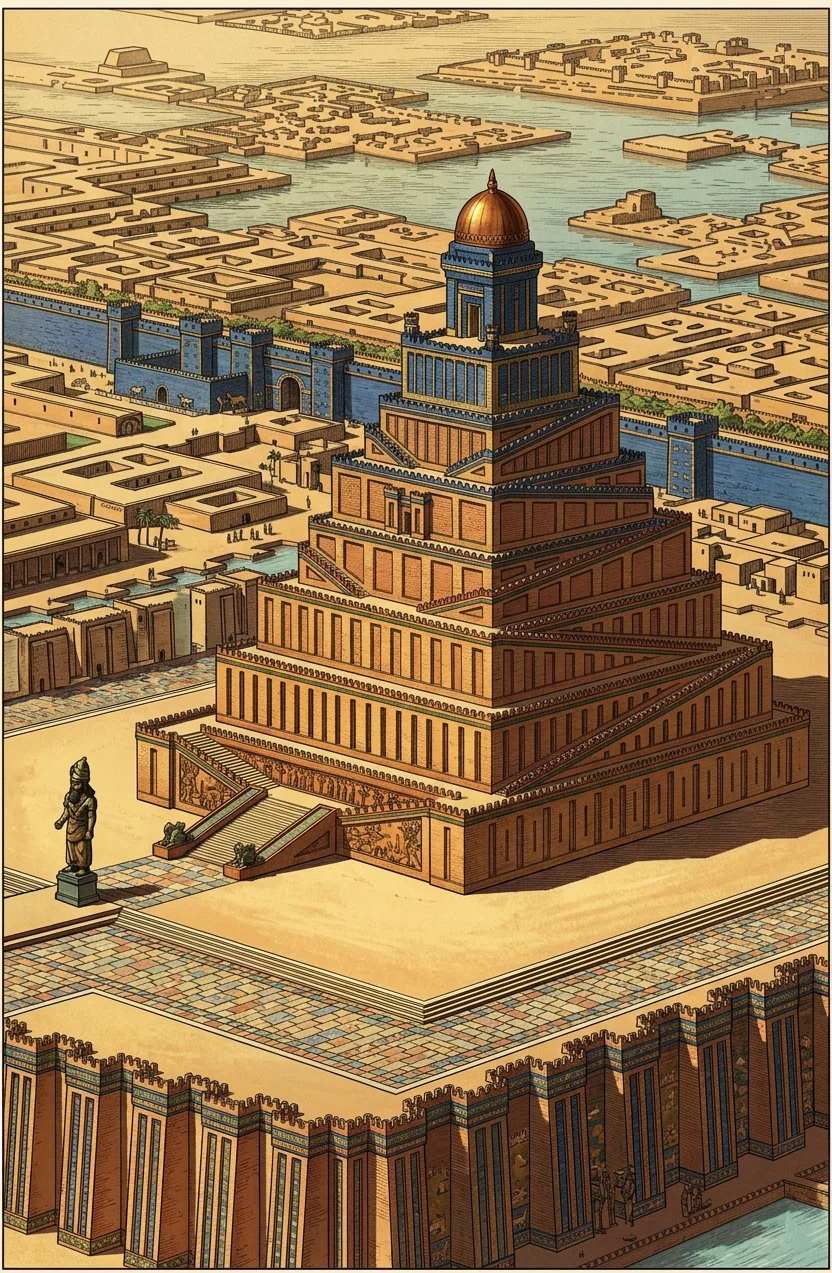
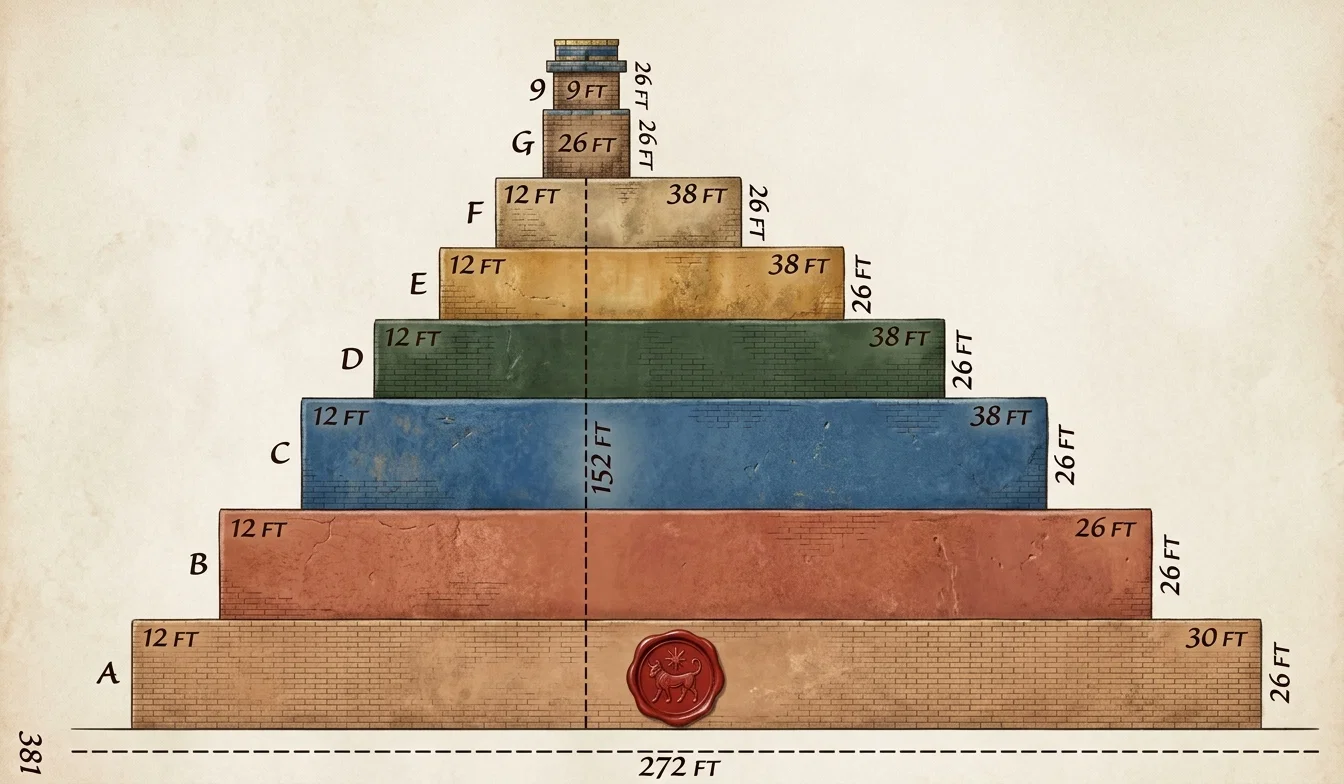
The Tower as It Probably Existed. Restored by Perrot and Chipiez.
A Pavement Slab from Koyunjik, Assyria. This ornamentation is frequently imitated now.
An Ornamental Doorway.
Plan of the Temple at Borsippa (Birs Nimrud), a Suburb of Babylon, thought to be the tower of Babel.
For two weeks we have had before us the study of the first chapter of Daniel. What is its lesson to us? for in behalf of us it is written. “For whatsoever things were written aforetime were written for our learning, that through patience and comfort of the Scriptures we might have hope.” The facts of the lesson were lived in the days of Daniel; they were recorded for the benefit of those who should come after; for those who live in “the time of the end.”
But what is the lesson? It was not written as a mere matter of history to satisfy the curious regarding Daniel’s early life; of the early life of the great Elijah we know nothing. It is not recorded for the mere temperance lesson and the record of a noble purpose. These are instructive. They are, in fact, about all the instruction which the chapter has yet furnished, and the lesson in this respect is precious.
Two Systems of Education.
But the lesson is larger than these. It is the contrast between the results of two great systems of education. The one system,—the worldly, the Babylonian,—showing at its best in the very height of Babylon’s prosperity, with the learning, the opulence, the resources of a mighty empire at its back; the other, God’s plan of education,—a life rather than a system, manifested in seemingly one of the most discouraging times of earth’s history; the people who had upheld it apostate and in captivity to an imperious, haughty nation, the system (if so we may call it) handicapped by its perversions in backslidden Israel, and hindered by the limitations and barriers of apostate, rebellious, and ubiquitously idolatrous Babylon. The Babylonian education manifested under the best condition; the Biblical education manifested in what to all human judgment were as low and mean conditions as would be possible in order that it exist at all. But behold the results. Four youth, whose early years were spent in war-ravaged and famine-stricken and utterly-defeated Judah, surrounded on every hand by corruption and forbidden idolatry, yet doubtless having godly mothers and hearing the prophet Jeremiah, are placed in competition, so to speak, with the brightest and best of Babylonia and surrounding countries. The latter, many in number, fed at the king’s table, cared for by the king’s most trusted servants; the former living in a strange land, environed by the most untoward circumstances, caring for themselves, subsisting on a simple vegetarian fare of pulse and water (“starvation diet,” it would be called by many), yet surpassing all other students in knowledge and learning, and excelling all the king’s counselors in wisdom and understanding! Is there not in this a lesson for the present?
Education To-day.
For what is the worldly educational system of to-day but Babylonian in principle? Let us note some of its most striking defects, recognized by many of the world’s best and most earnest educators.
1. It is a one-sided education, in that it aims largely to develop the mental at the expense (not purposely) of the physical and spiritual. The “cramming” process is in vogue everywhere. Said one prominent writer a little over a year ago:—
Do American men and women realize that in five cities of our country alone there were, during the last school term, over sixteen thousand children between the ages of eight and fourteen taken out of the public schools because their nervous systems were wrecked, and their minds were incapable of going on any further in the infernal cramming system which exists to-day in our schools? And these sixteen thousand helpless little wrecks are simply the children we know about. Conservative medical men who have given their lives to the study of children, place the number whose health is shattered by over-study at more than fifty thousand each year. It is putting the truth mildly to state that of all American institutions, that which deals with the public education of our children is at once the most faulty, the most unintelligent, and the most cruel.—Edward Bok, in Ladies’ Home Journal, January, 1900.
Dr. George H. Martin of San Francisco appeared before a joint session committee of the Senate and Assembly Committees on Education, Jan. 23, 1900, and spoke emphatically against the evils of home study. Among other things he said:—
Every physician has many children under his care, and how many times little ones are brought to us who are beginning to have restless nights, are losing their appetites, growing haggard and old in appearance, with loss of energy and ambition. Upon investigation we find that they go to school at 9 in the morning, stay there until 2:30 or 3 in the afternoon, have numberless exercises and recitations, go home, and at once go to their books and study a good part of the afternoon, then eat their dinner, and have more study at night until bed-time. By that time they are feverish and excited; and when they go to sleep, they are muttering over their lessons, showing very plainly the trouble that is on their minds. Is it any wonder that they soon break down and have to be taken from school, when they can not sleep or eat properly, and have no time for play? This is all during the formative period of life, when the child is growing, and should be storing up energy, instead of using up all that it gains, and even more.—S. F. Examiner, Jan. 24, 1900.
Many others,—physicians, teachers, and parents,—could be quoted to the same effect.
2. It is, to a great extent, an unwise education from a purely worldly point of view. Of what earthly use, to mention but one item, is the effort to fill a child’s mind with the tales of the myths? Children labor for years to obtain a knowledge of that which is no benefit in youth, and which at a later date, if it were ever needed, could be learned in a2short time from a cyclopedia or dictionary. Frequently the myths themselves are greatly perverted in adapting them to the child-mind, and in omitting the salaciousness and obscenity of their characters; and even then the little one gets very deformed ideas of what is left. Fiction falls in the same category, perverting the judgment of the child with distorted and false views of life, and unfitting him to discriminate between the false and the true.
Sacred Tree.
Emblems of the sun and moon from clay cylinders.
It is conceded that there are many who think that the study of fiction with other things of use will assist in developing discriminating judgment on the part of the child, but the conception is false. The same ones would not, in educating their children in art, continually keep before them a mixture or blending of the beautiful and ugly. They would not, in their musical education, continually have sounded into the ear a jargon of concord and discord. Eye and ear in such education would lose their power to discriminate. Even so the child-mind, with its fertile imagination, needs to be educated in absolute truthfulness as far as its parents or guardians can conceive. Let the standards of judgment, of taste, of morals, be of the highest. The man who discerns the counterfeit is the one who knows the ring and the features of the genuine.
3. The education of the day is wrong in that it does not develop the individual. As Harold E. Gorst expresses it in the NineteenthCentury and After:—
Thousands of young men and women are turned out every year by our schools and universities upon an exact pattern, like sausages from a Chicago factory. Each is provided with precisely the same stock of knowledge, and consequently the market becomes overcrowded with an enormous number of workers, all trained to perform the same set of functions.
And this is true; and the effects of it are seen in the multitude of graduates from one school or another who are utter failures. But in God’s method of education there will be developed in the individual all the possibilities of his received talents and ability. The boy will not be considered as a fraction of a class, but an individual soul, having before himself alone in this sphere the complex problem of life to solve—not alone for the present, but for eternity. And the educational effort will be, not to pass “courses,” not to obtain certain meaningless letters to attach to one’s name, but to develop men and women, sons and daughters of the Most High, here and hereafter.
4. It leaves the moral and religious side of the child’s nature untrained. We presume that the great majority of the readers of this article believe in a hereafter. This life is temporal. Beyond it lies eternity. Whatever that eternity is to be to us depends on the characters we form here. The majority of those who will read this are doubtless believers in the Bible as containing the revealed will of God, the Guide Book to the better world. And yet the sad fact is that almost no attention is given in present-day education to the training for that life that measures with the life of God; and ignorance of the Bible is well-nigh universal. The child’s body is fed and clothed. His mind is crammed from every dish of the mental menu of our wonderful school system; but the spiritual faculties, which need and demand instruction, are left to starve and die; and the result is the present conscienceless immorality of commercialism and the wide-spread skepticism of the day.
The remedy for this is a properly-balanced education,—a religious education which shall take into account the self-evident fact that a religion, to be of worth, must possess the whole man and be a motive power in every act of his life.
All this, in a dim sort of way, is recognized by many. In an editorial on the “Sources of Corruption,” the Independent of January 17 declares that,—
The wickedness and bribery and wholesale stealing from tax-payers for the benefit of the few lies almost wholly at the doors of men who move in what are called the “well-to-do,” or “exclusive” circles. It lies at their doors to-day, and it has lain there from the beginning of human government.
These men are those who have received education in the schools of their country,—an education lacking in what the Independent calls “the training of the satisfactions.” It further says:—
Who will show us how to make children learn from actual experience that duty, truth, and honor yield the only satisfactions that stay with us? He will be an educational philosophy worth talking about. When its clear, dry light arises in the moral firmament, the paths of wisdom will be easier to follow than they are at present, under the dancing will-o’-the-wisps of “free election,” and the moonshine of “pedagogy,” both of which too often make worldly success look like the only thing worth living for.
In its issue of May 30, the same journal, under the heading of “The Gospel of Wealth,” refers to the address of Mr. Charles M. Schwab, president of the United States Steel Corporation, before 200 boys in a trade school in New York City, and who set forth himself as “an example of the rewards of right living;” to the address of John D. Rockefeller, the Standard Oil magnate, to a Bible-class of young men, in which he lauded his pleasure of doing good in employing 70,000 men; to Mr. Andrew Carnegie’s book, “The Gospel of Wealth,” and asks:—
What is the effect on the public of this “Gospel of Wealth”? What is the influence of these men of vast fortunes who, on several occasions, have stood forth as examples of right living?
Apart from the means of getting this wealth, assuming them to be entirely legitimate, the Independent answers:—
This influence tends strongly to degrade the common morals. Let them amass their wealth; let them enjoy all the material good this earth permits; let them exert their power for weal or for woe in the markets of the world; but in the name of all that is good and precious to the human heart and imagination, let them not be set up before our young men as the great models of conduct to be imitated. . . . There has been wealth in the land before now; but the riches of these men is so colossal as to obtain an entirely new force. It acts with hypnotic effect on the imagination; it benumbs the senses, and in its vast glitter the eyes are blinded to all the simpler and purer attainments of life. . . . We are stricken down by these men with a delirium of material drunkenness, and they allow us no escape from its fascination.
It is all true, and its spirit dominates popular education everywhere. The education of the world has not protected us from wealth’s engulfing tide; and now that it has assumed the throne, it will not save us from slavery to its imperial demands.
A Sense of Need.
The remedy, the only remedy, is right education and training in religious lines from infancy. As one has expressed it, “The whole man must be educated; the whole man must be trained.” This training must be from the Bible. And men feel this. Professor Huxley, skeptic tho he was, felt it. This is what he says:—
I have always been strongly in favor of secular education, in the sense of education without theology; but I must confess I have been no less seriously perplexed to know by what practical measures the religious feeling, which is the essential basis of conduct, was to be kept up, in the present utterly chaotic state of opinion on those matters, without the use of the Bible. The pagan moralists lack life and color, and even the noble stoic Marcus Antoninus is too high and refined for an ordinary child. . . . By the study of what other book could children be so much humanized and made to feel that each figure in that vast historical procession fills, like themselves, but a momentary space in the interval between two eternities; and earns the blessings or the curses of all time, according to its effort to do good and hate evil, even as they also are earning their payment for their work?
Dr. Lyman Abbott has voiced the same thing in the Outlook recently, and declares that the State should teach the Bible as the history of a people and a religion. But this will not do. It must be taught as it was taught to Daniel and his fellows,—as the eternal, living truth. Taught in this way, souls will see its glorious beauty. They will see God’s hand in history, molding and shaping the nations of earth despite of sin. They will see God working in nature despite the curse. They will long for His creative and regenerative power in them. They will learn how to obtain it. They will see true worth to be more than wealth, faithfulness more than fame, ingenuousness more than ingenuity, purity more than mere power, character more than coin, the service of God and to mankind more than to be served of Him and to rule His creatures. And O, how minds wide opened on the Godward side will expand. In every branch of true science, in every useful occupation, they will excel; and this world will see again, in modern Babylon as in Babylon of old, that those taught of God in “every matter of wisdom and understanding” are “ten times better” than mere secular teaching can produce. Men are needed. This is the education which will make men. It made one man then that served grandly as prime minister under Babylon’s greatest monarch, and was called to the same post, and as effectually served under the3succeeding Medo-Persian dynasty, because he served his God; and if parents will return to God’s method of education, trusting to that alone, unwarped, unpermeated by heathen or medieval tradition, or by an infidel science, it will again make men more precious than the golden wedge of Ophir, or the combined wealth of the world.
The first chapter of Daniel is God’s object-lesson in education, with the world’s education at its best and His education at the worst, with the comparative results. Who will heed the instruction and be taught of God? M. C. WILCOX.