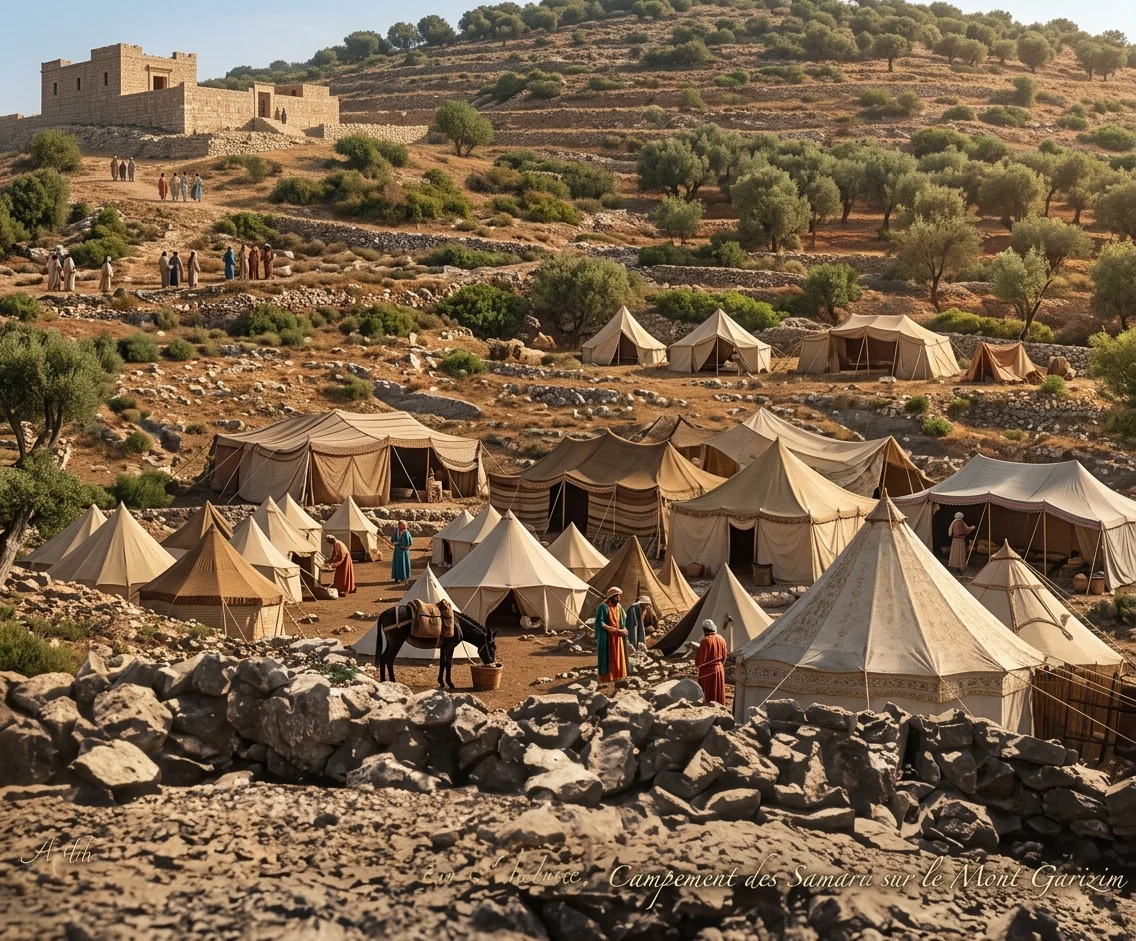
OUR illustration this week is strikingly suggestive. It is from a photograph of a modern encampment of the little remnant of that ancient people, the Samaritans, at Mt. Gerizim.
THE Samaritans were the mixed people brought to desolated Israel by the king of Assyria when the ten tribes were taken captive.
The graphic record is found in the seventeenth chapter of 2 Kings. The half-dozen nationalities and tribes among them had as many gods and numerous images, which they brought with them or made, as convenience and devotion dictated. They mingled this idolatry with the worship of the true God, taught them by an Israelitish priest, who was probably himself a worshiper largely in form. The result was that “they feared Jehovah, and served their own gods,” and so continued. Verses 32–41.
WHEN the Jews came back from their Babylonian captivity, the Samaritans desired to unite with them in the rebuilding of the temple; but on account of their mixed worship, Zerubbabel would have none of it. Ezra 4:1–3. From that time forth there was continual strife between Jew and Samaritan. The Jew considered the Samaritan without hope. The Samaritan hated the Jew because of his exclusiveness and spiritual pride. The Galilean Jew, to escape insult and violence, avoided passing through Samaria on his way to Jerusalem, and a Samaritan in Judea would in all probability have fared little better. The seventy disciples were forbidden to go to Samaria, evidently because their Jewish prejudices were so great that they could not help the Samaritans. It took the great love of Jesus to reach them, who saw in Samaritan as in Jew the purchase of His blood.
UNDER the ministry of Jesus and His apostles, many were converted. They did as the converted Jews,—went out into the great, needy world to save the lost. Of both the world has kept little record; but when God writes up His people, He will place the names of all faithful ones, Jew or Samaritan, American or Chinese, among the true Israel of God.
SINCE the beginning of the Christian era the traditionary Samaritans have rapidly grown less. Vespasian slew 11,600 at one time2because they offended him. Now all that remains of those who still cling to the dead past is a little company of forty or fifty families, represented in our illustration. These, three times a year—at the feasts of unleavened bread, of weeks, of tabernacles—make a pilgrimage to Mt. Gerizim. At the feast of the Passover they still offer sacrifice. A copy of the Pentateuch, very ancient, is possessed by them. Thus much for the people.
MOUNT GERIZIM is the mount of blessing. Deut. 27:12. On the other side of the valley is Mt. Ebal, the mount of cursing. Verse 13. Mt. Gerizim was to the Samaritan a holy mountain, simply and solely because God there at one time pronounced His blessing. The mountain, because of that, was the place of worship. John 4:20. This is superstition, not faith.
FOR all that brings the blessing of God, is God’s presence. All that will insure continued blessing is His abiding presence. And all that will secure His abiding presence is harmony with God, faith in Him, a heart of obedience to do His whole will. God comes with blessing even to the sinful and unjust, to win them to repentance; but if men continually by disobedience turn the channel of His mercies and blessings as selfish hearts will, they pervert the blessings to curses, and drive from them God’s presence.
THE blessings of Gerizim were blessings to the obedient. “All ‘these blessings shall come on thee and overtake thee, if thou shalt ‘hearken [“to observe and to do”] unto the voice of the Lord thy ‘God.’” And then follow the blessings which would shower upon them, which would pursue and overtake them. See Deut. 28:1–14.
THE poor superstitious Samaritans, like many others to-day, believed that the blessing was in Gerizim, in the thing,—the spot, the place. And vainly each year they seek to the thing for the blessing which is not. They offer the sacrifice of the paschal lamb, when the one great Passover is sacrificed once for all. The lesson of Gerizim is that God’s blessing continues to the faithful and obedient. Heeded, it is a growing, flowing stream of blessings, filled with the vitalizing, expanding, beneficent presence of God. If His Word and counsel be rejected, Gerizim becomes as Ebal, the blessings become curses.