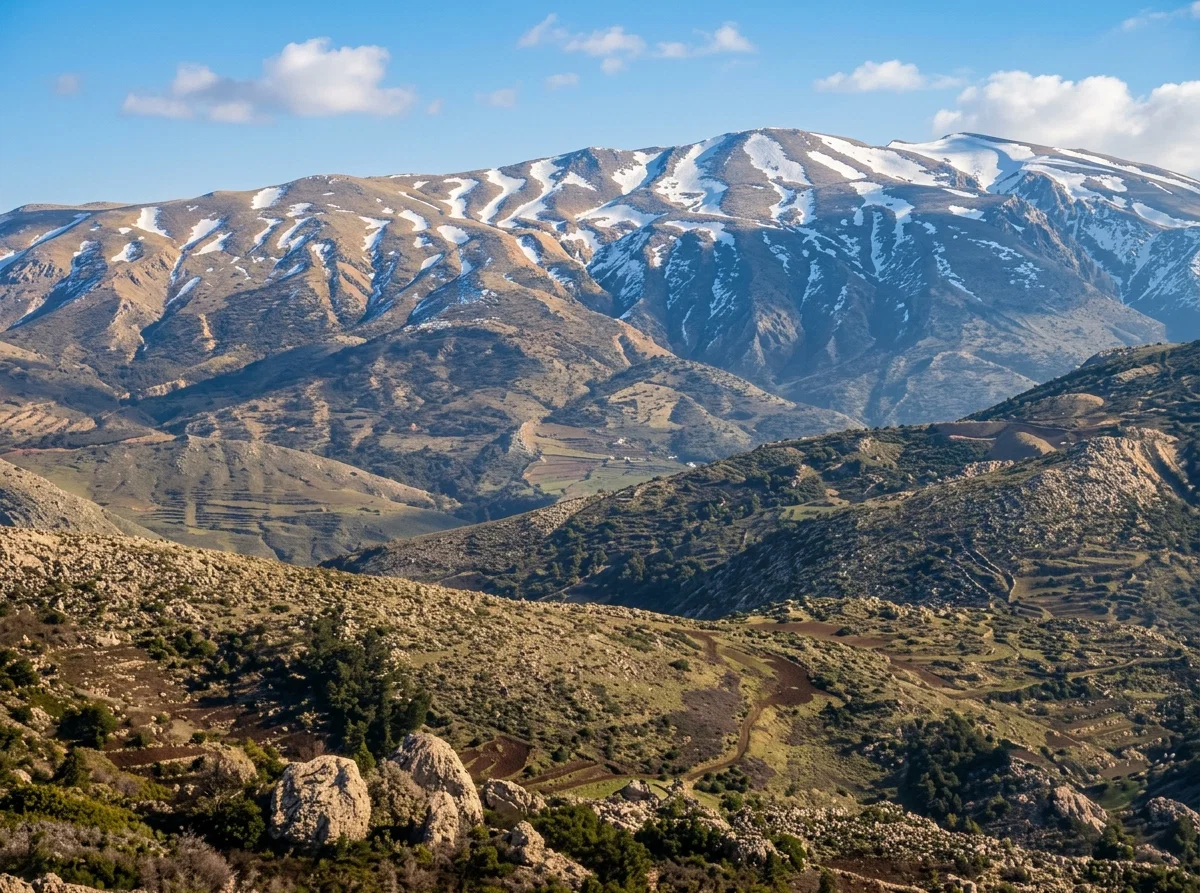
MOUNT HERMON

7%

Pacific Press Publishing Company · Oakland, California · Jun 26, 1901

FromSigns of the Times, Vol. 27, No. 26.

Read the full edition

MOUNT HERMON.

ON the east side of the Jordan Valley, at the southern extremity of the Anti-Libanus range, Mount Hermon lifts his hoary head into the air more than 9,000 feet above the level of the Mediterranean.
MOUNT HERMON.
MOUNT HERMON.
THIS lofty mountain, the highest in Palestine or its immediate vicinity, is situated on the northern border of the tribe of Dan. It was anciently a political center; for here converged the great ancient kingdoms of Syria—Bashan, Damascus, Phenicia, Israel.
HERMON is also “a grand central point in the geography of Syria and Palestine. From it radiate all the most noted rivers—the Jordan, whose fountains are fed by its eternal snows; the Abana and Pharpar, ‘rivers of Damascus;’ the Orontes, which swept past the walls of the classic and ‘Christian’ Antioch;” and the Leontes, tumbling over rocky precipices as it hastens thru its deep-cut channel to the sea.
“THE high mountains and the hills” were chosen by the ancient Canaanites as their places of worship; on these they erected temples and shrines to Baal, their sun-god. Mount Hermon and its vicinity abound in ruins of this character. On a rock that forms the crest of one of the peaks are curious and interesting ruins, including a small temple and fire-altar. These ruins are in a most picturesque location, on the brow of the mountain, overhanging a deep glen in which are the sources of the Pharpar. On the mountain and in its vicinity are the ruins of many other temples. These ruined temples indicate that Mount Hermon, the crown of “Lebanon toward the sun-rising,” was a center for the sun-worship of primeval Syria. “The glorious view obtained from it of the sun’s course, from his rising in the eastern desert to his setting in the great sea, would naturally mark it as the most fitting locality for his chief worship.”—Kitto, Cyclopedia of Biblical Literature.
MOUNT HERMON is not a single peak, but a cluster of mountains. From the central cone, which is itself divided by depressions into three distinct peaks, radiate a number of lofty ranges; but from a distance the mountain appears to form one great cone. So there is appropriateness in the psalmist’s words, “I remember Thee from the land of Jordan and the Hermons.” Ps. 42:6, R.V. One of its southern spurs is called Abu Nady, “the father of dew,” reminding us of the psalmist’s comparison, “As the dew of Hermon.” Ps. 133:3. A traveler says he encamped two nights at the base of this mountain; and “his tent was as completely saturated as if heavy rain had fallen.”
A NATURAL landmark of great beauty and interest is this loftymountain. In the clear air of Syria it can be seen from many places among the mountains and plains of Moab, Gilead, and Bashan, and from nearly every prominent point in Palestine, appearing as “a pale-blue, snow-capped peak, terminating the view on the northern horizon.” No doubt Moses saw Mount Hermon when from Mount Nebo, “that is over against Jericho,” “the Lord showed him all the land of Gilead, unto Dan.” Excellent views of the mountain are obtained from the plain of Esdraelon, on the borders of which Nazareth was located; and so to the Saviour it must have been a familiar object from His earliest years.
ONCE the Saviour visited Mount Hermon; for Caesarea Philippi, the northern limit of His journeying, nestles at the foot of one of its southern ridges, or, rather, is built on a broad terrace on the mountain-side, overlooking the rich plain of Huleh. It was near the close of His ministry that Jesus came here with His disciples. He was anxious about them. He knew the time was near when He should be offered up, the Sacrifice for the sins of the world; and notwithstanding all the instruction He had given them, they did not understand that His kingdom was not of this world. They still looked for Him to establish an earthly kingdom; how, then, would their faith stand the test that was so soon to come?
WHILE they were in this region of grand and picturesque scenery, the mountain with its rocky cliffs, its deep ravines, and its temple-crowned, snowy peaks in full view, Jesus had a memorable conversation with His disciples. “Whom,” He asked them, “do men say that I the Son of man am? And they said, Some say that Thou art John the Baptist; some, Elias; and others, Jeremias, or one of the prophets.” Then followed the important question, “But whom say ye that I am?” It was Peter who replied, “Thou art the Christ, the Son of the living God.” Christ indorsed Peter’s words, and declared, “Upon this rock I will build My church; and the gates of hell shall not prevail against it.” Matt. 16:13–18.
In this great political and religious center, evidences of power were all about Christ and His disciples. Above the town frowned the almost impregnable walls of the Castle of Banias, which from its rocky height for centuries commanded “the pass from the Huleh and the plain of Jordan over Hermon to Damascus and the East.” All around them were temples of Syrian, Greek, and Roman deities, each an evidence of Satan’s power to enslave the human mind with the fascinations of a false worship. There, too, stood the mountain, grander, stronger, and more enduring than any work of man. And there was “the Christ, the Son of the living God,” infinitely strong. Thru Him His church should be victorious over every enemy, human or Satanic. Would His disciples trust in Him when His cause seemed ruined?
THE faith of the disciples faltered in the test. It faltered; but it did not fail. Once, when some were offended, and leaving Him, Jesus had asked, “Will ye also go away?” And they had replied, “Lord, to whom shall we go? Thou hast the words of eternal life.” So it was now. To whom should they turn from Him whom they had believed and known to be “the Holy One of God”? John 6:67–69, R.V. Since that time the church founded on the Eternal Rock has had many fierce conflicts to pass thru; but its banner has never trailed in the dust, nor will it ever. The gates of hell shall not prevail.
“O Lord God of hosts, Who is a mighty One, like unto Thee, O Jah? And Thy faithfulness is round about Thee. Thou rulest the pride of the sea; When the waves thereof arise, Thou stillest them. Thou hast scattered Thine enemies with the arm of Thy strength. The heavens are Thine, the earth also is Thine; The world and the fulness thereof, Thou hast founded them. The north and south, Thou hast created them; Tabor and Hermon rejoice in Thy name.” Ps. 89:8–12, R.V.
E. J. BURNHAM.