THE LIVING WATER

10%

Pacific Press Publishing Company · Oakland, California · Jul 17, 1901

FromSigns of the Times, Vol. 27, No. 29.

Read the full edition

THE LIVING WATER.

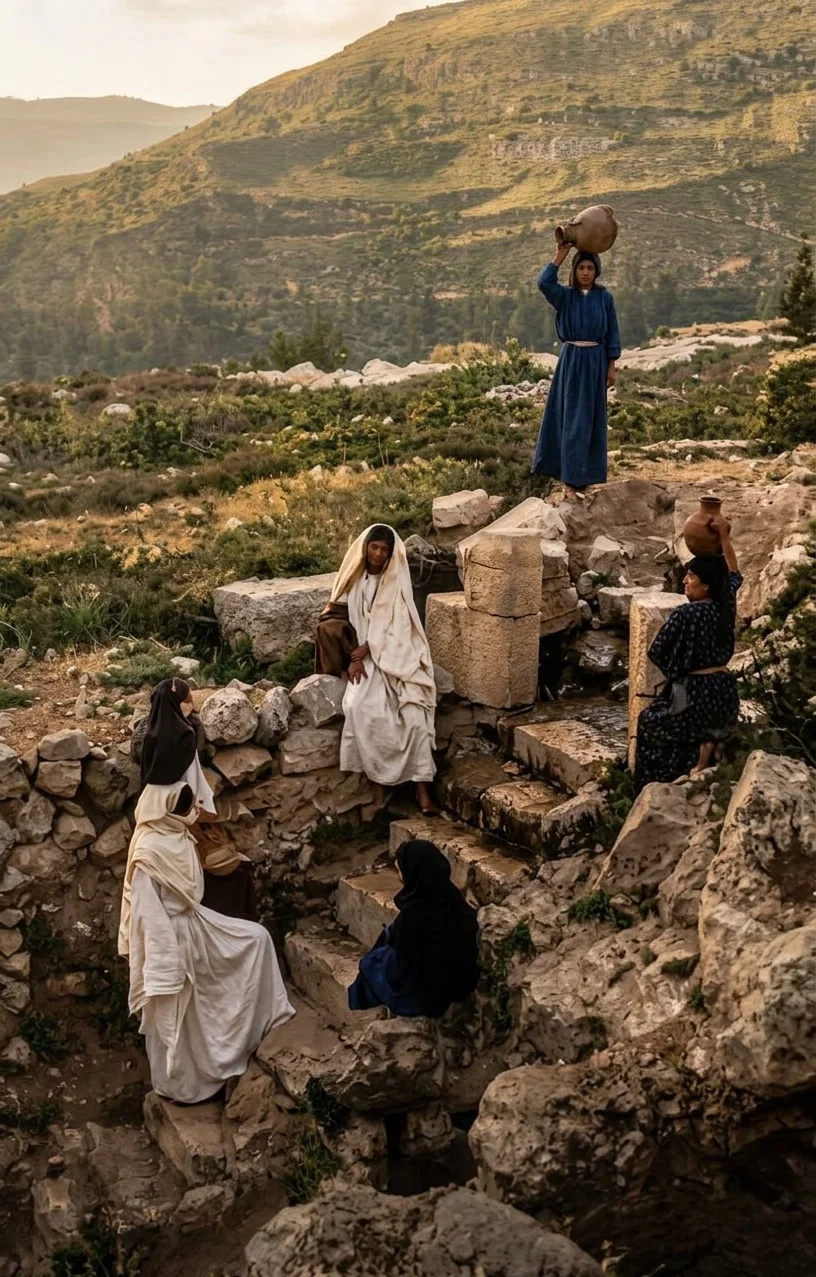
OUR illustration is strikingly suggestive of a beautiful lesson. The picture is that of women coming to draw water from a well near Nablus, the more ancient Neapolis; in New Testament times Sychar, and, further back, Shechem. It was in this vicinity that the son of Isaac opened a fountain, long afterward known as “Jacob’s Well.” And it was to just such a well as this, perhaps to the same well, that the woman of Samaria came to draw water in that long-ago noontide heat, and found sitting near a weary Jewish Traveler and Teacher. John 4:4-42. Customs change but little in Oriental lands, and women come from the city now as of old to draw water.
Women at a Well in Samaria.
YET how little many of them know of the great Teacher and His lesson. How few in that once favored land know aught of His precious teachings, other than the glossed and perverted form in which His lesson has been clothed. Jacob’s Well is now a place of pilgrimage; thousands seek it out, but receive from it no more benefit than have the majority of those who have drawn water from its store during the centuries since He sat by its brink and asked for a draught.
WONDERFULLY did the great Teacher enlist the woman’s interest. He asked her to do something for Him,—“Give Me to drink.” It was a strange request for the separated Jew to make of an outcast Samaritan. Jesus does not stop to argue the matter, or to justify Himself, in response to the woman’s question. He forthright tells her that the asking should have been reversed; she should have asked of Him, and He would have given her living water. But this does not pierce the gross materialism of the woman’s life. She reasons that the Stranger must get His water from that well, and how could He do it when He had nothing with which to draw it forth? She saw only with physical eyes.
JESUS replied again: “Every one ‘that drinketh of this ‘water shall thirst ‘again; but whoso‘ever drinketh of the ‘water that I shall ‘give him shall ‘never thirst; but ‘the water that I ‘shall give him shall ‘become in him a ‘well of water spring‘ing up unto eternal ‘life.” God’s Spirit is that water. The drinking is yielding to that Spirit absolutely, and receiving it from the great Fountain of life. It not only heals and vivifies the heart, but it makes that heart a fountain of refreshing to other hearts, a place where the weary may become refreshed. It opens the whole being to God, and all thirst for other fountains, other water, is forever quenched. Even the material liquid will be used as life from the great Giver of all.
BUT persistently the woman saw in it only physical benefit. “Sir, give me this water, that I thirst not, ‘neither come all the way hither to draw.” The wise Teacher takes another tack, and opens by an adroit question the way to the woman’s inner life, thus showing her her great need. Then, either because she knew no better, or because she did it to avoid further revelation of her past life, the woman raised the century-old controversy of salvation between Gerizim and Jerusalem. “‘What about it? Does salvation ‘come by the way of‘Gerizim, the Mount of Blessing?’ The only thing that makes holy or blessed is the presence of God, which both Jew and Samaritan had banished.
JESUS is not there to argue for mere place or time or ceremony, and what a lesson it should be for His servants! He wanted her to learn her soul’s great need; all minor matters could wait, and His words come ringing down the centuries to us, as full of life and truth as when the Master spoke them: “Woman, believe Me, the hour ‘cometh, when neither in this mountain, nor in Jerusalem, shall ye ‘worship the Father.” God is not confined to particular places. He uses them as long as they will serve His wise purpose, and no longer, and Jerusalem’s day was soon to close. Turn from the material, the man-made, the earthly.
HERE is acceptable worship, carrying with it the twofold assurance of what is evidentially true and what is pleasing to God: “Ye ‘worship that which ye know not; we worship that which we know; ‘for salvation is from the Jews. But the hour cometh, and now is, ‘when the true worshipers shall worship the Father in spirit and ‘truth; for such doth the Father seek to be His worshipers. God ‘is a Spirit; and they that worship Him must worship in spirit and ‘truth.” Not alone must the life-power be present, but the life must be that which shapes its course in harmony with God’s revealed truth. There are thousands who cry, “We have the Spirit,” yet who ignore the truth of God’s Word. Let those who abide by the Word fear lest their loyalty degenerate into adherence to a mere form of words. In the true life, both the Spirit and the truth bear equal sway. The Spirit works according to truth; it is the “Spirit of truth.”
WHETHER the woman gave Jesus to drink, we know not. It would almost seem from the narrative that she did not; but perhaps she did at once, asking her question afterward. At any rate, the Master gave to her from the great fountain of His life and love. He found refreshment from His own weariness in ministering to the woman. He sowed there, by means of simple, wayside-incident seed, the crop which was reaped by His disciples on the other side of Pentecost. Acts 4:4-8. Jesus might have said, “I am weary; why should I ‘talk with this strange woman who is not even seeking spiritual ‘things?” But there was an opportunity, God-given, and He purchased it at the cost of physical rest. So God desires His children to look “carefully how ye walk, not as unwise, but as wise; buying ‘up the opportunity [margin], because the days are evil.” Eph. 5:15, 16. So shall they not only find life, but be themselves wells of life-giving water.