IN JAPAN

7%

Pacific Press Publishing Company · Oakland, California · May 22, 1901

FromSigns of the Times, Vol. 27, No. 21.

Read the full edition

IN JAPAN.

WHILE I was in the United States, Japan made great progress in all directions; but what has most astonished me is the lack of advancement in the cause of Christianity. Indeed, many churches which were once prosperous are now desolate and powerless. Not long since, an elderly Christian friend complainingly remarked to me that six or seven years ago the interest to hear the Gospel was so great that her church was filled to overflowing, and even twenty-five or thirty would be found in the house-to-house prayer-meetings, where old and young would testify of the love of God or offer up fervent prayers in the name of His Son. The entire church was in a blessed spiritual condition. But now the church attendance is very, very small, and only a few come to the ladies’ prayer-meeting. This is a sad downfall, and there must be some cause for it.
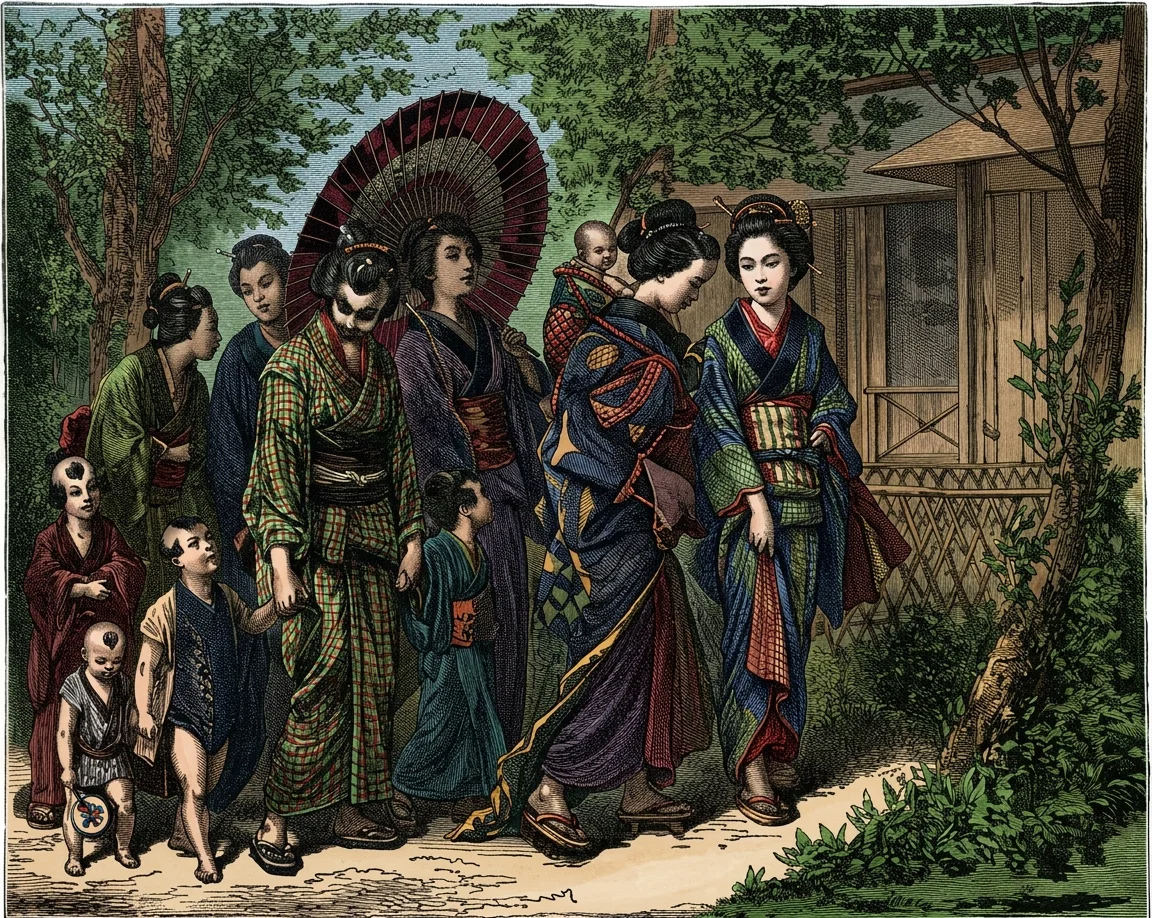
Japanese Women Visiting.
In view of the large sums of money spent in the propagation of the Christian faith, and considering the number of missionaries devoted to the work, it seems that the Japanese field is somewhat discouraging, since there is so little visible fruit. Some might think my people quite indifferent in religious matters, but this is not the case. It is true that the upper and educated classes are inclined to regard religion as the toy of the unlearned, but the masses are very pious. Those who should be leaders and educators in the nation entertain such shallow views that their writings are not noble. They breathe the spirit of hypocrisy and vainglory. They hold forth no high spiritual ideal. And the stronger their influence over the common people, the worse off will be their spirituality.
In this land may be witnessed examples of devotion that would put to shame many professed Christians. For instance, in the East Hongan temple are fifty ropes made of the hair of Japanese women, to assist in lifting the timbers used in the construction of that building. These cables of human hair vary in size, ranging from fifteen to thirty-five feet in length, and from four to fifteen inches in circumference. The making of the ropes required a sacrifice, for Japanese women take special pride in their hair. The other day I read of a poor old man who walked from his home to Kyoto, because he wished to save car-fare; but he offered hundreds of yen to the temple, altho it had probably cost him long years of hard labor to save the amount. These things are not rare here. This spirit of self-sacrifice will make good Christians of those who will but turn to the Lord. Catholicism, under a leader none other than the famous Xavier, accomplished great things three centuries ago. When bitter persecution broke out against the converts to the new faith, they died glorious martyrs, and the pope honorably recorded their deeds in the history of Catholic missions.
The Japanese in general are too religious. They are superstitious, overcredulous. “Even the head of a sardine, by faith,” is one of their proverbs; that is, even the head of a sardine, if worshiped by faith, will give us some power.
If such devotion is manifested in these respects, why will they not accept the Gospel?—Because they do not test the truthfulness of it; they know it only as a thing hideous and detestable. After the persecution above referred to, the Tokugawa government did everything possible to root up its seeds, and Christianity came to be regarded as magic and sorcery. Had it not been for that unfortunate occurrence, it is quite probable that Christianity would have entered this country along with the customs and inventions adopted from civilized nations, just as Buddhism and Chinese literature were introduced at a very ancient time. Altho the government was not in favor of the reception of the Gospel, yet it was obliged to tolerate it, or incur the ill-will of civilized powers. But with European culture came the bad as well as the good.
At one time Christianity seemed on the verge of success. It began to attain popularity. This was the very time when the followers of Christ should have been on guard: “Let him that thinketh he standeth take heed, lest he fall.” But they thought everything would be all right. The discouraging policy of the government, conservatism, the war with China and the vainglory after conquest, mammon worship, and Epicureanism have tended to block the advance of the Gospel and promote the downfall of Christianity. Young men and women in whom the churches hoped to find earnest pastors and evangelists, have been carried down in the whirlpool of social degeneration; many eminent Japanese preachers have become men of the world; and the majority of the people remain unbettered and unenlightened by the Light of men. Their present condition is very deplorable.
However, it would be unjust to the Japanese to heap upon their heads all the blame for this state of affairs, since many of their vices have been brought in with Western learning and advancement. Japan is, perhaps, taking the worst part; for she grasps at the husks of civilization, and rejects its life, its Christianity. But that our country puts no great premium on Christianity is not without reason. Behold the Western nations in their dealings with the Filipinos, the Boers, and the Chinese. And yet they boast of their Christianity. What influence will they exert over Japan, who is misinterpreting Christianity by their actions?
Withal the present condition of Japan is not at all disheartening to the faithful Christian worker. Now is the harvest time; but if we labor faithfully and patiently, a large field will open to us. To-day, by the terms of the new treaty, any missionary can go anywhere throughout Japan, and will have access to the common people, who are much more promising subjects for the Gospel worker than the higher ranks of society. We must go to the poor and the needy, to the unlettered and uneducated. If we are faithful and manifest practical Christianity, we shall surely win the people for Christ. Japan leads the Orient, and missionary success in this country will give prestige to the propagation of Christianity in Korea and China. I quote from a Japanese lady:—
“Japan, as a nation, has been given the noble privilege of being the first to receive and interpret the civilization of the West. Standing at Asia’s gateway, the task assigned her seems to be to open her mind to Western ideas, to assimilate them, and then give them to her sister nations in a more or less modified form. Christianity, like many other gifts from the Occident, must first be studied and reducedto its fundamental elements by minds other than European, before it can be comprehended by the Asiatic mind. It often comes in forms too highly colored with Western modes of thought for our ready appreciation. It stands to reason, therefore, that we can approach our Korean and Chinese sisters, as well as our own in Formosa, with better facility, perhaps, than our Western sisters. We shall have to seek them in their own homes, as we have been sought in ours, and give them our truest and best—in short, give them, in our turn, what has so freely been given to us. We must remember that we have many things in common—our literature, our social customs, etc., which ought certainly to be a bond between us to prepare the way for mutual understanding.”
These words were written with reference to the work among the women, yet the principles adduced are of universal application.
We hope that, thru the blessing of God, the time will come when our work will grow, and many laborers will be raised up here to spread the truth in Japan and in China and Korea. But this can not be unless we are faithful, and our American brethren and sisters co-operate with interest and earnestness.
S. HASEGAWA