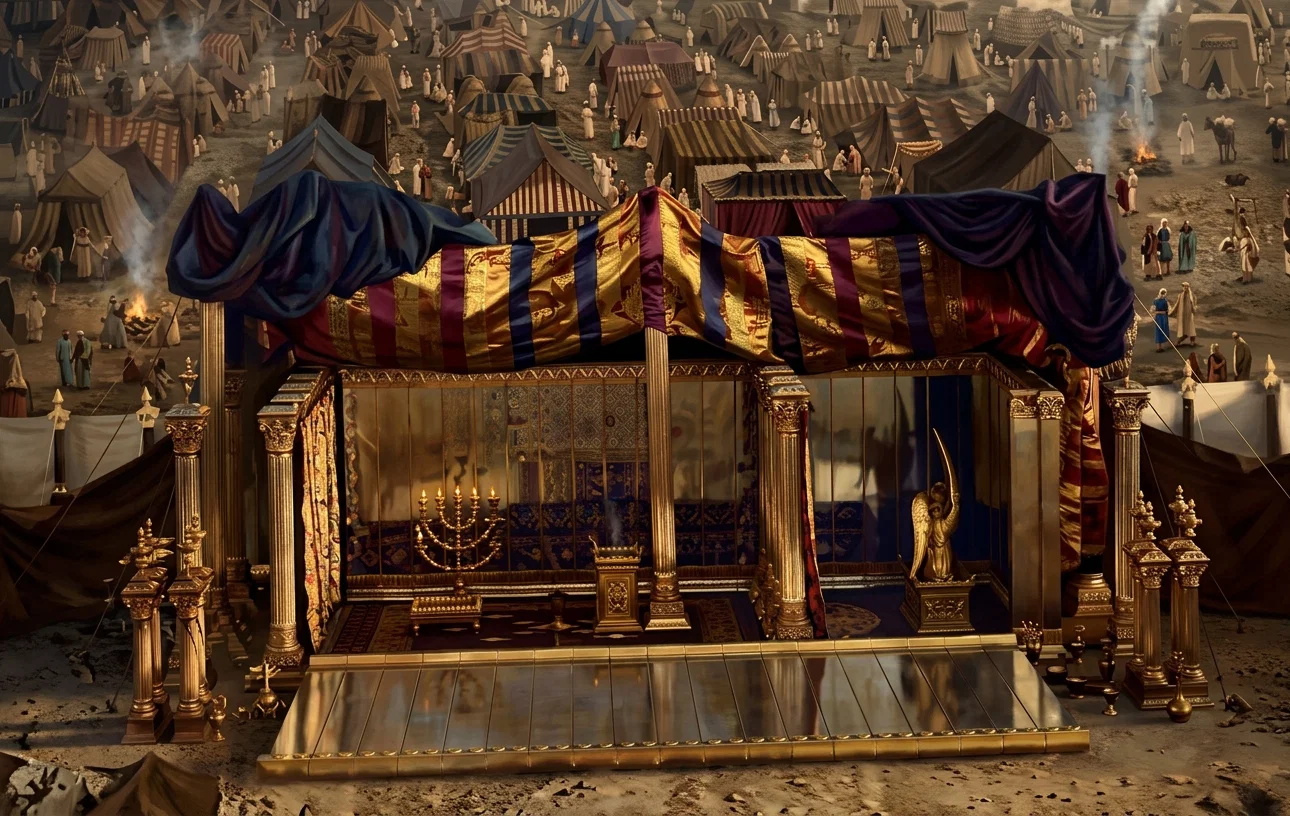
The Sanctuary, with Side Curtains Lifted So that its Interior Arrangement and Furnishings May Be Seen.
ON the way to consider at length the arrangements of the most holy apartment of the sanctuary, we may halt for a moment before the curtain which divides between that and the holy place. Just before the central division of this curtain, called the “second vail,” stood the altar of incense. It was built of wood, was eighteen inches square and three feet high, and was overlaid with gold. Ex. 30:1-6. Every morning when the lamps were trimmed and filled, and also at evening when the lamps were again cared for, an incense, finely compounded of sweet-smelling spices, was offered upon this altar by the high priest. Verses 7, 8.
The incense was offered by laying it on coals of fire held in a censer, which produced a cloud of fragrant smoke. Eze. 8:11. This was the daily method of approaching God in morning and evening worship. The cloud was to separate between Him and the priest while God was being addressed and blessed. Ps. 141:2. In time, however, because of the idolatry of Israel this service became meaningless so far as the worship of Jehovah was concerned, and word was sent to them that the performance of the act was as tho the one doing it blessed an idol. Isa. 66:3.
After the return from Babylonian captivity, the true service of God was largely restored, and this part of the ceremony recovered its lost significance; so that in the days of the priesthood of Zecharias, the people all united their prayers with the ascending smoke of incense. Luke 1:9, 10. That this was the original design of incense-offering is made clear from the fact that since Jesus became our High Priest in heaven, an angel has been seen to offer incense in the heavenly temple when presenting before God the prayers of His people. Rev. 8:3, 4.
As before learned, the “second vail” was drawn across the sanctuary to separate one-third of the building in the rear from its front part. The reason for having two apartments becomes apparent at once upon learning the use to which the rear, or inner apartment, was devoted. In this place was kept the sacred ark, which contained the law of God, the ten pillars of His eternal government. Deut. 10:4, 5. The lid of the ark, which also covered the Ten Commandments within it, was known as the mercy-seat, because it was constituted the throne of the God of mercy, and was the point from which heavenly commandments were spoken to the tribes of Israel. Ex. 25:21, 22. No common priest, daily ministering in the first apartment, was permitted to come into such a presence, hence the second vail. Heb. 9:3-7. Even the high priest could not enter the second apartment at will, but must time his visits there according to the heavenly regulation of the sanctuary service, under penalty of death. Lev. 16:2.
The entrance of the high priest into the most holy place was marked by the most solemn ceremony of the whole Hebrew year, as we shall have occasion to note in a later article. It is enough now to say that in his service there he appeared for all Israel, in the closing work of their yearly atonement, to sprinkle its blood before and upon the mercy-seat, in presence of the shekinah of God’s glory, which shone from between the cherubim on the golden throne of mercy. Ex. 25:18; Lev. 16:15.
Christ having passed into the heavens as our great High Priest, and become a minister before the ark of Ten Commandments there (Rev. 11:19), we may now enter the “holiest” place thru a new2 (306)and living way, that is, thru the vail of His flesh, which has opened the door to the throne of mercy for all. Heb. 10:19-22.
Jesus having entered the holiest place of the heavenly sanctuary, there to make atonement for sin, He becomes our forerunner there, to prepare the way for us to be represented at the throne of mercy. Our hope, therefore, enters into that which is “within the vail,” even to Jesus, the eternal One; and so hope becomes to us a sure and steadfast anchor, because it is fastened there before the mercy-seat of God. Heb. 6:19, 20. It is because of this fact that we have boldness to come to the throne of grace, expecting mercy from Him who sits on the mercy-seat. Heb. 4:16.
If every professing Christian could realize his privileges under this arrangement, there would be more intelligent and cheerful service rendered to God. There would be less complaint of roughness, and less discouragement along the way. But all might know the full hope and even comfort of the Christian’s path, if they would study more the heavenly Guide-book. Without the knowledge it contains, every one must perish; and the enemy of souls will surely do his best to prevent any from gaining this knowledge, if in no other way, by loading them with care and anxiety concerning the things of this life. Matt. 13:22. Let all beware of Satan’s devices.