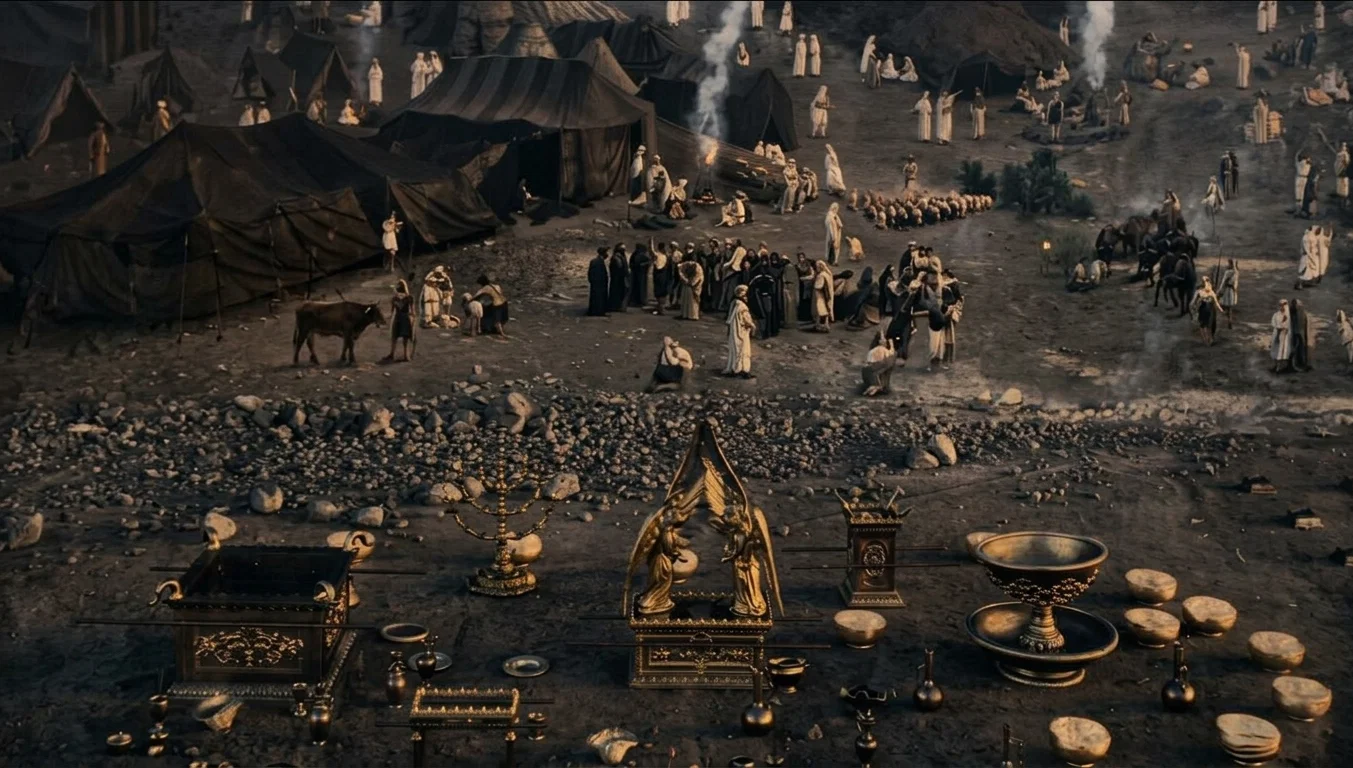
The Hebrew sanctuary was divided into two apartments. This was done by stretching a curtain from side to side, thus dividing the space within the building into what were called the holy and most holy places. Ex. 26:33. The Bible does not definitely state the dimensions of these two apartments; but by reference to a description of the temple sanctuary, which succeeded the one built in the wilderness of Sinai, it is seen that the most holy place in it was a perfect cube. 1 Kings 6:20. It has been concluded from this that the corresponding apartment in the first sanctuary must have been in the same proportion. As the earlier sanctuary was fifteen feet in height and width and forty-five feet in length, this would require the most holy place to occupy fifteen feet of the rear end of the sanctuary, and the front apartment, or holy place, thirty feet.
The Various Articles of the Sanctuary Furniture Shown in the Foreground.
The larger, which was the outer apartment, had, as furniture, a table, which stood at the north side of the room just inside the door; a seven-branched candlestick stood directly across the way, close to the south side of the apartment, while in the back part of the room, and in the center, stood the altar of incense. Back of the second vail, or curtain, and in the center of the most holy place, was located the ark, containing the Ten Commandments engraved in stone. Ex. 40:20-26.
The table in the outer apartment was to hold what was called “showbread.” This consisted of twelve large cakes, baked from fine flour, and arranged in two rows of six cakes each. Each Sabbath morning the stale cakes were replaced by fresh ones, and the priests ate the discarded bread. Lev. 24:5-9. These cakes were for a memorial, to turn the minds of the people toward the goodness of God in providing for the tribes. The loaves, twelve in number, indicated that every tribe was to be individually looked after in the way of heavenly sustenance. Being freshly placed in position every Sabbath morning, they were also a pledge of renewed blessings from heaven on that best day of the seven, to be continued all thru the week. But beyond all this, these loaves kept in mind the promise of that Bread of God's life, who was yet to come and restore all things. John 6:33-35, 51, 56. It was truly bread thru which God was revealed to the Hebrew nation, hence was appropriately named “showbread.”
To make the candlestick, or lamp, required a talent of pure gold, which was nearly twelve pounds Troy weight. It consisted of a main stock, with six branches, extending outward, and gracefully rounding upward from two sides to the same height as the main stem, all being similarly ornamented. Each of these was crowned with a bowl for the reception of oil, which was to be kept burning perpetually. Ex. 25:31-33; 27:20.
The practical significance of the sanctuary candlestick can not be overestimated. Christians are now called temples of God. 1 Cor. 3:16, 17; 6:19. Jesus, the light of the world (John 8:12), thru the constant exercise of faith, is expected to have His abode with these. John 14:1-3, 16, 17; 17:23. This constitutes each believer a light in the world. Phil. 2:15. It is the duty of every one, as the curator of his personal temple of the Lord, to keep the lamp supplied with the oil of grace and gladness, that his light may not grow dim. As God produced the source of supply for the pure olive-oil burned in the Hebrew sanctuary lamp, so now He liberally provides a constant supply of material with which to keep the Christian's lamp ablaze.
This assurance is found in the vision of Zechariah. Looking down the stream of time thru prophetic eyes, he saw an olive-tree on each side of a candlestick, which emptied oil of itself thru a golden pipe, or tube, for the supply of the candlestick. Upon inquiry as to the meaning of this singular sight, the prophet was informed that2the two olive-trees represented “two anointed ones [sons of oil, margin] that stand by the Lord of the whole earth.” Zech. 4:11-14.
So, then, fresh supplies of heavenly oil from God come constantly to every one whose vessel is ready to receive it, conducted thru the golden tube of communication which has been established between heaven and earth. The Lord Jesus is said to walk in the midst of the seven golden candlesticks (Rev. 2:1), as tho He would supply them with material for light. But He says to those who have ceased to care for the light within themselves, “Remember therefore from whence thou art fallen, and repent, and do the first works; or else I will come unto thee quickly, and will remove thy candlestick out of his place, except thou repent.” Verse 5. Surely grave responsibility rests on all who become connected with our great High Priest, who walks among men to see who lives in the light of heaven's kindling.