EVERY large city has its colony of vice, where those who lead lives of shame and crime congregate in the pursuit of an evil calling. Especially is this true of a great seaport like San Francisco, to which a world's commerce pays daily homage, and from whose Golden Gate sail fleets freighted with merchandise for all nations.
Each year sees the city's giant growth in population and wealth, with their baleful satellite increase of sin. And the rapid advancement of religious truth has by no means thinned the bold display of vice; on the contrary, “evil men and seducers shall wax worse and worse, deceiving, and being deceived.” 2 Tim. 3:13.
The maritime position of San Francisco, the gateway for the Orient, has attracted to its shores large numbers of Asiatics, many of whom comprise an undesirable element, saturated with the worst features of oriental vice.
A Broad Field for Missionary Work.
It will be readily seen that in this big center of cosmopolitan life exists a broad field for the exercise of missionary work of a twofold nature. The good that can be done by the hand of spiritual and temporal helps is enormous, and the Helping Hand and Medical Mission, established on the confines of Chinatown and the Barbary Coast, has already accomplished much in mitigating and removing the evil results of localized vice.
The mission has done more. It has by no means confined its labors to the feeding of the hungry, the clothing of the naked, and the sheltering of the homeless.
The rescuing of the flickering sparks of manhood from extinction by the forces of penury and despair; the efforts to elevate the rescued to the spheres from which they had fallen; the reunion of families rent by the agencies of sin or misfortune; the restoration of converted children to praying mothers, and the cultivation of moral independence in minds shattered by evil habits and degrading influences,—these are a few of the many instances in which the Helping Hand and Medical Mission has been instrumental in widening its influence to the extent of a national benefactor.
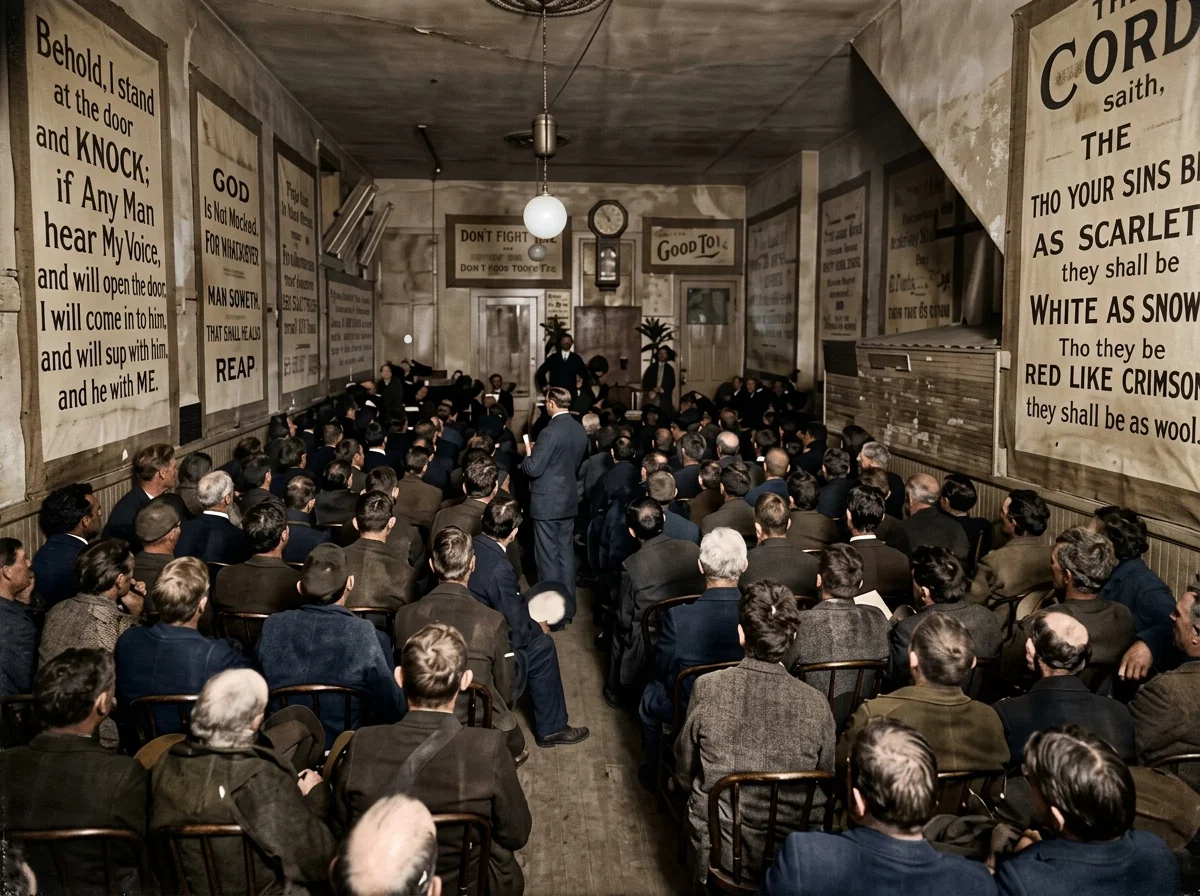
Helping Hand Mission Chapel.
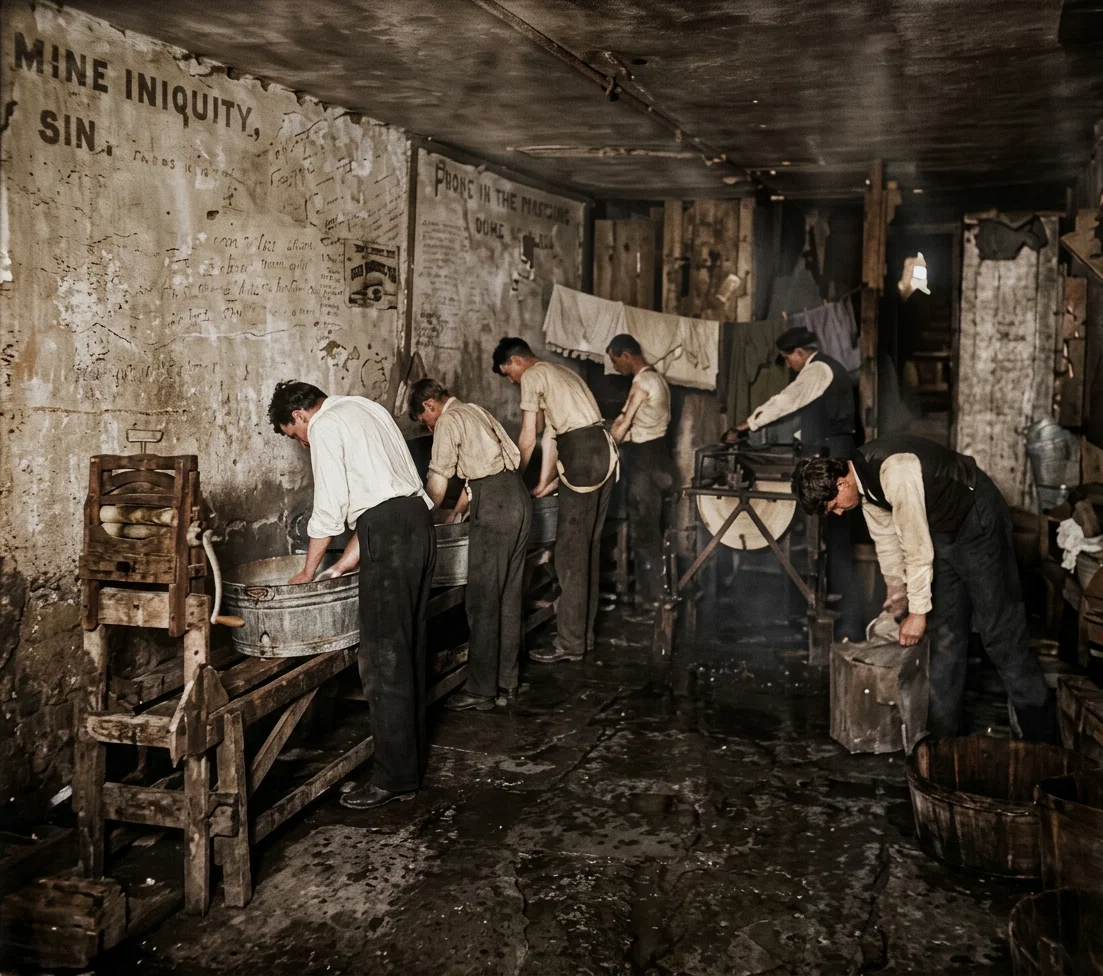
Helping Hand Free Laundry.
Cases of Individual Help.
Since the opening of the institution in February, 1898, there have been forty-four cases of individual help, amongst which may be mentioned instances where husbands have returned as bread-winners to their wives; wayward children restored to the friendship of the family circle; men of respectability assisted back to the plane from which they had fallen thru affliction, intemperance, or other causes, and many others where the jagged surfaces of life have been made smooth by the wonderful touches of the second great commandment.
Here are a few examples. Number one had left Maryland with a considerable sum of money, realized by the ten years' lease of his drug store. Dreams of wealth untold tempted him to seek his fortune in the golden regions of the Klondike. Like hundreds of others, he found only disappointment from the hour of his landing at the new El Dorado. He lost all his money, and after many hardships returned to San Francisco, broken down by the dreaded disease known to Northern miners as the Klondike scurvy. He sought the mission for medical treatment and shelter, which he received, and after some three months was enabled to secure a position at $90 a month. This man is now proprietor of a wholesale business house in San Francisco.
Number two is a Chicago man who had been engaged in mercantile pursuits in that city. He too became afflicted with the itching palm, and, leaving wife and baby behind, sped to the inhospitable regions of the Klondike, to extract golden ore with a miner's pick. He proved to be another of the disappointed ones, and got back to California so wretched and despondent that suicide alone seemed a happy method of terminating his woes. Thoughts of his once happy Chicago home, of a far-off wife and child now bereft of support, and of the sweet family influences that sweeten the cup of existence, had been brooded over and had well-nigh unbalanced a mind already weakened by months of hardship. After a few months' rest at the Helping Hand Mission, the position as manager of a book concern opened up for him, and now his San Francisco home is a model of taste and comfort. He is happily reunited with his family.
Number three deserted his family in Chicago, to become a wanderer on the earth. Arriving at San Francisco, he happened one evening to drop into the mission during Gospel services. Struck with the force of several testimonies to the saving power of Christ, he came forward and accepted the divine truth that sets sinners free. He is now holding a good position, and is united with his wife and children.
Number four is representative of a large class of American youth and manhood for whom mothers' prayers are unceasing. The chivalrous ideals of our American youth, their sanguine temperament, their thirst for travel and conquest of fortune, all combine to make the boys of Columbia wanderers from the parent home. While some succeed in life, many fall by the wayside, to become the objects of mother's solicitude. The mother's prayers for her wandering boy are long and tearful, and what sound has a more joyous ring than the postman's announcement of a letter from the long-lost prodigal, telling of a wonderful peace found thru reconciliation with the Lamb of God, who taketh away the sin of the world! John 1:29. Then has the tear of joy glistened with thanks to Him who had guided the feet of a loved son to some far-off mission, where the heavy-laden rest, to take up the burden of sin no more.
Only a few days ago, one of the Helping Hand converts, a bright young man, wrote to his aged mother, living in a neighboring city, that he was no longer a slave to drink or the deadly cigaret; that he had found salvation and a better life. The mother's joy was intense; she immediately replied by saying that her long hours of prayer were not in vain; for that prayer was at last answered.
Number six came to the mission about six months ago, a wreck morally and physically, thru drink and the cigaret habit. Engaged in worldly pursuits from early manhood, he finally drifted into the ownership of a California saloon, gradually becoming his own best consumer. Poverty and paralysis resulted from reckless dissipation, and for eighteen months he lay bedridden and speechless. Since his stay at the Helping Hand he has almost recovered the use of speech and limbs. The old man of sin, too, is dead, and the new man a monument of God's saving power.
The Helping Hand Free Employment Office.
Side by side with this leverage for the uprising of the fallen, is the inestimable benefit conferred by the mission's free employment office. The peculiarly helpless condition of a large portion of San Francisco's floating population, in its vain efforts to obtain honest labor thru lack of employment-office fees, has been a source of vexation and difficulty to thousands of poor workingmen. Homeless, shelterless, hungry, and despondent, these objects of deserved sympathy roam the city for jobs that rarely, if at all, turn up. To render their condition the more galling, they are13generally classed with the vagabond parasites of the town, who prey on the kindness of the benevolent, and are frequently compelled to accept the sheriff's hospitality in one of the demoralizing homes for criminals. The climatic conditions surrounding California render it the paradise of vagrants, they frequently subsisting on the fat of the land, while the indigent workingmen eke out a miserable existence.
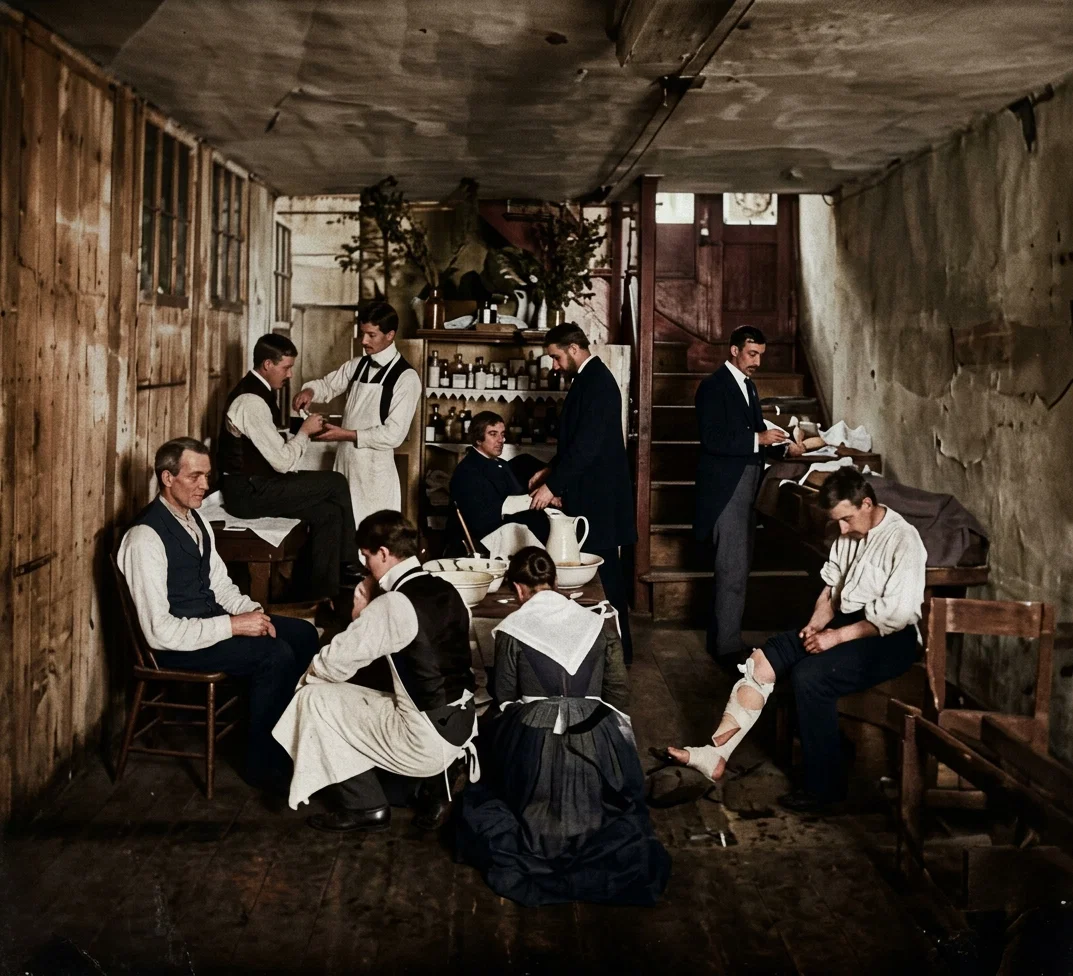
Helping Hand Medical Department.
The Class of Men Assisted.
To throw out the life-line to this honest class of workers; to rescue them from the miseries of a large city; and to give them that honorable place in society deserved by all honest labor, has been the paramount consideration of the Helping Hand management. In assisting the unemployed the mission has, thru God's blessing, been eminently successful. The man showing evidences of a desire to lead a better life is given board and lodging in exchange for a couple of hours' light work around the mission. There are daily calls for help, and every ring of the telephone leaves the institution one less on the roll of candidates for positions. Thus the sheltering benefits and moral influences of the mission are thrown around a wide stratum of persons deserving the grasp of a helping hand.
Since the founding of the mission, nearly three years ago, more than five hundred have been furnished permanent positions, and more than four thousand provided with temporary employment. As a rule, the men furnished by the mission give satisfaction, and in one leading restaurant on Montgomery and Market Streets, five of its best employees are converts of the Helping Hand. These men, like hundreds of others, were taken care of by the mission until able to care for themselves.
Since the mission started, in February, 1898, more than one million and a half (1,500,000) have been fed and sheltered, outside the assistance given to poor families in the way of food, provisions, clothing, etc.
Religious Services.
Religious service is conducted every evening in the mission chapel at 8 o'clock, lasting one hour. It commences with a season of song, followed by prayer; then the chaplain's sermon and converts' testimonies, with an exhortation to sinners to come forward and resolve to lead better lives. The chapel is usually crowded, and, considering the location of the mission, in the center of the city's rougher elements, the general conduct of the audiences is exemplary. There have been more than seven hundred professed conversions since the opening of the mission, and, tho it is, of course, impossible to say positively what number of these have been real, the conclusive evidences of wonderful conversions are exemplified in the changed lives of many claiming salvation at the Helping Hand Mission. The other religious meetings of the institution consist of “family” prayer, at 8:30 A.M., attended by the employees and brethren of the mission, and the Bible study, from 7 to 8 P.M., conducted by the chaplain. Many new converts seeking Bible truths have been wonderfully blessed at this meeting. The “inquiry room” of the chapel has proved of much benefit in the explanation of doctrinal and religious points to those hampered by erroneous ideas and rooted superstitions. Truly the world is full of darkness, and the mission chaplain has no inconsiderable portion of his time devoted to the loving task of lifting the veil of human mist from the infinite ocean of God's love.
Medical and Surgical Department.
This department of the mission is in the hands of able physicians and surgeons, and the amount of good done within the past three years is enormous. The medical department is a free emergency hospital for the northern section of the city, and the cases for treatment embrace almost every bodily ailment common to poor humanity. The operating-room during dispensary hours presents a scene of professional activity, in which the visiting doctor of the day and his trained nurse form the central figures.
An important aim of the Medical Mission is to teach men how, in ordinary cases, to take care of themselves. Victims of tobacco, whisky, and other vile drugs are shown their physiological effect on the human system, and the instruction almost invariably ends with the patients' renunciation of these evil habits. Men whose faces bespeak approaching death are kindly reasoned with and told of a better life. Thus the doctors, who, cheerfully and without fee or reward, heal the sores and bruises of the flesh, gladly impart spiritual help to minds long diseased with the leprosy of sin.
The Mission Restaurant.
The mission restaurant has proved an invaluable department of the institution. Nowhere else in the city can be had five clean substantial dishes of hygienic food for five cents. The patronage is varied and extensive. Not only is it a boon to the poor soul down to the last few pennies, but a veritable blessing to those forced to adopt a system of rigid economy in order to escape the indignity of charitable appeal. Stripped of all its other machinery for the relief of the poor, the Helping Hand could readily base its claim to warm public recognition on its restaurant alone.
Congested cities are those of a population half of whom know not how the other half live. Seductive freaks of imagination paint pictures of far-off shores where wealth holds unbroken revelry; where brains and ability, unsupported by means and social influence, are welcomed with open arms; and where, if all else fails, one may sumptuously feast on the charms of an unrivaled climate. The immigrant loaded with these ideas—and his name is legion—soon finds his Utopian castles melt into thin air, and it is only a matter of a little time until his downcast features take a place among the street galleries of moving pictures so commonly encountered on the thoroughfares of large cities. Now it is that the oft-despised power of a lone dollar is recognized, and the blessing of the penny lunch-counter appreciated.
With the acquaintance of the restaurant generally comes an introduction to the free reading-room, where, amid the atmosphere of wholesome literature, dreams of golden images are dissipated, and the world seen in its stern reality. The helping hand of the mission is sought and cheerfully given, and soon the once despairing soul without friends and without hope suddenly finds himself possessed of both. Visitors to the mission are frequently not a little surprised to see at its rows of tables a large proportion of all classes, from the hard hand of honest toil to the polished grace of some learned profession.
The penny-meal tickets of the institution are issued singly or in coupons of one hundred, the latter proving more convenient to regular customers and to patrons of the mission, who, in the dispensation of charity, do not desire their gifts to be exchanged for beer instead of bread.
A most gratifying feature of the restaurant is its material assistance in the subjugation of depraved passion. Grains, fruits, milk, and vegetables comprise the bill of fare; they are the natural food of man, are easy of digestion, and capable of ready assimilation by the system. The consumption of animal food is the parent of the world's army of inebriates, slaves to the deadly habit of irritant stimulants, the foes of the physical, intellectual, and moral organisms. The great majority of our mission converts, when accustomed to the food of the restaurant, evince a repugnance to the use of flesh meat, and more easily overcome the cravings for intoxicants or other poisons pandering to human debasement.
The Free Laundry.
In nature's laboratory, water is a choice gift, and true it is that cleanliness is next to godliness. Recognizing this potent factor in the building up of the moral as well as the physical system, a free laundry was established, where, without money and without price, the poor would find the means of cleaning themselves. Since the opening of the mission, there has not been a single instance where anybody has been refused a bath during laundry hours.
As the chief aim of the Helping Hand management is to provide labor for the unemployed, it is proposed on the removal to larger quarters in the near future to establish a steam laundry, affording employment to no small portion of those adapted for such work seeking the help of the mission. So far the institution has been without a home for women, but this will be remedied by the operation of the steam laundry.
Both these industrial branches will not only prove sources of relief to the unemployed, but will enable the management to carry out its plans of relief, unhampered by a dread of financial embarrassment.
The sleeping accommodations, if judged by the paying patrons of the Helping Hand, are all that may be desired. They are far above those provided by the average lodging-homes for the same price. The charge of ten cents includes a free bath. On an average, two hundred free beds are given weekly.
Bathing and Fumigating.
The cleansing process employed at the mission is effective and simple. The applicant for a bed receives two tickets, one of which calls for a bath, and these are taken to the bath-room clerk. The bather now places his clothing, with the exception of hat and shoes, in a sack tagged with a number, the duplicate of which he retains for identification of clothes next morning. While enjoying the luxury of a hot bath, his clothes are carried to the fumigator, into which all insects enter, leaving hope behind. After donning a nightgown fresh from the laundry, he receives back his bed ticket, stamped on the back by the bath-room clerk. This he presents to the dormitory clerk, who shows the clean man to a bed. Permanent roomers at the mission are not, of course, compelled to obey this iron-clad rule. Any lodger, however, sleeping away from the mission, if only for one night, goes thru the same routine process as the newcomer. By this system the institution is always kept clean.
The place of this mission is 641-647 Commercial Street, San Francisco, Cal. J. A. DOLSON.