“For we are made a theater unto the world, and unto angels, and unto men.” Who is made a theater, a spectacle, unto the world, and unto angels, and unto men?—Not alone Paul and others called apostles, but every individual called by the name of Christ.
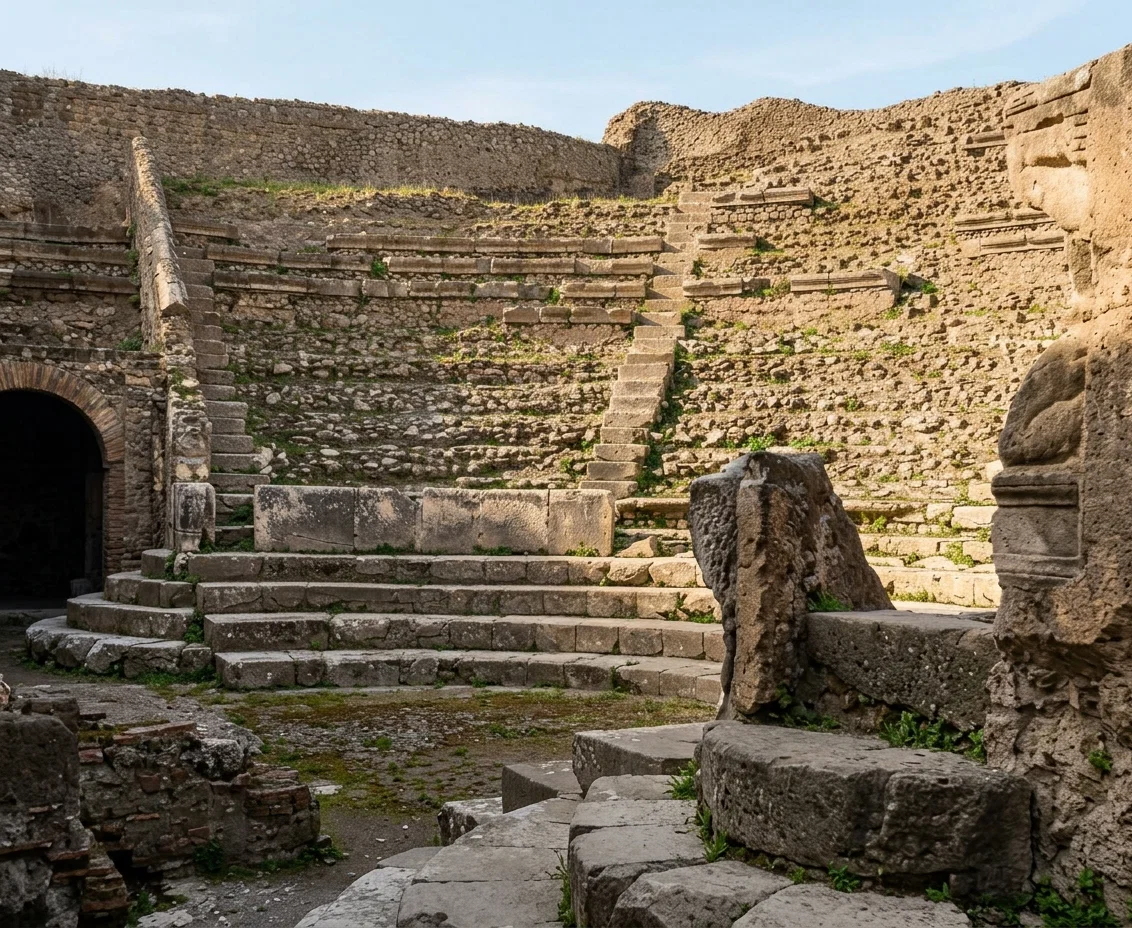
RUINS OF A POMPEIAN THEATER.
It is because they are called Christians that they become a spectacle unto the world. This is what makes them such. The word means a theater, a show, a spectacle.
It is as tho the whole world were assembled in one great amphitheater, row upon row, bank upon bank, from the arena to the sky-line of the great wall, and the actors on the central stage those called by the name of Christ. We are the spectacle, the thing looked at, the actors.
Why a theater? why actors?—O, here are those who personate others, who study to present the words and actions of other men or women, more or less renowned, or of supposed characters, in living act and word; and here are the spectators to be amused or edified, and observe the skill of the performers. A most forcible way indeed is this of appealing to the emotions of mankind. So the illustration is drawn from an institution familiar to the world for ages.
Then, being the spectacle, the show, the actors on this great stage, what is there that Christians are doing, or can do, to arrest and hold the attention of the vast audience? What characters are being depicted? Whose lives and words are being re-enacted? What great scenes from history are being presented? Men say of a great actor, “He takes the part of Hamlet;” of another, “He is Othello.” If a word means aught, there should be studied in this mighty theater only the words of One; there should be revived only one life, one character—Christ.
But is not the subject too limited? Does it not become monotonous? —Well, opinions vary here; but at one thing there is certainty,—the world continues to look on. Says the Christian actor: “The theme is as wide as the universe; for in Him is the fulness of all things. He is made unto us wisdom, and righteousness, and sanctification, and redemption.” Says the world, “It is foolishness.” The Christian replies, “God hath chosen this kind of foolishness to confound the wisdom of the world, and unto us which are saved it is the power of God.” And the world continues to look on.
What does it see? This is a tremendous question. It is written to those in this world arena: “Ye should show forth the virtues [excellencies] of Him who hath called you out of darkness into His marvelous light;” “Let the Word of Christ dwell in you richly in all wisdom. . . . And whatsoever ye do in word or deed, do all in2the name of the Lord Jesus.” And one said, “I live; yet not I, but Christ liveth in me.” “Let this mind be in you which was also in Christ Jesus. . . . For it is God who worketh in you, both to will and to do of His good pleasure.” Does the world see and hear all this? Does it see faithfully portrayed in the act before it the life of the Christ? Are the words spoken such as it should expect to hear from the Man of Galilee Himself? Professed Christian, answer.
But there is more. The question of what is seen takes on intensity and solemnity. Supposedly—and truly it ought to be—Christ the Master, in life and in word, should be seen by the world in the spectacle before it. Said Christ the Master, “He that hath seen Me hath seen the Father.” Yes, a moment’s thought shows that it must be true, and that the added truth does not enlarge the first; for in Him is the fulness of the Godhead bodily. “God was in Christ, reconciling the world unto Himself, not imputing their trespasses unto them; and hath put in us the word of reconciliation. Now then we are ambassadors for Christ, as tho God did beseech you by us; we pray you in Christ’s stead, be ye reconciled to God.” “As Thou, Father, art in Me, and I in Thee, that they also may be one in Us. . . . I in them, and Thou in Me, that they may be made perfect in One.” Does the world see all this on the stage of acting? And does it hear in the voice of the speakers the reconciling voice of the Majesty of heaven?
If it does, some will believe, for the record is, “God was manifest in the flesh, justified in the spirit, seen of angels, preached unto the Gentiles, believed on in the world.” But of the vast throng the many look on and scoff. The wisdom of this world makes the truth of God a lie, God Himself unknown, and salvation a farce. As ever it was, so now it will be, the humble actors on this stage will be “made a gazing-stock both by reproaches and afflictions.” But the greatest apostle comforted those of his day with words that carry comfort to the end: “We are fools for Christ’s sake, but ye are wise in Christ.”
A spectacle to the world, and unto angels, and unto men! There are times when the Christ-follower may think himself unobserved, when there are no human spectators. But, lo! the heavens open, and a multitude of witnesses surround him. Who are these that watch with such intent gaze every word and action?—Messengers of light from the court of Christ, and messengers of darkness from the court of Satan. Be on thy guard, Christian, that Christ be in you, your constant hope of glory, in secret and in public. Your arena is exceeding large, tho it be only in your own home and neighborhood. Be true to the character you are representing; for upon your conduct depends the honor of your Master, and the salvation of perishing souls.