PEACE, BE STILL

8%

Pacific Press Publishing Company · Oakland, California · Dec 1, 1898

FromSigns of the Times, Vol. 24, No. 48.

Read the full edition

“PEACE, BE STILL.”

Scarcely anything so fully stirs a tempest within the human breast as being held under false accusation. To protest one’s innocence at such a time is held to be just and meritorious. Indeed, the silence of one who is charged with wrong and holds his peace, is usually construed as evidence of his guilt, regardless of his former standing or present profession.
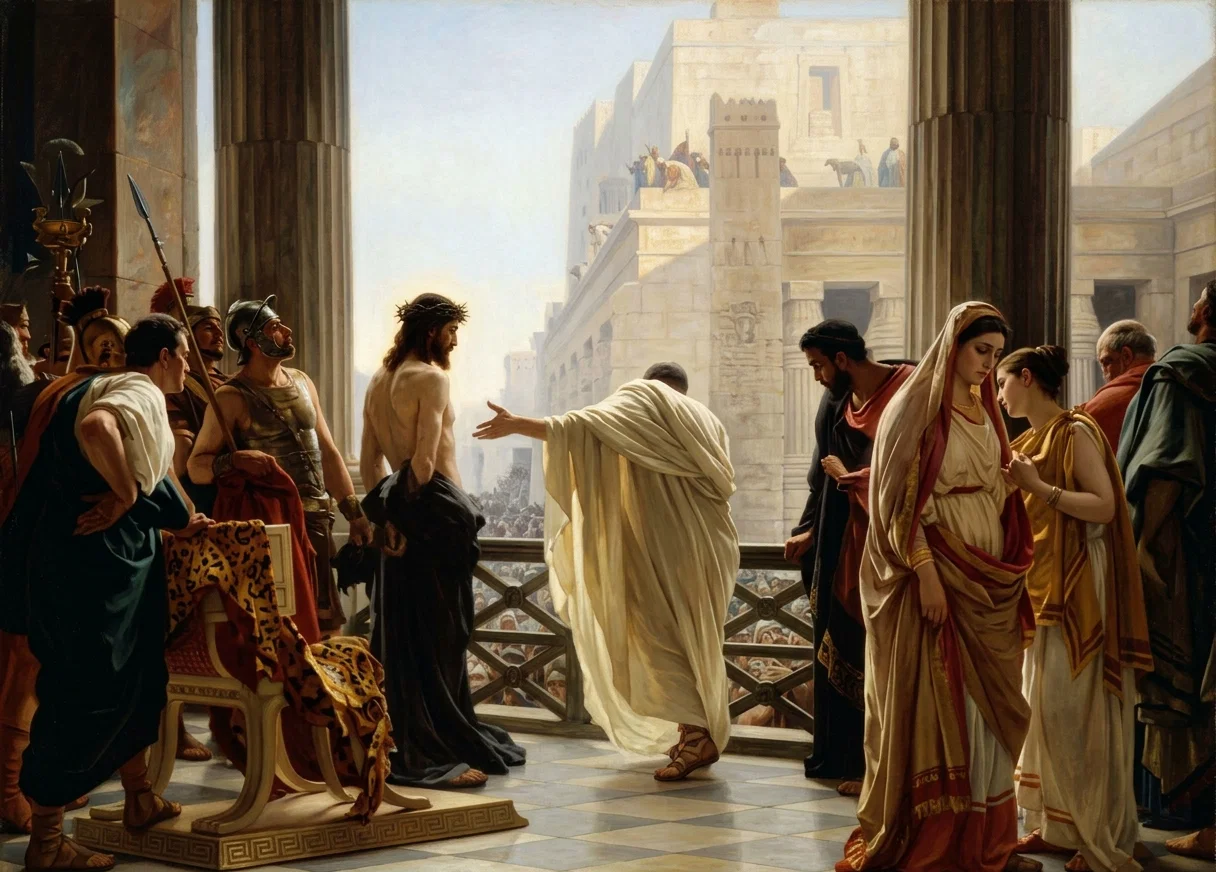
“BEHOLD THE MAN.” PILATE PRESENTING CHRIST BEFORE THE MULTITUDE.
But one’s silence under such circumstances is not certain evidence of guilt. On the other hand, it is more likely to be the opposite, for the reason that a guilty person works in his own interest, and is the more likely one to attempt his own defense. It requires great control of the human passion, however, to keep entirely calm and quiet under what one knows to be a false charge, brought against him through prejudice and pique.
The example of Christ in this respect is worthy of careful study. The Jews having secured His person through the treachery of a professed follower, were determined to find charges against Him serious enough to warrant them in putting Him to death. Their long-continued system of putting spies to watch Him for some traitorous word had failed. Even false witnesses were hired to testify against Him before the tribunal of the high priest, but their testimony did not agree. Two witnesses must be found who would testify to something in His past life that would condemn Him; for His condemnation was already determined upon.
At last one was found who said that he had heard Jesus say that if the temple at Jerusalem were pulled down He could build it up in three days. Others agreed that something of this sort had been said. But this was not enough; and so the wily Jewish priest, hoping to see Jesus commit Himself to some statement which might be labeled a civil offense, put Him under oath, and then demanded that he should state, as before the living God, whether or not He claimed to be the Son of the Most High.
Silent up to this moment, Jesus could do no less than answer truthfully. Hearing His answer, the priest declared that no further evidence of guilt was necessary. The next step was to take the case before the Roman tribunal to have the judgment of the high priest confirmed. Pilate, the “Javelin-man,” had his official seat elevated to its accustomed place, high above the crowd. This spot was in front of the judgment hall, and known as “The Pavement,” because of being laid with a mosaic of colored stones hewn out of costly marble.
Set down on this tessellated floor was the ivory chair of the procurator.
Up the steps of this tribunal Christ was led by the priests and elders of the Jews. As Roman law knew no condemnation but for cause, Pilate demanded to know the nature of Christ’s offense. The Roman judge had probably heard much about Christ and His work, and so from the first understood that from envy the Jews were delivering Jesus to the Roman judgment-seat. Altho his nature was heartlessly cruel, Pilate seemed willing from the outset to release Christ from the power of Rome’s enemies, the Jews. As charge after charge was brought against Jesus, Pilate marveled that He made no attempt to vindicate Himself. Taking Christ inside the palace,Pilate asked Him privately concerning the charges brought against Him. The Saviour there candidly stated who He was and His mission to earth. He was then brought out before the crowd, and the verdict rendered that no fault could be found with Him.
Upon this the mob below became furious in their demands for the life of Christ. Thinking to appease them Pilate gave orders to have the divine prisoner stripped to the waist and scourged, after which His lacerated and crippled form was presented before them with the pathetic appeal, “Behold the man.” But again from the court-yard below came the railing laugh, and the brutal demand for His crucifixion. Amid all the tumult of the hour no complaint escaped the lips of Christ; not even a murmur was heard. Under the circumstances He might have appealed to the honor, the compassion, or the pity of the people in a way to touch the hardest heart. But He was calmly silent, not because He was crushed with sorrow, but because He had risen to the serene joy of a conqueror.
But the determination of His tormentors was to be carried out at all hazards, and, altho no word of censure or retaliation escaped the lips of the divine Prisoner, He was finally brought to His death, as He had lived, with His mind under full control, a shining example to all His professed followers when suffering unjustly.
JOHN ORR.