ONE of the most pleasing themes of Bible study is that of the fertility of God’s resources for the rescue of His people from distressing circumstances. To provide an asylum for the seed of Abraham in the midst of famine, Egypt was brought under the control of a member of the favored family, through the most peculiar circumstances, showing that this very protection of His people was anticipated, and being provided for during a series of eventful years. When the favor of Egypt toward that people was afterward changed to hatred, and they were oppressed under the slave-master’s lash, a man was raised up to lead them forth from bondage. When menaced with destruction by their pursuers at the hemmed-in border of the Red Sea, the waters were divided, that the oppressed might escape to the opposite shore. When the barren sand of the inhospitable desert refused them sustenance, bread was provided direct from heaven.
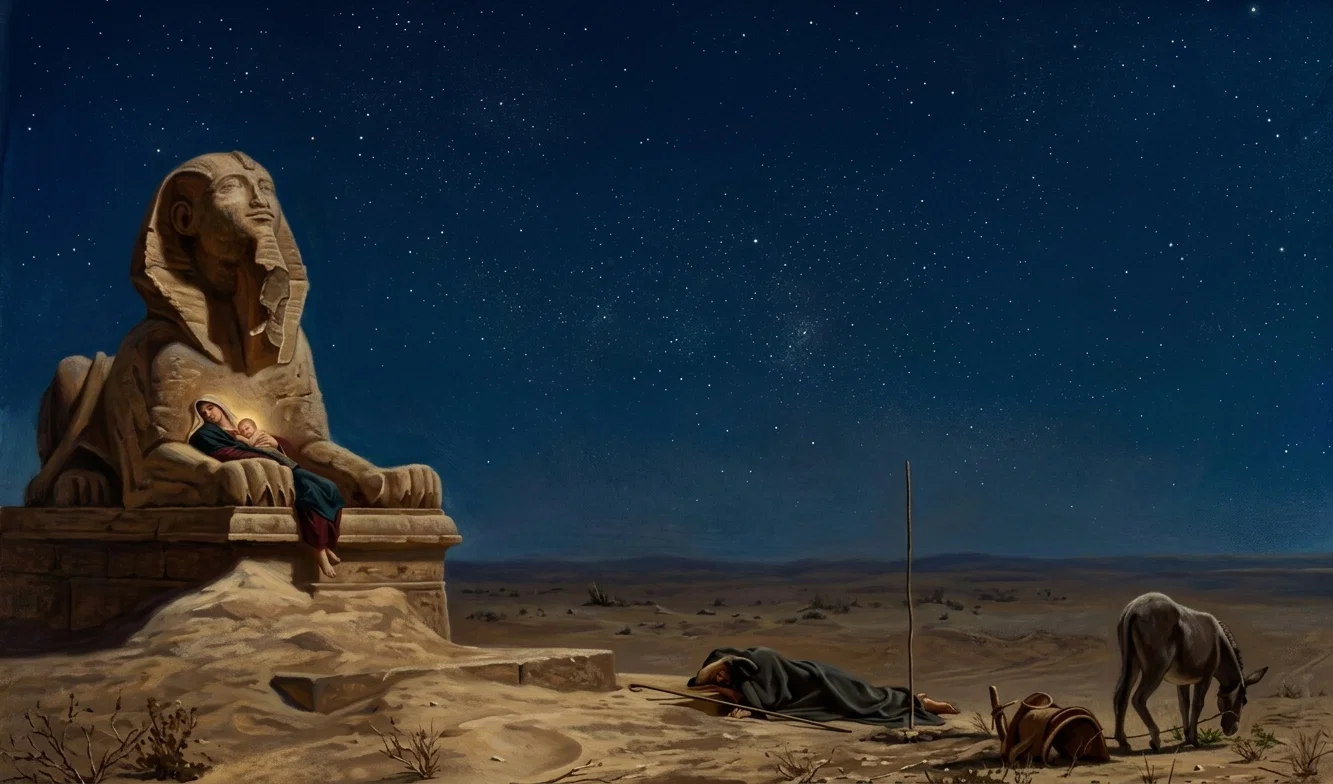
REST IN EGYPT. The genius of the artist has provided us an illustration typifying the protecting care of Heaven toward the seed of Abraham, by showing the infant Jesus, with His mother, resting within the arms of the sphinx—a fitting symbol of Egypt—while hiding in that country from Herod’s wrath.
Cases might be indefinitely multiplied in this line, but these are sufficient to illustrate the point referred to. One thing, however, in connection with these various circumstances is worthy of consideration. No matter what the state of the people’s mind was,—how little they appreciated God’s care, or how much inclined they were to have their own way,—the protection of Heaven was uniformly accorded them. This was not because Jehovah winked at their sins, but because He could not possibly do otherwise, on account of His oath to Abraham. Heb. 6:13–17.
In the beginning God gave the earth to man, to hold in trust for its rightful Owner, the Lord Jesus. Col. 1:16; Ps. 115:16. He having yielded it to Satan, by becoming His servant, the redemption of the lost territory of the Lord’s kingdom became as necessary as the lost subjects of the same. The first definite promise of the restoration of this territory to the redeemed subjects, was to Abraham and his seed. Gen. 13:14, 15; 17:7, 8. This promise was a proclamation of the Gospel of the kingdom (Gal. 3:8), which was to be restored through Christ (John 8:56). It was a promise to the seed of Abraham alone, and not to the seeds represented by the slave woman’s Ishmael, and the children of Abraham’s later life. Gen. 25:1–4. God recognized but one seed,—Isaac. Rom. 9:7. From Isaac was to come, through his direct line, the true Seed begotten from heaven,—Jesus Christ. Gal. 3:16.
From the moment this promise was made to Abraham, his seed became the one object of Satan’s attacks. The force of national decrees was from that time employed to destroy the promised seed, lest in the fulfilment of God’s promise to Abraham, Satan should be dethroned and thus God’s right to the usurped territory be vindicated. So, through the king of Egypt, the effort was made to prevent the return of the seed of Abraham to Palestine, by ordering all the male children of Israel slain. Ex. 1:8–16. After the people of Israel were miraculously delivered, and established in Egypt, ten of the tribes were removed by the Assyrians, and their places filled by heathen. 2 Kings 17:6, 24. The remaining tribe of Judah was then taken away by the Babylonians, and the place of God’s sanctuary left desolate. Dan. 1:2. This tribe was afterward restored to the land of promise, but, as other nations in succession gained control of the territory under dispute, the literal seed of Abraham was constantly harassed. Only by the extended power of God were they kept from being scattered abroad, before the divine Seed could be born in the land promised to Him through God’s oath to Abraham. But when the Seed in whom all the heirs2of Abraham must rest their claim, was born in the land so long before promised Him, the supreme effort of Satan’s whole career was put forth in the attempt, through Herod, to wipe out all the seed of Abraham, by destroying the infant Christ, and so prevent the restoration of the usurped territory to its rightful owners. But through the keeping power of God the link necessary to connect the pedigree of Abraham’s seed was preserved, and recorded as a necessary preface to the Gospel of Christ. Matt. 1:1–17. This accomplished, the necessity for holding the Jewish nation together no longer existed, and they were soon permitted to be dispersed over the whole earth, no more to be united as a distinct commonwealth.
Satan’s hatred has ever been against the “seed of Abraham,” and whoever bears that title, in whatever age of the world, must expect the weight of his power. Gal. 3:29; 2 Tim. 3:12. The divine Seed, in whom all of Abraham’s stock must find their title to the inheritance, was the One above all others whom Satan sought to overthrow. He was, however, preserved from death by being taken into Egypt, as was the immediate seed of His patriarchal ancestor. As the beginning of that seed was preserved from death by going to Egypt, and then being led back to the land of promise, so the Seed royal, to whom this figuratively pointed, found refuge in Egypt, and was afterward led back to His own land.
The genius of the artist has provided us an illustration typifying the protecting care of heaven toward the Seed of Abraham, by showing the infant Jesus, with His mother, resting within the arms of the sphinx—a fitting symbol of Egypt—while hiding in that country from Herod’s wrath. Though purely a work of the imagination, it is a beautiful representation of the asylum which Egypt provided, under the direction of God, for Him who was given to be “The everlasting Father” of the seed of Abraham, whose seed we are, if we have given ourselves to Christ. Gal. 3:29.