LOYALTY TO PRINCIPLE

9%

Pacific Press Publishing Company · Oakland, California · Nov 24, 1898

FromSigns of the Times, Vol. 24, No. 47.

Read the full edition

LOYALTY TO PRINCIPLE.

The history of the race, so far as recorded, furnishes but few examples of men of real principle and integrity. Among these, standing out in bold relief against the prevailing wickedness of his time, is the prophet Daniel. His rich qualities of character were early manifested, thus showing that these principles of truth and integrity had been instilled into his mind from tender years. His refusal to violate his religious scruples by partaking of the king’s meat, as recorded in the first chapter of the book that bears his name; his fearless interpretation of Nebuchadnezzar’s dreams, as given in the second and fourth chapters; and his fearless revelation to profligate Belshazzar of the mystic characters written on the wall of the palace, show that he did not count the cost of right-doing. The pomp and glory of the royal court did not deter him from his purpose; nor did the fear of incurring the royal displeasure lead him to soften the message of God, or abate one iota from its pointedness.
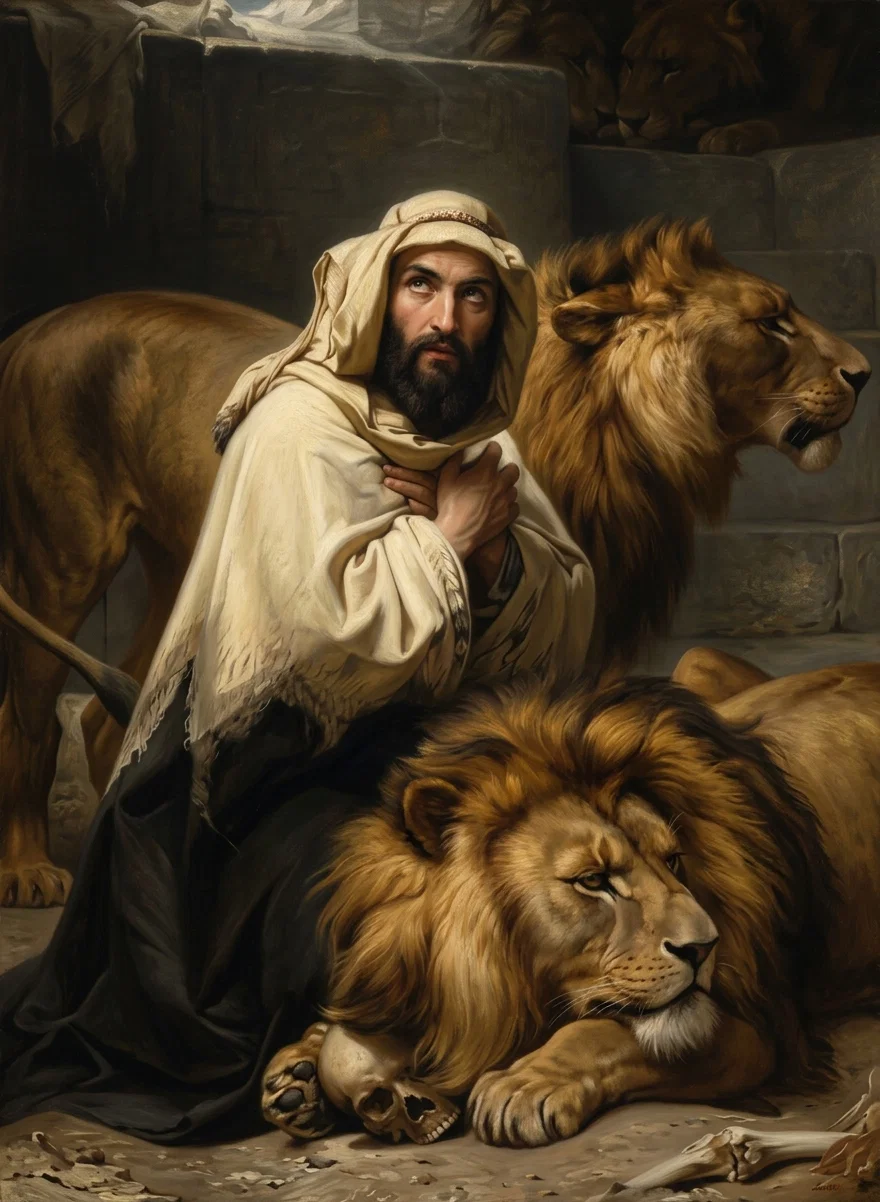
DANIEL IN THE LIONS' DEN.
It was reserved for the times of Darius, after the Babylonian Kingdom had given place to Medo-Persia, to bring the great test of his life to the prophet of God. Daniel, on account of his sterling qualities, his honesty, his discernment, had been set over the affairs of the kingdom. This aroused the enmity and jealousy of the native rulers; to think that a captive, and especially an Israelite, should be preferred before them, was a constant source of irritation and annoyance. That there was no fault in the administration of public affairs in the hands of Daniel, is evidenced from the testimony of his enemies. They admitted, “We shall not find any occasion against this Daniel, except we find it against him concerning the law of his God.” Hence the religion of the prophet became the special point of their attack.
With craft and policy they proceeded to the execution of their diabolical scheme. They went to the unsuspecting Darius, making a proposition which naturally would please his pride and minister to his vanity. The king, in accordance with their request, promulgated a decree that if any one in his realm should make a petition of any god or man for thirty days, save of the king only, he should be cast into the den of lions. The proclamation is published, and now the enemies of the prophet begin to dog his footsteps. They did not expect to find occasion in his public acts, for Daniel did not parade his religion before the gaping multitude. If violation could be found, it must be sought in the private devotions of their rival, hence they set a watch upon his house. Lo! at the stated hour for prayer, they saw Daniel, in harmony with his usual custom, open his window, and, kneeling with his face toward Jerusalem, as did all the captive Israelites, send up his petition to the God of Abraham, Isaac, and Jacob. Doubtless his enemies had known of his custom in this respect, and so had made provision in the proclamation for the apprehension of Daniel upon this charge. It would have been easy for Daniel to vary his custom, in deference to the king’s decree; but had he done this, a lack of real principle and integrity would have been manifested. It was his God-given right to worship the Creator of heaven and earth as he saw right and fit. His devotions could not disturb the king in his palace, nor any other member of the king’s realm. In pursuance of his God-given right, he changed not one iota from his usual custom.
The discovery of Daniel’s enemies is enough. The snare has been warily laid, and the desired prey has been caught in the net. They make haste to the palace of the king; and, calling to their aid an old tradition of the empire, they first inquire of the king if it is lawful for any of the decrees of the Medes and Persians to be altered or abated. The king, without knowledge of their purpose, assures them that the royal mandate is unalterable, and thus unwittingly doubly commits himself to the execution of the plot against his chief minister. The king is then informed that the proclamation he had issued but a short time before, has been violated by Daniel, and the visitation of the penalty upon the prime minister is decidedly demanded. The king sees with surprise and horror the fearful work to which he has been committed. Most gladly would he save the life of Daniel; but he feels that his own authority is at stake, and, rather than violate the traditions of his government, he gives command for Daniel to be cast into the den of lions. Altho himself an idolater, Darius, in the execution of the decree, showed a respect for the God of heaven which the influence of Daniel had instilled into his life; and “the king spake and said unto Daniel, Thy God whom thou servest continually, He will deliver thee.”
After the mouth of the den was sealed, and Daniel was left alone with his grim companions, the king went to his palace and passed a sleepless night in fasting and bewailing the fate of his trusted counselor. Early the next morning he went in haste to the den of lions. With a voice of lamentation he cried, “O Daniel, servant of the living God, is thy God, whom thou servest continually, able to deliver thee from the lions?” With solemn, eager expectancy the king awaits response. With an influence that thrills his heart, and sends a tremor through every fiber of his being, the tones of his servant issue from the loathsome prison-house: “O king, live forever. My God hath sent His angel, and hath shut the lions’ mouths, that they have not hurt me; forasmuch as before Him innocency was found in me; and also before thee, O king, have I done no hurt.” The anxious sorrow of Darius gave place to joy, and he commanded that Daniel be taken out of the den; and the record is that “no manner of hurt was found upon him, because he believed in his God.” Then the king commanded that the men who had been instrumental in bringing Daniel into this plight should themselves be cast into the den of lions. In their case the restraining power of God was not exercised over these ferocious beasts, and these evil-workers fell a ready prey to the hunger and rapacity of the lions.
In this experience we see a vindication of the right on the part of God, even tho the course Daniel pursued, as in the case of his three companions in refusing to worship the golden image, was contrary to the command of the powers of earth. God has circumscribed the limits of the authority of civil government. It is for the governments of earth to regulate the affairs of their subjects in civil matters alone. When government oversteps this boundary, it invades the relation between God and the individual, a relationship in which God has reserved to Himself alone the exercise of authority.
The same stand was taken by Peter and the apostles when commanded not to preach in the name of Christ. They replied, “We ought to obey God rather than men.” Acts 5: 29. This was the answer in the stand taken by Daniel, and this will be the answer in the stand taken by the disciples of the Lord in all ages who are moved by principle alone. In our own day, when the governments of earth are legislating upon religious questions, and seeking to coerce the consciences of men, the noble stand taken by Daniel must be duplicated in the lives of Christ’s true followers.
To-day, as then, God calls for men of principle; men who will stand true when others are false; men who will do right when all others do wrong; men who will sacrifice their worldly interests, property, reputation, and even life—for the sake of truth and righteousness. Men and women are wanted to-day to represent the God of righteousness, who can not be intimidated by fear, cajoled by flattery, or bribed with gold; men who will do right, not for policy’s sake, but for the truth’s sake, and because they are actuated in so doing by the spirit of truth that dwells within them.
From such lives will go forth a leavening power and influence; and such disciples of the Lord will stand as beacon lights in the midst of the prevailing darkness, and as mighty bulwarks against the tide of sin and wickedness in the world. May the integrity of principle that possessed the life of Daniel possess the lives of both writer and reader in all the conflicts of to-day and the trials of the future through which the church of God may pass. Such a stand may bring persecution here, but the glorious results achieved will more than compensate for the trials endured. F. M. Wilcox.