A Walk about Jerusalem

7%

Pacific Press Publishing Company · Oakland, California · Nov 10, 1898

FromSigns of the Times, Vol. 24, No. 45.

Read the full edition

A Walk about Jerusalem

JOTTINGS FROM PALESTINE. NO. 13.

A Walk about Jerusalem.
From the German Temple Colony we walked a short distance to the west, where, amid a wilderness of rocks, is located the Moravian Leper Hospital. Mr. Shubert, in charge, kindly showed us through all the building. The director and nurses live in the same building as the lepers, but have to themselves a distinct part, which the lepers are not allowed to visit. There are about thirty lepers, some very near death, and others able to work some in the garden. There are two forms of the disease,—one in which portions of the body drop away, especially the extremities, and one in which all sensibility is gradually lost.
Some of the lepers will not stay at the home, but run away, preferring to beg their living, as thus they get more pocket money. Along the road from the Joppa Gate to the railway station may be seen quite a number of lepers sitting, and begging of the passers-by. Where the disease is at an advanced stage, lepers are a pitiable sight.
It is now near sunset; so I return to the city, and, passing the Joppa Gate, go around the city to the north, past the Damascus Gate, and around the northeast corner down the Kidron Valley to Stephen’s Gate, called also the Sheep Gate. All along the north, outside the walls, are many modern buildings. The surface is here quite undulating; but there is no deep valley, as on all other sides of the city. It is claimed that this is the only side from which the city was accessible to a besieging army. The present wall entirely encircles the ancient city, and is of Mohammedan origin; it is supposed to occupy in many parts the same place as the ancient wall, tho it must be that the city was anciently much larger than at present. It would not be possible for the population of the city at the time of its destruction by the Romans to be contained within the present walls; for in those days they knew nothing of “sky-scraper” buildings.
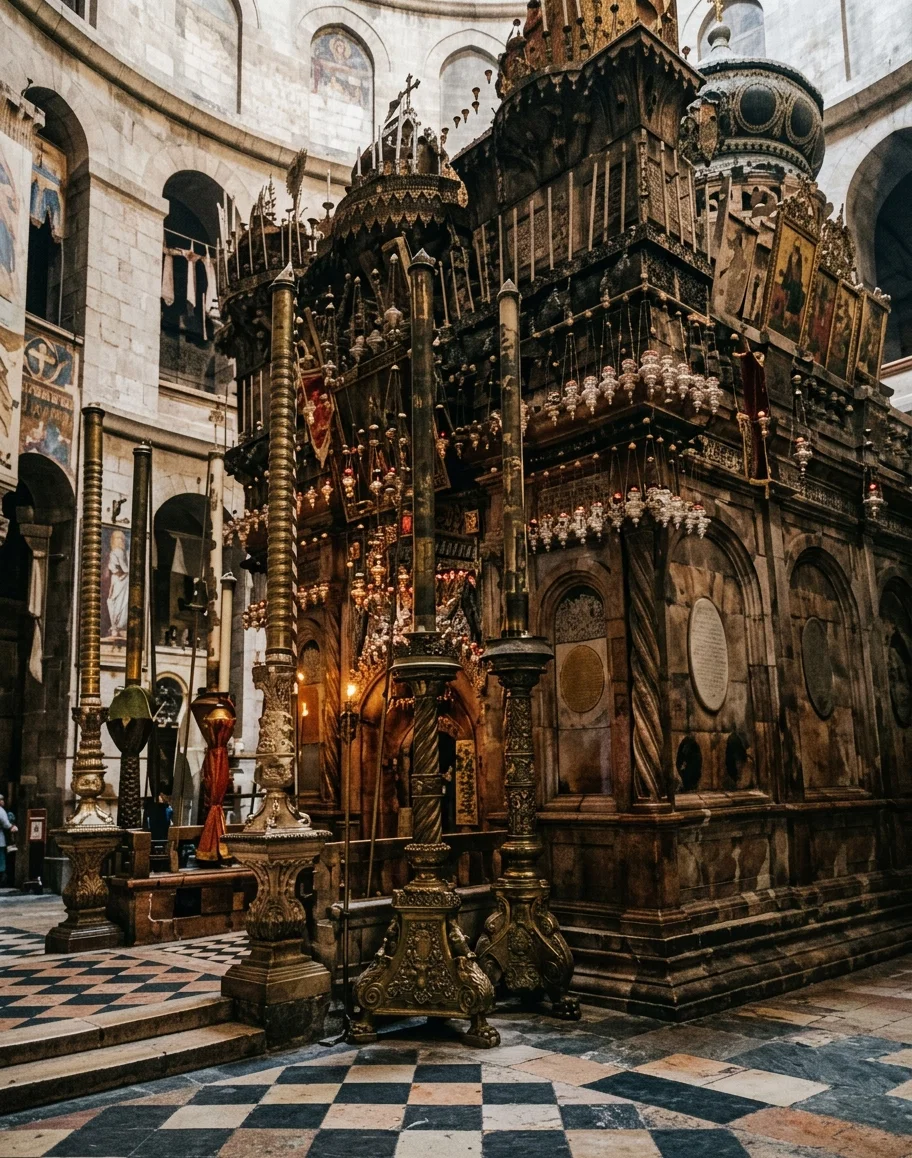
THE CHURCH OF THE HOLY SEPULCHER (AN INTERIOR VIEW).
We walk along outside the eastern wall above the Kidron Valley to Stephen’s Gate, near the center of the city north and south. As we stand at the gate viewing the Valley of the Kidron, or Valley of Jehoshaphat, and the Mount of Olives, we see here and there in the valley and on the sides of the mount small groups of black goats. In the evening hour the shepherds are leading them to the city. They enter by this gate, anciently called the Sheep Gate, doubtless because the many sheep required in the temple service entered the city here. The goats are driven into the city every evening for their milk.
Entering the Sheep Gate—which is doubtless at the same place as the ancient gate, for the eastern wall occupies the same place to-day as anciently—we pass along a well-paved street to the west; on the left is the large square formerly occupied by Solomon’s Temple; on the right, but a short distance from the gate, is the pool of Bethesda, where Jesus healed the man that had been sick thirty-eight years. We turn in to view this pool; it is approached through ruins of an ancient church, and is considerably beneath the present surface of the ground. If it is the veritable pool of Bethesda, it is so covered with ruins and changed by later buildings that one can form very little idea of its appearance in the time of Christ.
Continuing down our street, we observe by the inscriptions that it is called Via Dolorosa (Way of Sorrow), because it is claimed that Christ passed along it bearing His cross to Calvary. Along the route, tablets in the buildings mark the “stations” to the number of fourteen, indicating what took place at each; such as where Christ first took up the cross, where He fainted, and the cross was laid on Simon, where His mother met Him, etc., till the fourteenth, which marks the sepulcher. At one station, an indenture in the stone wall of a building is claimed to have been caused by the hand of Christ, as He sank beneath the cross and thrust His hand against the wall for support. This is a specimen of the superstitions and fictions with which Jerusalem is filled. The Latins, Greeks, and Armenians, all desirous of obtaining possession of as many so-called “holy places” as possible, have not only presumed to locate all the events mentioned in the Scriptures, but have invented many not mentioned; and, like the wood of the cross, some of these places have been multiplied. It is doubtful if there is another city on earth where there is as much superstition to the square rod as in Jerusalem. And, as if the matter so overdone by Christians were not enough, Jews and Mohammedans have added their quotas of still more shallow superstitions.
As an illustration may be mentioned the Church of the Holy Sepulcher, which is claimed to cover both the tomb of Christ and the place where the cross stood. And, as if one inconsistencyjustified another, both places are located within the city, not far from the center, when the Scriptures plainly say that He suffered without the gate. Heb 13: 11-13. So in our walks about town we will lose no time in visiting such places, but will enjoy the genuine.
The general location of the city and of the surrounding valleys and hills is the same now as in the days of David and Solomon and Christ; these we can view with great satisfaction, as we recall the many scenes here enacted. But the location of streets is quite out of the question. As in nearly all cities of two thousand years ago, the present level is considerably above the ancient; in the Roman Forum, it is about fifteen feet; in Jerusalem, it is from four to ninety feet. Some of the ancient pavements have been excavated, and a few places are identified. One which has considerable show of authenticity is the pavement of Pilate’s judgment-hall. In connection with this pavement are portions of two arches, one of which is called the arch of “Ecce Homo,” because it is claimed that above it Pilate presented Christ to the mob, when he said, “Behold the Man!”
Concerning the place of the temple there is no question; the surface of the ground here is nearly the same as it was anciently. The temple square occupies nearly a fourth of the present city’s space within the wall, and is located in the southeast corner. It is now in possession of the Mohammedans, who are exceedingly fanatical about it, regarding it as a holy place next in rank to the Kaaba at Mecca. Until recently they would not permit Christians to enter this inclosure; and to-day they can visit it only by obtaining permission from the proper officials. One day I was walking around the temple square with an American who had lived in Jerusalem many years, and as we walked up one of the passages leading to the inclosure, to see a Mohammedan school which was hard by the wall inclosing the square, I thought to take a step farther to peep in; but my friend called me back, stating that if I stepped through the gate within the inclosure, I would very likely be stoned.
Altho the Jews might obtain permission to visit the temple area freely, they would not do so for fear of treading on the place where the holy of holies of the temple was located. The chief building of this inclosure is the Mosque of Omar, situated near the center.
Passing through the city near the walls of the temple square to the southwest corner, we come to what is called the Jews’ wailing place, where a portion of the ancient wall, consisting of huge blocks of stone, is laid bare. Here the Jews assemble to bewail the departed glory, and to pray for its return. It is a sad sight to see them leaning against the wall, kissing the stones, weeping, and praying, especially when one considers the great light which was committed to them in the Sacred Oracles, and the utter darkness in which they now are in consequence of rejecting that light. But we are all human, and under the same conditions we could not expect better results for ourselves. “Because of unbelief they were broken off, and thou standest by faith. Be not high-minded, but fear; for if God spared not the natural branches, take heed lest He also spare not thee.” Rom. 11: 20, 21. H. P. H.