A DAY’S SOUL-KEEPING

3%

Pacific Press Publishing Company · Oakland, California · Nov 3, 1898

FromSigns of the Times, Vol. 24, No. 44.

Read the full edition

A DAY’S SOUL-KEEPING.

They had been having a great frolic, Mrs. Bradly and the baby; for Mr. Bradly was away on a lecturing tour, grandma had been made comfortable for the night, and Puss and Pet were fast asleep. But, tho mama’s arms ached with weariness, Bonny boy had taken a freak of wakeful, restless playfulness. They had played “peek-a-boo,” and “blind man’s buff,” thrown bean bags, sung songs, and gone to “Banbury town on a white horse,” and looked at all the pictures.
All through the evening Mrs. Bradly had kept up a steady undercurrent of thinking of life’s discipline, of the meaning of all the patience and love required. Now and then, as baby’s demands seemed more exacting, and as, from the resources of her love, a new submission and patience met the emergency, she seemed to catch a glimpse of the face divine. Had she not exacted of Him, and met only patience and love? Surely she could bear a little with restless, sleepless Bonny.
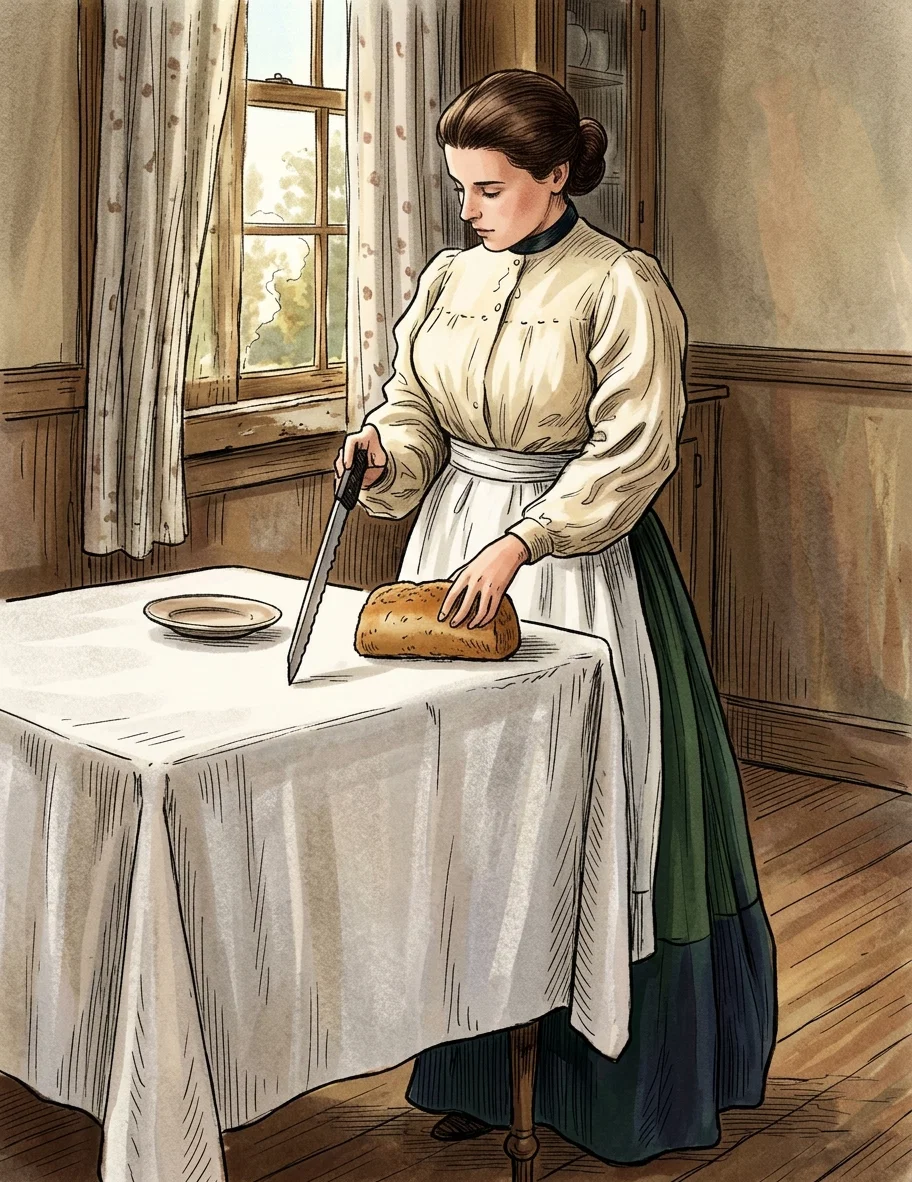
“She paused over the bread ere she cut it.”
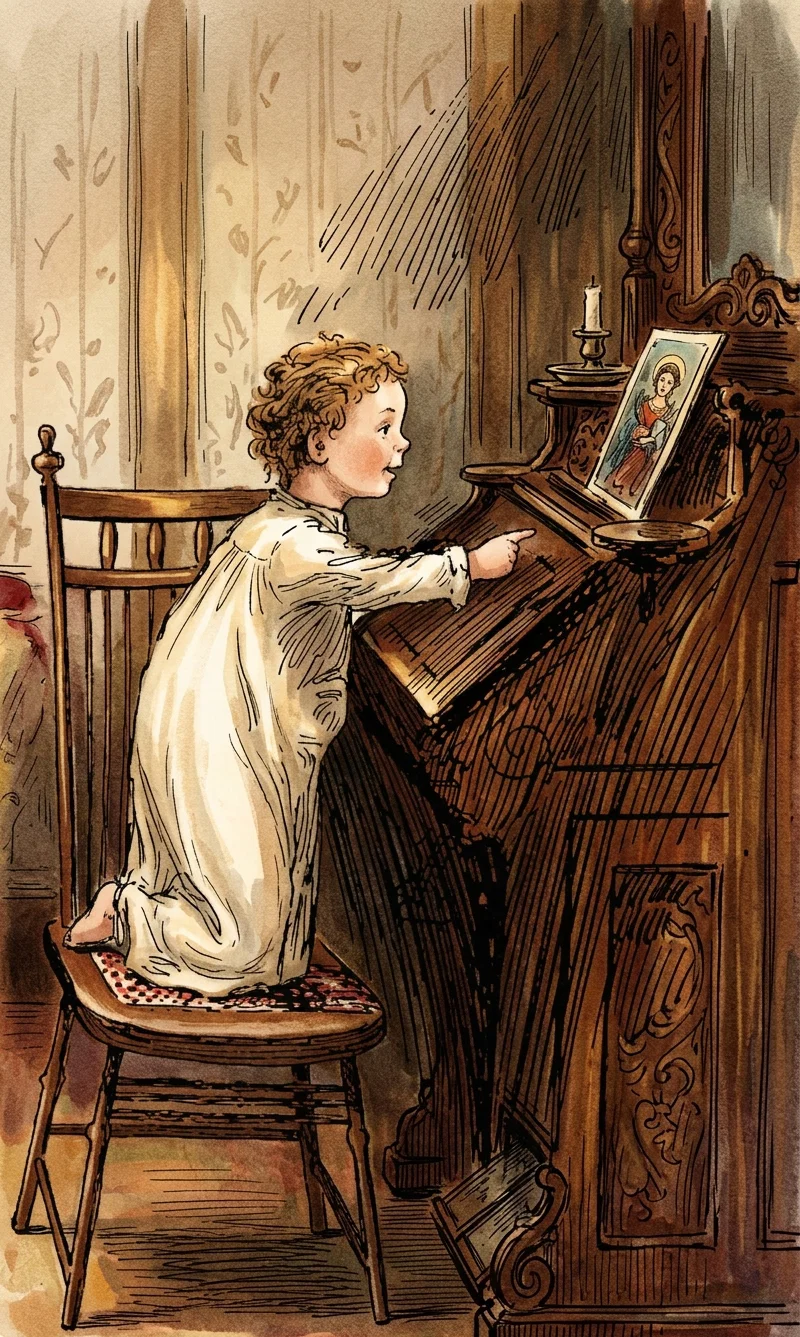
“Bonny was interested in the picture.”
Bonny was interested now in the picture of “Saint” Cecelia, at her organ. His little fat fingers were poked into the pictured roses, his hands smoothed the angels, and he wanted to kiss “the boo’ful yady.” “Moosic,” he lisped, and then he snuggled down in his mother’s arms, relaxed, as she sang:—
“Now I lay me down to sleep; I pray the Lord my soul to keep.”
What was the soul? questioned the mother. She looked at the picture. Something shone in that beautiful face, something that lit and reached out. What was it more than the artist’s conception? Had he seen it on some human face? What was it? “It was,” she said, “the capacity of knowing and of loving God and all. It was the developed spiritual nature that finds how thinly intervene the veils between the seen and the unseen, the temporal and the eternal.” A great longing took hold of Mrs. Bradly’s heart.
“Now I lay me down to sleep; I pray the Lord my soul to keep.”
Baby was asleep; fair and fresh, with a look of angelic peace, his face lay on his mother’s bosom. She looked at him long and lovingly. The look was there,—the tracing of the lovely and the holy.
“O love, keep his soul!” she whispered, as she remembered how the innocent grace of childhood is marred. As she laid him down to sleep, she left a kiss and a tear on his rosy cheek.
“I pray the Lord my soul to keep,” she prayed, as she laid off the day’s garments, and robed for the night. How still it was! Her couch was snowy. She thought of the time she should be robed for her last sleep; would she lie down as peacefully?
Aleck was away. She was alone with grandma and the children. What if peril, robbers, fire, danger should come? “Even the night shall be light about me.” “Come, My people, enter thou into thy chambers, until the indignation be overpast.” “I will both lay me down in peace, and sleep; for Thou, Lord, only makest me to dwell in safety.” “No evil shall befall thee, neither shall any plague come nigh thy dwelling.” “The Lord shall preserve thee from all evil; He shall preserve thy soul.”
One after another the Comforter whispered these texts, and peace flooded her soul. She sank into sleep, repeating, “He shall preserve thy soul.” What would it all profit her should that marvelous capacity for love be lost? But it would not.
The night passed. Something wakened her, saying, “When I awake I am still with Thee.” A smile played over her face ere she opened her eyes, as she prayed, “My soul to keep.” If it needed keeping in the night, then surely in the day. She lay a moment looking out of the window. It was early. The east was flushing softly, shading from one change of color to another,—gray, rose, purple, and gold. The miracle of the morning struck her as never before, and again a spiritual significance touched the whole into revelation for her soul. “If we follow on to know the Lord; His going forth is prepared as the morning.” “Unto you that fear My name shall the Sun of Righteousness arise with healing in His wings.” Would the glorious Lord so gently, so tenderly, as she was able to bear it, through that day open out to her soul the marvelous changes of His love, growing richer and richer? Yes, she would follow on, walking softly, “my soul to keep.”
But the day must be met,—the old cares, the old trials. How could the soul be kept? “If”—she paused—“if only it were a holy day or a holiday; but it was wash day.” “Thou wilt keep him in perfect peace, whose mind is stayed on Thee; because he trusteth in Thee.” That was the way the soul was to be kept on all days. But the children were waking, and there was the door-bell.
“O Aleck, how is it you are back?” she exclaimed as her husband met her at the door.
“Unexpected providence,” he said. “Don’t you know, dear, ‘the steps of a good man are ordered by the Lord; and he delighteth in His way’? He shall keep the feet of His saints.”
Mrs. Bradly smiled and flushed. Not the soul only, but the feet, and the steps, even, were to be kept. Was it all involved in the soul-keeping? But she would not tell him in words of what God was teaching her of soul-keeping. She seemed as shy about it as a coy girl, as if it were something between her and her heavenly Lover.
The children were washed and dressed. “Read the sixth of John,” said Mrs. Bradly, handing her husband the Bible for morning prayers. How eagerly she listened to the miracle of feeding the five thousand, of gathering the fragments, and of the spiritual bread that came down from heaven, of which if a man eat he shall never hunger! “My soul to keep,” the words still sounded in her heart. Then they all prayed the Lord’s prayer, saying, “Give us this day our daily bread.” “Daily,” thought Mrs. Bradly. “It must be fresh morning by morning. The old manna turned to corruption. It must be a daily, living experience.”
What a pleasure it was to prepare breakfast!
She paused over the bread ere she cut it. “The bread of life,” she thought. “Is this, too, the figure of Him on whom my soul must feed to be kept?” Yes, it was, she saw, the very life of Christ.
Mr. Bradly started, wondering, as she said, “Ho, every one that thirsteth, come ye, buy bread and milk without money and without price—or, otherwise, come to breakfast.”
Was she becoming a little irreverent? No, he saw her face lit up with inner glory.
“You have a look like Saint Cecelia this morning,” he said with a smile.
She flushed, and pointed to the table, and said, “I have eaten my honeycomb with my honey, I have drunk my wine with my milk; eat, O friends, drink, yea, drink abundantly, O beloved!”
Then Mr. Bradly understood that some new thought of God’s love had unfolded to his companion. She sat smiling as they ate, with her food untouched, and he urged her to eat. With a bright look she answered, “I have meat to eat that ye know not of.”
If she had not been so quiet, he would have answered her differently. As it was he supplied her plate, and said, “‘Every creature of God is good, and to be received with thanksgiving.’ Eating itself is a divine ministration.”
Mrs. Bradly thought she fathomed the meaning of the artist who had painted angels doing up the work of the house. Why should it not be done heartily as unto the Lord? She repeated Herbert’s line, as she took the broom:—
“‘He who sweeps a room as for God’s laws, Makes that and the action fine.’”
“Whatsoever ye do, . . . do it all to the glory of God.” Could it be that all the little trifles could be done to His glory? She would do them all, singing and making melody in her heart unto the Lord.
But before the children were off to school, she grew weary. Pet was so fretful, and Puss broke one of her old colonial dishes. Bonny was into all sorts of mischief, and all of a sudden an impatient utterance flew to her lips.
“O you naughty, naughty girl,” she exclaimed! “What a perfect nuisance you are? I’ll be glad when you’re out of the way.”
Puss looked astonished, her chin quivered, and the great tears rolled over her cheeks. Mrs. Bradly’s peace was broken, and in his study Mr. Bradly sighed. “Why had the revelation proved ineffectual?”
Puss was bundled up for school. Pet was already calling her from the bottom of the steps. She ran and fell. Bump, bump, bump went the little bundle on the steps. Mrs. Bradlyflew from the kitchen; but Mr. Bradly was there before her; leaping down the stairs, he caught Puss to his breast. How white his face was, filled with alarm and anguish! But it soon cleared up.
“She’s not hurt, mama,” he cried. “You rolled her up till she was like a cotton-batting doll. Run back and kiss mama.”
Puss had her kiss, and felt her face wet with tears. Mr. Bradly read repentance in the face of his companion, and stooped for a moment to whisper: “Like as a father pitieth his children, so the Lord pitieth them that fear Him. . . . He remembereth that we are dust.” She understood,—as he had hurried to pick up his little stumbler, so the heavenly Father hurried to aid her weakness. “Tho I fall, I shall not be utterly cast down.”
FRANCES E. BOLTON.
(Concluded next week.)