LET us pause for a moment upon the outermost member of our sun's great family before we take our flight across the vast gulf that separates us from our sun's nearest neighbor, a Centauri, a star that is less than half the distance to the next nearest star—61 Cygni. Looking back, the human mind is overwhelmed by the immense magnitude of the worlds we have passed; the enormous distances that lie between them are incomprehensible to the human mind, and we shrink from the eternity of space before us. Vast as is the system comprised within the orbit of Neptune, it is, as we shall soon see, only as a grain of sand on the shore of this ocean of eternity upon which we are now to launch ourselves.
Until now we have been counting the time of our journey, flying with the speed of light, as we are, by seconds, minutes, and hours. But now this will not suffice us; we must deal with days, weeks, months, years, and centuries, for our very next stopping-place will require over four years for us to reach.
The solar system is itself enough to declare the glory of God and quicken our sluggish thoughts to contemplate His omnipotent power and wisdom. No boundary can be set to our Father's House; the awful grandeur, the amazing aggregations of thousands and thousands and millions of suns (for each star is a sun), arranged in pairs, groups, and clusters, held in place by God's great laws, all moving in the most perfect harmony, all in their appointed places, not in a state of rest, of stagnation, for all nature is at work—for the stars are flying in their appointed paths with a velocity that is startling; thus, Arcturus and Alpha Lyræ are approaching us at the rate of fifty miles every second; others are receding with equal velocity; yet so vast is the gulf between us that hundreds, maybe thousands, of years must elapse before we could detect the slightest increase or decrease of their light by the unaided eye.
The naked eye, under the most favorable conditions, can not see over five thousand stars in all the sky. A good opera-glass will increase this number to an astonishing degree, while a powerful telescope—say of a diameter of five inches or more—will bring forth millions from the depths of space. In the constellation Hercules there is a little spot of light, barely visible to the sharpest eye, apparently only a tenth part as large as the moon, and yet this little speck is a cluster of fourteen thousand suns! These suns may be smaller or dimmer than our own sun, but they may surpass him in size and splendor. The astronomers can not tell anything about it in this case, but there are stars that are known to be immensely superior to ours, while others are not nearly so great. It is believed that our sun is far less than the average of the stars in size and brightness.
Astronomers are wont to deal with incomprehensible distances by comparing the speed of railroad trains, cannon-balls, and the like; but while these are capable of giving us some idea of the solar system, they are useless when we deal with stellar space.
I will endeavor to give a comparison that may clearly bring to our minds one of these vast intervals between the stars—that separating our star, the sun, and our next-door neighbor, a Centauri. This star, tho the very nearest of them all, is about twenty-five millions of millions of miles away. This is absolutely meaningless to the mind of either the layman or the astronomer. The human mind breaks down at this point as completely as if the distance were a thousand times as great. We can understand it, but we can not comprehend it.
For illustration, let us imagine our sun reduced from a vast globe eight hundred and sixty-four thousand miles in diameter, to a ball only nine feet in diameter; next let us imagine that all the planets and all space should dwindle down to just the same proportions; then would our earth be less than a thousand feet from the sun, and it would be only one inch in diameter, while our near neighbor, a Centauri, would, on this same scale, be nearly fifty thousand miles away!
Another way of expressing the same thought would be to say that the distance from our sun (or Earth) to the nearest fixed star is just as many times fifty thousand miles away as our earth is larger than a good-sized marble; or, for every marble that it would take to make a world as large as ours, a Centauri is fifty thousand miles away. Do the heavens begin to show the glory of God as we look into His treasure-house?
We will continue our journey now, and again on the wings of light we are speeding away at the rate of six hundred and sixty-nine million six hundred thousand miles an hour. A few hours, and the last vestige of the solar system has passed from light, excepting only our sun, and he at this point outshines every other body in all the visible universe. In about two and one-quarter years we will be at the half-way point, and then if our sun and a Centauri are of equal size and brightness, both would appear the same. The bright star, Sirius, and all the rest of the stars would appear about as they do from the earth. In a little over four years (late measures make the distance somewhat greater than this) we would be in the midst of the system of a Centauri.
We would see our sun as a first-magnitude star, but the planets would be entirely invisible, even in the most powerful telescope man has yet constructed; and, according to Young, it would require a telescope twenty-four feet in diameter (and it would be about four hundred feet long) to show even the giant Jupiter from such a distance. This being the case, we can readily understand just why we can not actually see the planets circling round their central suns. Should the question be asked, How then do the astronomers tell of other worlds around other suns? I can not enter into an explanation here, but they know it without seeing them! Indeed, the companion to Sirius was discovered years before it was seen, by the motions (perturbations, astronomers call them) of his majestic primary, and its position exactly computed. Again, Procyon has a companion that has never yet been seen, altho its existence is known as certainly as if the telescope brought it to our view.
Were we to continue our journey, we would see our sun dwindle away into a mere glimmering point of light, and finally it would vanish altogether.
Only about one hundred stars give anything like satisfactory evidence of their distance, and not more than forty furnish measures that place the question beyond dispute. All the remaining millions are plunged into the vast eternity of space we call the universe, to a distance that the astronomer has as yet been unable to penetrate with certainty.
Here one is tempted to dwell upon how vastly the stars vary among themselves in size and light, and we will linger a moment to see what are the latest conceptions of the beautiful star Arcturus, based upon the exquisitely delicate measures of Dr. Elkin, whose reputation for accurate work is world-wide, and he probably stands at the head of this most intricate and difficult branch of astronomy—the measurement of stellar distances. The result, eighteen-one-thousandths of a second of arc, is the smallest reasonably reliable result ever obtained, and fairly astonished astronomers. Assuming it is correct, and astronomers do not appear to doubt it, this star, the theme of song and story since history was writ, twice mentioned in the oldest of records, the book of Job, is at such a distance that the light that leaves him requires 181 years to span the gulf that separates us. He is so much brighter than our sun that, could we remove our sun to an equal distance, it would require a fairly powerful telescope to show it as a faintly glimmering star of about the tenth magnitude. Could we be removed one hundred and forty thousand times farther from our sun than we are now, then would our sun appear to us about as bright as Arcturus, while if we increased our distance the same amount from this stellar giant, the difference in his brightness would probably not be appreciable, for Arcturus is eleven and one-half millions of times farther away than one hundred and forty thousand times ninety-three million miles. His brightness has been computed (assuming that a given area of his surface gives out the same amount of light as an equal area of our own sun) to be about five hundred and fifty-eight thousand times as bright, and that in size he is more than a million times as large as our own sun. His heat is about proportionate to his light, and, if we were placed as near Arcturus as we are to our own sun, the very rocks and metals would melt and turn to vapor like a drop of water in a sea of fire.
In addition to all this, Arcturus is a runaway. That is, his velocity is so great (nearly 400 miles per second) that the combined attraction of all the stars we know can not stop him or swerve him from his course; no, not even if the universe is many times larger than the wildest conceptions of astronomers. And this magnificent globe, with his attendant worlds, is sweeping majestically on, passing through our universe for the first time. How grand the words we find in Holy Writ: “Canst thou guide Arcturus with his sons?” Job 38:32.
We have scarce begun our journey, reader; but we have learned this great fact, that only in an eternity of time can we pass through an eternity of space, only with infinite time can we comprehend infinite works, and at the5snail's pace of 186,000 miles a second, it would require from tens of years to centuries to visit our near neighbors of the star depths, while it would require thousands and thousands (estimated at 50,000) of years to reach the stars that lie at the limit of vision of our greatest visual and photographic telescopes. And is this the universe? is this our Father's House? are the stars barely visible in our great telescopes on the outskirts? Every increase of telescopic power has increased our power of penetration, and every thinker finally reaches the unphilosophical and incomprehensible conclusion that there is no end,—no bounds, no center, no circumference!
To show that our journey, even though it could be carried on under the conditions we have imagined, would end in failure, let me give a few brief results of recent work in astronomical photography, which has in the last fifteen years revolutionized the study of the star depths. A photograph in my possession of the central parts of the great constellation of Orion shows thousands upon thousands of stars where only eight are visible to the unaided eye. In the square formed by the three stars in the belt, the star μ, and the upper star in the sword, where the naked eye sees nothing but a blank space, is an incredible number of stars. I have never had either the time or the curiosity to count them. This photograph would be counted as poor work compared with some of the marvelous productions.
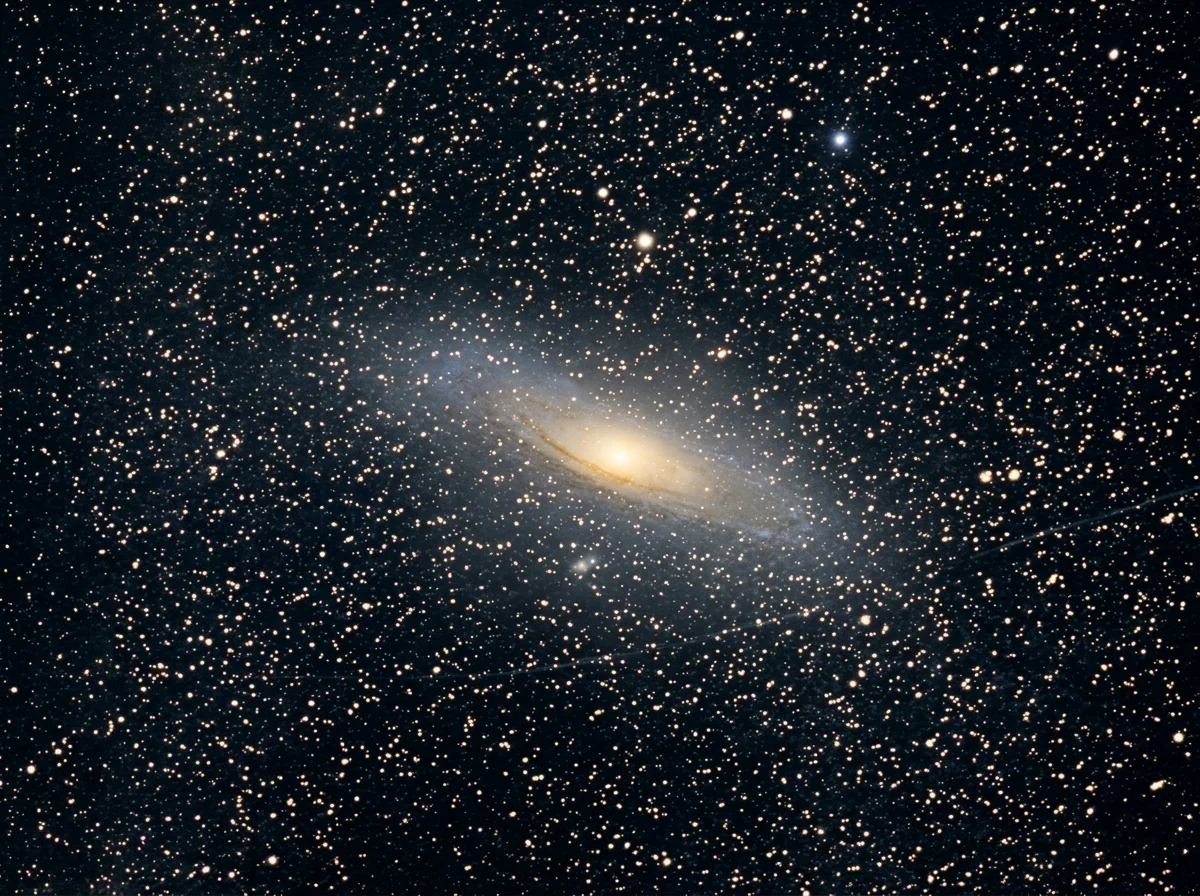
One of the astronomers of the Lick Observatory recently photographed, with only a six-inch lens, that portion of the constellation of Andromeda in which is situate the great nebula. The space on the sky covered by the photographic plate was about ten degrees square; to the ordinary observer two stars are visible (μ and ν Andromeda); the keen-eyed astronomer could perhaps see six, while the photographic plate shows sixty-four thousand running together in one unbroken blaze. (See illustration.)
Another plate exposed to one of the richer portions of the Milky Way shows so many stars that it is impossible to count them. The plate may show five hundred thousand or a million and five hundred thousand. There are simply clouds of stars, each one of which would be invisible even on the photographic plate unless it were a sun, for they are photographed by their own light!
And now for the most astounding conception it has ever been my lot to know: assuming that one-tenth of the light we receive at night comes from the stars (and we can see well enough to follow roads and distinguish objects, etc., at night, without the aid of the moon, and of course this is starlight), a recent computation shows that we receive this light from no less than sixty-six milliards (sixty-six thousand millions) of stars, counting only stars as faint as the seventeenth magnitude, and our greatest telescopes will show us stars to the eighteenth or even less. Verily, "the heavens declare the glory of God; and the firmament showeth His handiwork," and it is the fool who saith in his heart, "There is no God."
Our wildest dreams and conceptions of the power of the Creator shame us with their insignificance. The reality overwhelms us, and our minds and hearts grow sick with the knowledge of this infinity of greatness. Lo, this is the God of the astronomer! Utterly dazed and overwhelmed with the grandeur and immensity of our Father's House, bewildered and hopelessly cast down with the thought of our nothingness, we read with a new understanding the words of the Hebrew poet: "When I consider
From a photograph of the great Nebulae of Andromeda, taken by Prof. E. E. Barnard, formerly of Lick Observatory, now of Yerkes Observatory. Time of exposure, 4 hours 18 minutes. During these exposures the eye of the photographer is kept constantly fixed on some star bisected by cross wires in the eye-piece.
Thy heavens, the work of Thy fingers, the moon and the stars, which Thou hast ordained; what is man, that Thou art mindful of him? and the son of man, that Thou visitest him?" But what a comfort it is to know that even a sparrow can not fall to the earth without His knowledge, and that we are more than many sparrows!
How strange it seems that God should consider us worthy of the sacrifice of His Son! But God's ways are not our ways, and after the thoughts with which we have been dealing, we perhaps more fully realize what is meant when God tells us: "My thoughts are not your thoughts, neither are your ways My ways, saith the Lord. For as the heavens are higher than the earth, so are My ways higher than your ways, and My thoughts than your thoughts."
How strange it seems that men whom God has endowed with minds to grasp these mighty problems, can lightly pass or entirely ignore the laws of the great Creator and the sacrifice of His Son, for the frivolity and sin that everywhere surround us. They are mad. "Father, forgive them, for they know not what they do."
I can do no better than to quote the words of the German poet Richter in his sublime thoughts on this subject: "God called up from dreams a man into the vestibule of heaven, saying, 'Come thou hither, and see the glory of My house.' And to the servants that stood around His throne, He said, 'Take him, and undress him from his robes of flesh; cleanse his vision, and put new breath into his nostrils; only touch not with any change his human heart—the heart that weeps and trembles.' It was done; and, with a mighty angel for his guide, the man stood ready for his infinite voyage; and from the terraces of heaven, without sound or farewell, at once they wheeled away into endless space. Sometimes with the solemn flight of angel wing they fled through Zaarrahs of darkness, through wildernesses of death, that divided the worlds of life; sometimes they swept over frontiers, that were quickening under prophetic motions from God. Then, from a distance that is counted only in heaven, light dawned for a time through a sleepy film; by unutterable pace the light swept to them, they by unutterable pace to the light. In a moment the rushing of planets was upon them; in a moment the blazing of suns was around them. "Then came eternities of twilight, that revealed, but were not revealed. On the right hand and on the left towered mighty constellations, that by self-repetitions and answers from afar, that by counter-positions built up triumphal gates, whose architraves, whose archways—horizontal, upright—rested, rose—at altitudes by spans—that seemed ghostly from infinitude. Without measure were the architraves, past number were the archways, beyond memory the gates. Within were stairs that scaled the eternities below: above was below—below was above, to the man stripped of gravitating body: depth was swallowed up in height insurmountable, height was swallowed up in depth unfathomable. Suddenly, as they rode from infinite to infinite, suddenly, as thus they tilted over abysmal worlds, a mighty cry arose—that systems more mysterious, that worlds more billowy,—other heights and other depths,—were coming, were nearing, were at hand.
"Then the man sighed, and stopped, shuddered, and wept. His overladened heart uttered itself in tears; and he said: 'Angel, I will go no farther. For the spirit of man acheth with this infinity. Insufferable is the glory of God. Let me lie down in the grave and hide me from the persecution of the Infinite; for end, I see, there is none.' And from all the listening stars that shone around issued a choral voice, 'The man speaks truly: end there is none, that ever yet we heard of.' 'End is there none?' the angel solemnly demanded. 'Is there indeed no end?—and is this the sorrow that kills you? But no voice answered, that he might answer himself. Then the angel threw up his glorious hands to the heaven of heavens, saying, 'End is there none to the universe of God. Lo, also there is no beginning!''
Let us end our journey now, reader, and return to our little present home we call Earth, and let the distant stars, with their attendant worlds, whirl and wheel and roll and shine in the boundless empire of space, while a new light—the light of God's universe—shines upon His word, that carries us backward to the time when "in the beginning God created the heaven and the earth," and when the "morning stars sang together," and forward to the time when there will be a "new heaven and a new earth," and the overcomers shall inherit the kingdom.