Bethel to Jerusalem

7%

Pacific Press Publishing Company · Oakland, California · Oct 27, 1898

FromSigns of the Times, Vol. 24, No. 43.

Read the full edition

Bethel to Jerusalem

JOTTINGS FROM PALESTINE. NO. II.

Bethel to Jerusalem.
Shortly after leaving Bethel we pass a spring and a large reservoir hewn from the native rock, to preserve the water for irrigation purposes. It is needless to say that the reservoir is now in ruins and the land not irrigated. About two hours from Bethel, and the same distance from Jerusalem, we pass Ramah. When within an hour’s ride of Jerusalem, we were opposite Mizpeh, situated on quite a high eminence to the west of us; but a short distance north of Mizpeh is Gibeon, whose inhabitants by deception obtained an alliance with Joshua, and in consequence were doomed to be hewers of wood and carriers of water.
At Gibeon, while Israel battled with the five kings, the Lord discomfited the enemy with hailstones, and at the command of Joshua caused the sun and moon to stand still. Hither Abner resorted with his forces when he attempted to make Ish-bosheth, son of Saul, king, and was met by Joab, when hostilities were opened by twelve chosen young men from each side; it was near Gibeon that Joab treacherously killed Amasa; here Solomon had the vision in which he made the novel choice of wisdom in preference to riches; and it was here that he offered a thousand burnt-offerings. It seems also that Gibeon was one of the “high places,” and that for a time the tabernacle was here, while the ark was in Jerusalem.
A short distance west of Mizpeh lies Emmaus, tho it was not visible from our route. Soon after passing Mizpeh, we were opposite Gibeah of Benjamin, on our right. Here occurred the disgraceful murder of the concubine of the Levite, which nearly resulted in the extermination of the tribe of Benjamin. After Saul was anointed king, he dwelt here; it was at Gibeah that he hewed the oxen in pieces, and sent them to the tribes as a call to arms; from here, Jonathan gained his noted victory over the Philistines; and it was at Gibeah that seven of the sons of Saul were hanged. This was all within an hour’s walk from Jerusalem.
Shortly after passing Gibeah, we were opposite Anathoth, situated three miles from Jerusalem. This was the home of Jeremiah, and is now a small place called Anata. About a mile on the way from Anathoth toward Jerusalem is Nob, the city of the priests, to which David fled from Saul, and where he took the showbread and sword of Goliath. Nob is but a little more than a mile from Gibeah, where Saul dwelt. Gibeah, which means “high,” is 2,690 feet above the sea, or about 200 feet higher than Jerusalem, and hence commands a fine view of the country even beyond the Dead sea, far into the mountains of Moab. We halted here some time, to enjoy the fine view; all in this vicinity is desolation and ruins, yet there are more evidences of ancient building operations than farther north.
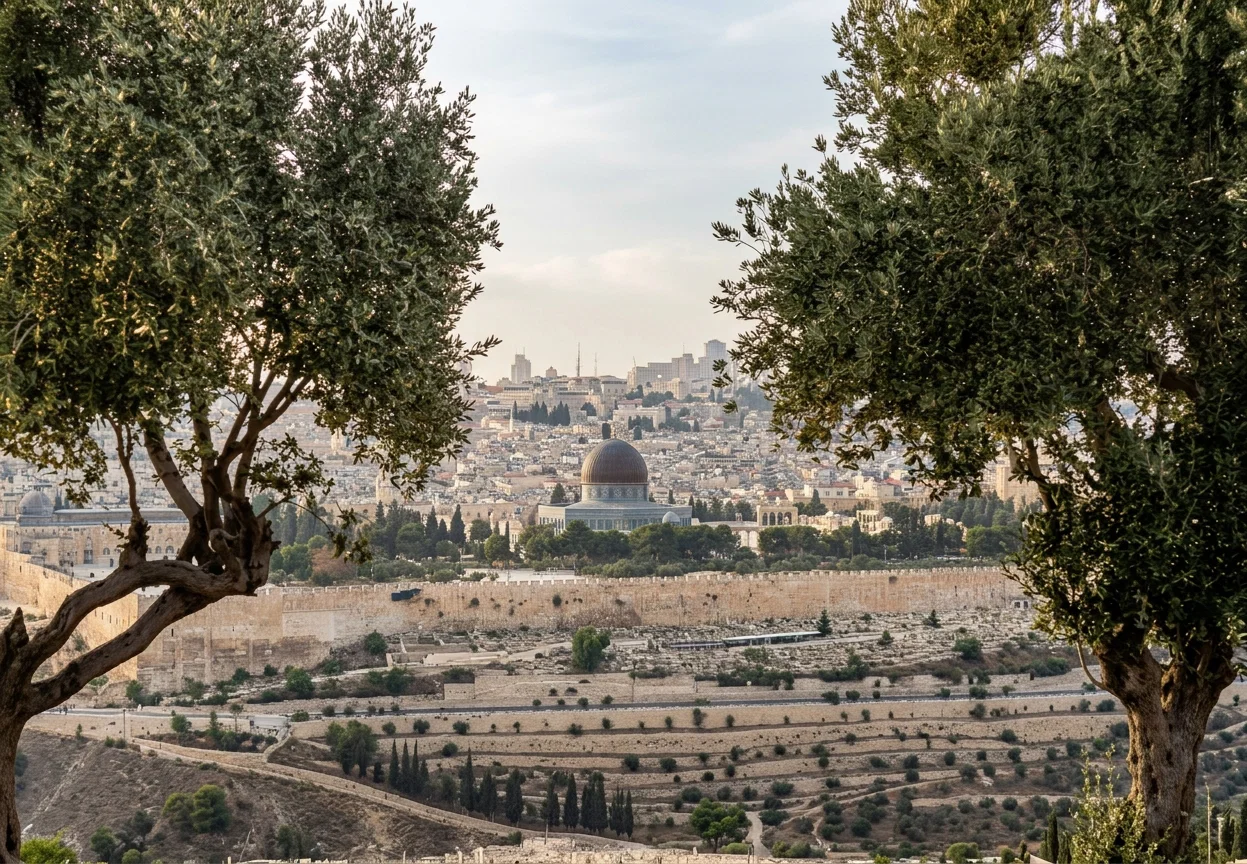
A VIEW OF MODERN JERUSALEM.
About a mile from Gibeah, we were on Mount Scopus, where the Roman army was located during the siege of Jerusalem under Titus, A.D. 70. From this point, the view of the city is excellent; we could see nearly the entire surface of the city and surrounding walls; just in front of us was the Damascus Gate; to the left, the large space where Solomon’s temple stood; and to the right, the Joppa Gate and the Tower of David. A little to the east of the city, and considerably higher, rises Mount Olivet; and between it and the city is the valley of the brook Kidron, or the valley of Jehoshaphat.
Descending from Mount Scopus and crossing the valley of Jehoshaphat, we entered Jerusalem by the Damascus Gate and took up quarters near the center of the city in the hospice of the Knights of St. John. Here I took leave of my Arab companion, who proved to be an honest man, fulfilling his agreement perfectly, and making no efforts at extortion. I was afterwards informed that few such men are to be found; and from my own experience in the Orient, it is not hard to believe this assertion.
What a delight it was to be in this place! How thronged is this city and surroundings with sacred memories! How much of the Bible history was here enacted! And now I could walk about, and behold the many places mentioned in the Bible narrative, and, above all else, the places visited by the Saviour just before His crucifixion. I wanted to walk about alone, and not be disturbed by the chatter of a guide who is more familiar with uncertain tradition than with the Bible. My pocket Bible was a more satisfactory guide than any man. Many guide-books have been written about Jerusalem and the Holy Land, but none are equal to the inspired Guide-book.
I will not in my account attempt to give an exhaustive description of Jerusalem and surroundings, and the many institutions located here, but will give a simple account of the places which I could visit during my brief stay, and speak of them as I saw them. Leaving the hospice, I made my way westward towards the Joppa Gate. There are many grades in the city, some of them quite steep; the streets are all narrow, averaging from ten to twenty feet wide, and are unusually well paved for an eastern city; most of them are crooked, and, generally, they are crowded with all sorts of people, animals, and wares. Nearly every nationality is represented here. Many of the shops and stores are but alcoves opening to the street, with the wares displayed where the sidewalk should be; this leaves only a narrow space in the center for the passage for people and animals; and the animals, mostly donkeys, have great loads of wares in huge baskets hanging like saddle-bags on both sides, one is obliged to dodge to the right or to the left, and often wait some time, to avoid a collision. For the most part, the wares exposed for sale are not very inviting in appearance. The Eastern idea of cleanliness prevails in Jerusalem.
In less than ten minutes, we have reached the Joppa Gate; just before reaching it, we pass a tower in the wall on our left, called the Tower of David, situated in that part of the city called Mount Zion. It is on the opposite side of the city from the temple, and is nearly the highest part. Just without the Joppa Gate are many stores in modern style, and several hotels for the accommodation of tourists. As a rule, pilgrims, who sometimes come in large numbers, lodge in the hospices of their respective churches. From the Joppa Gate to thenorth, quite a large quarter, containing many good buildings, has recently sprung up; and the building still continues. One of the large hotels stands on the site occupied by the Tower of Hananeel.
From the Joppa Gate, we walked down a steep grade, by a well-made road, to the south, reaching the Valley of Hinnom, below the south-west corner of the city wall. Between the Valley of Hinnom, which is on the south of Jerusalem, and the valley on the west, which unites with the Valley of Hinnom, we cross by a bridge, and continuing south about half a mile, we reach the station of the only railway in Palestine, that running between Joppa and Jerusalem. Just beyond this station, on the west, is the German Temple Colony of 48 families, founded by the same movement as the colony at Haifa. Here we find the various industries as carried on in a village of Germany, including a steam flouring-mill and a beer brewery. Surely Jerusalem is being civilized! We here stop to visit the families of this colony, and will continue our walk in another number.
H. P. H.