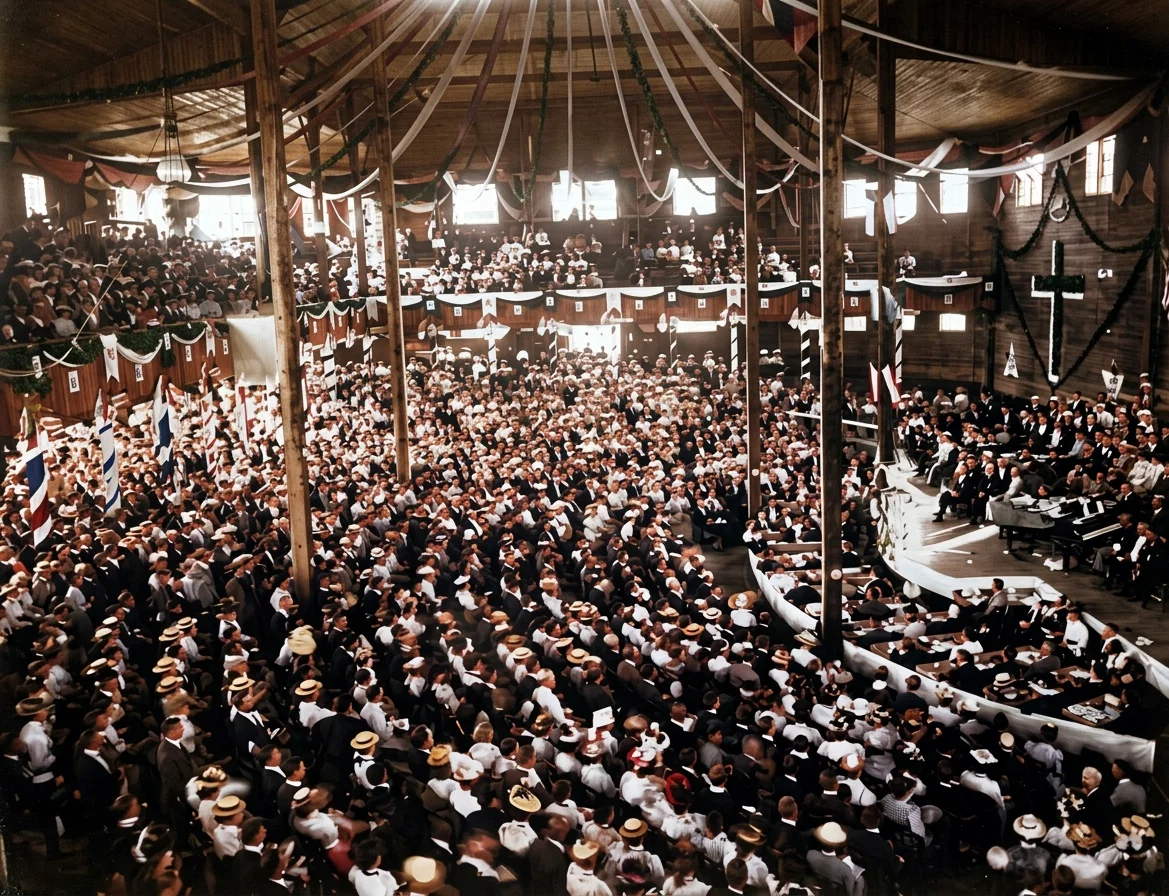
The seventeenth annual convention of the Christian Endeavor Society was held at Nashville, Tenn., July 6–11, 1898. While the convention was the smallest numerically of any held by that body for many years, yet what was lacking in numbers seemed to be made up in enthusiasm. The entire registration of those from outside the city was published as being 6,800, not over a third or fourth of what it is reported to have been at some of the conventions in recent years. Various reasons were assigned for this falling off in attendance, but whatever the real causes may have been, it was clear that zeal and earnestness had not died out of the hearts of those who were in attendance.
The name of the organization is beyond question very appropriate for many of the adherents, and doubtless the organization numbers among its workers many of the devoted followers of the Master. It would require much space to mention the many good things that were said; the encouraging reports that were given of missionary work that is being done among the benighted heathen of other continents; the blessings to be received by consecrating the tithe of one’s income to the Lord; the necessity of devoting a stated portion of time each day to silent or personal communion with God in order to true Christian living; the efficient work that may be done for youth and children by using blackboard illustrations with colored crayon—chalk talks—to interest them in scriptural topics,—all these were intensely interesting. The last mentioned is by no means an unimportant matter. If youth and children will become as much interested in this as adults—judging by the experience of the writer—this will be a powerful factor in the hands of the teacher who has a love for souls, in enlivening the young mind to a happy appreciation of Bible instruction.
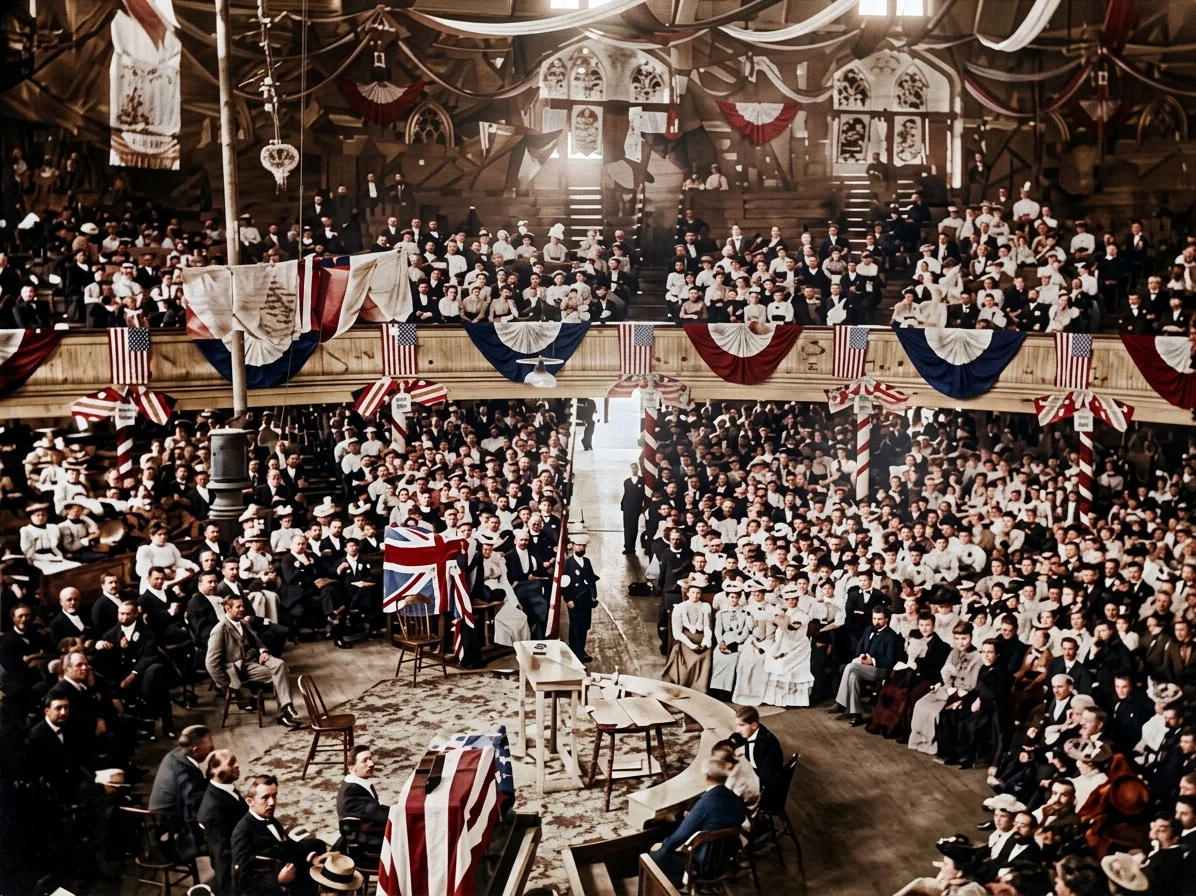
The endeavor to live a Christian life is the highest aim that young or old can have, and it is sad to see such endeavor perverted or turned from its original purpose. The term world endeavor as signifying a broader mission was sometimes substituted for Christian endeavor. It was publicly stated that “patriotism” was the keynote of this convention. A deep interest was manifested in the political affairs of the nation; “the line between civil and religious matters should at this convention be forever wiped out.” The pulpit of the convention assembly room was completely covered with the flags of the United States and Great Britain, and allusions to the prospective alliance between these two countries were greeted with tremendous cheering and applause. Under this union these nations would be invited in their gigantic strength to carry the Gospel and Christian civilization to all other countries, even to the ends of the earth.
Auditorium of the Centennial Grounds, Nashville, showing first general meeting of the Y. P. S. C. E. at the International Convention.
Scene in the Union Gospel Tabernacle, Nashville, where the devotional meetings of the International Convention of the Y. P. S. C. E. were held.
The recent conflicts with Spain were cited as proof that God was on the side of the American arms. It was stated that the signal victory of Admiral Dewey at Manila harbor, and the more recent naval engagement near Santiago, were as marked demonstrations of divine interference and the presence of God with the conquering forces of the nations as any that were recorded in the book of Exodus. Such overwhelming defeat of the enemy, with almost no loss of life whatever on the part of our soldiers, was undeniable proof of the presence of God with the hosts of His Israel of to-day. No allusion was made in this connection to the experience of our land forces in Cuba, the many hundreds who have fallen before the foe. One speaker said if the victory at Manila had been recorded as one of the experiences of ancient Israel, the higher critics would say to-day that that was an impossibility, that it never could have occurred.
It seemed to be taken for granted that war by a Christian people in defense of right was justifiable. In this particular the incidents and practises of Old Testament times were made the basis of reasoning. The non-resistant teachings of Christ in His instructions to His followers were not introduced in this matter. There seemed to be an unfortunate forgetfulness of the statements of the Master that His kingdom is not of this world, that His followers are not to resist evil, or seek to avenge themselves. The distinction, “Render therefore unto Cæsar the things which are Cæsar’s; and unto God the things that are God’s,” seemed to be left out of the question, as tho no line should exist between the things of religion and the concerns of earthly governments. The endeavor of our youth and of all Christians, it was thought, should now be along the lines of national issues, loyalty to this Christian government and its institutions.
There was, it was said, no danger of this nation’s ever going to war against Great Britain, for there was too much of the Spirit of Christ in each of these for them to ever fight each other. The question arises whether the Spirit of Christ merely keeps us from fighting our friends, or will it not also restrain us from fighting our enemies? “Love your enemies, do good to them which hate you.” Luke 6:27.
Representatives of the National Reform Association and American Sabbath Union were on hand to impress upon the people the necessity for more aggressive work along the line of sabbath (Sunday) reform. The observance of Sunday was presented as the foundation of national greatness and national security. Undermine the Sunday and the nation will go to ruin. So an effort was made by these Sunday advocates to focus the whole matter down to the point of earnest effort to secure a better observance of the national weekly rest day. Strict Sunday observance was represented as the emblem of good government, a righteous nation, and Anglo-American civilization. On the other hand, Sunday desecration led to the debasing indulgences of the European Sunday holiday, immoral pastimes, Spanish bullfights, and was in fact an emblem of Latin and Spanish civilization. To be a good Sunday-keeper is to be a good American; to be a Sunday desecrator is to accept of Spanish customs and Spanish tendencies, and of course it would be hard to find anything more unpopular now than a Spaniard.
Strong appeals were made in behalf of the sabbath (Sunday) cause. Much stress had been put upon the necessity of obtaining the abiding presence of the Holy Spirit. Said the representative of Sabbath reform before a limited number of workers: “You have been told how to get the Holy Spirit; I can tell you how to keep it. Your daily period of consecration will amount to nothing unless you go to work.” And the work presented to them was to circulate literature on the subject of stricter Sunday observance. In this way the blessing could be retained.
The matter of consecrating the tithe to God had been considered, and many had testified to the great blessing they had received in returning to the Lord the tenth of their income. The same speaker urged that not all of this money be used for foreign missionary or church work, but that a part of it be invested in Sunday literature to distribute among the people, for the work of converting the heathen to Christianity was seriously hindered by their knowledge of the fact that the Sunday was not observed as it ought to be in the country from which the missionaries come, hence the necessary work to be done was to reform the heathen at home. The people must be enlightened so that we can procure stricter laws for Sunday observance, and have them enforced.
It was stated that the preachers ought to be well acquainted with the law. A good Christian citizen is one who will help to make good laws, and, when necessary, to enforce them. Thus the sentiment of the people must be educated up to the point of enforcing the Sunday laws.
Good arguments were made in behalf of the enduring nature of the Sabbath commandment. We might as well talk about abrogating the fifth as the fourth commandment. It was stated that the Sabbath is a divine institution; that it inheres in the very nature of God Himself, as well as in the nature of man, for whom it was made; that that law is just as immutable as the law of gravitation; that we might as well think of abolishing sunlight as the Sabbath day.
(Continued on page 13.)9
International Christian Endeavor Convention.
(Continued from page 8.)
The strange thing in this regard is that those who make this argument do not discover that it is the seventh day of the week, the Sabbath, that is mentioned in the fourth commandment, and not Sunday, the first day of the week. What more reason is there for applying the fourth commandment to the first day of the week than there would have been to apply the first commandment to the calf that Aaron made? We hope many will see this point and be led to turn away from the precepts and commandments of men to the true observance of God’s memorial, the Edenic Sabbath, the Lord’s day, the real Christian Sabbath, because instituted and observed by Christ our Lord at the close of creation week.
To take a comprehensive view of this great Christian Endeavor movement we see a large body of well-designing men, women, and youth, endeavoring to do something for Christ and humanity. We see also a persistent effort made to divert the attention and work to political issues, national and international concerns and alliances, glorying in national emblems rather than in the cross of Christ, and concentrating the endeavor on the work of securing a closer connection between the Church and the State, securing legislation favorable to religious bodies and institutions, particularly the observance of the first day of the week. That these societies would not be very energetic in the way of securing Sunday observance unless urged on to do so by zealous leaders and agitators, would seem to be indicated by the fact that only three local organizations reported having done anything in that line. This was held up as indicating remissness in duty, when it was really a credit to the organization.
That many of these workers may, like the eloquent and devout Apollos of old, gladly learn the way of God more perfectly instead of heeding the misleading voices, is to be confidently expected.