ONE evening, at the Sunday Breakfast Association [Philadelphia], after a very full and clear explanation, the following questions were put and very fully answered by the raising of the hands in the congregation of nearly 900 poor, unfortunate, discouraged persons:—
1. How many had Christian parents and were instructed in religious life?
About 90 per cent. of all present raised their hands.
2. How many were faithful Sunday-school teachers?
About 75 per cent. raised their hands.
3. How many have been brought to their unfortunate, dilapidated condition by the use of strong drink, directly or indirectly?
About 75 per cent. replied.
4. How many commenced drinking before twenty-one years of age?
About 70 per cent. voted they did.
5. How many deliberately started out to be drunkards?
Two persons raised their hands.
6. How many started drinking liquor with the idea that they could and would stop whenever they wanted to?
About 75 per cent. of all the drinkers raised their hands.
7. How many who have had the experience in the path of sin will say to us, “Use all your influence and power to keep young men from the path in which we have been walking?”
About 98 per cent., nearly every hand, was raised.
At the close of the after-meeting, about 9:20 o’clock, when there were about 400 persons present, the following question was asked:—
8. How many are desirous of getting out of their sinful ways and would make an attempt to lead righteous lives, if they thought they could, and would succeed in holding out to the end?
Of those then present, about 95 per cent. held up their hands and seventy-eight persons came forward for prayer.
The above questions and answers ought to be very suggestive to any thinking person. We believe the answers are very accurate, as they were taken with great care, to get at the exact statistics.
These answers also show that 75 per cent. of these persons coming to the association are brought to their sad, deplorable plight by the effects of strong drink, and that the drinking commenced before they were twenty-one years of age.
These answers also show that, tho men’s better natures are blunted and seared by the awful curse of rum and other sins, yet deep down in the heart there is still some good and some tender feeling left which prompts them to say, almost to a man, “Use all your influence and power to keep young men from the path in which we have been walking.”—Rescue Evangel.
OUT OF TOUCH.
By Rays of Light
Only a smile; yes, only a smile
That a woman o’erburdened with grief
Expected from you. ’Twould have given her relief,
For her heart ached sore the while;
But weary and cheerless she went away,
Because, as it happened, that very day
You were “out of touch” with your Lord.
Only a word; yes, only a word
That the Spirit’s small voice whispered, “Speak;”
But the worker passed onward, unblessed and weak,
Whom you were meant to have stirred
To courage, devotion, and love anew,
Because when the message came to you
You were “out of touch” with your Lord.
Only a note; yes, only a note
To a friend in a distant land,
The Spirit said, “Write;” but then you had planned
Some different work, and you thought
It mattered little. You did not know
’Twould have saved a soul from sin and wo:
You were “out of touch” with your Lord.
Only a song; yes, only a song
That the Spirit said, “Sing to-night;
Thy voice is thy Master’s by purchased right.”
But you thought, “’Mid this motley throng
I care not to sing of the city of gold;”
And the heart that you might have reached grew cold:
You were “out of touch” with your Lord.
Only a day; yes, only a day;
But, O! can you guess, my friend,
Where the influence reaches, and where it will end,
Of the hours you have frittered away?
The Master’s command is, “Abide in Me;”
And fruitless and vain will your service be
If “out of touch” with your Lord.
—Rays of Light.
ANCHORED FROM ABOVE.
By Rev. George A. Paull
As a huge anchor goes down into the great deep and fastens its iron tooth upon the moveless rocks, holding the ship like a giant arm, so the Christian’s anchor of hope goes up into the heavenly sanctuary and fastens itself upon Jesus, and we are held safely forever, sure and steadfast. The Christian hope reaches up to heaven and whispers to the soul, “This light affliction is but for a moment.” God’s people meet adversity with courage, one trial after another, shock succeeding shock, because they are anchored safely, and have trust in God, and a sublime hope in His present favor and His future blessing.—Rev. George A. Paull.
READING AND CONVERSATION.
Reading will be of little use without conversation, and conversation will be apt to run low without reading. Reading fills the lamp and conversation lights it. Reading is the food of the mind and conversation the exercise. And, as all things are strengthened by exercise, so is the mind by conversation. There we shake off the dust and stiffness of a retired scholastic life; our opinions are confirmed or corrected by the good opinions of others; points are argued, doubts are resolved, difficulties cleared, directions given, and frequently hints started, which, if pursued, would lead to the most useful truths, like a vein of silver or gold which directs to a mine.—Great Thoughts.
THE PURPOSE OF LIFE.
LIFE is action. Life is growth. Life is progress. Life is overflowing and outflowing. Life’s harmony is giving. Death is fixity and stagnation.
God gave life to this earth that it might be a fitting home for his sentient, intelligent creatures; and life throbbed in it from center to circumference. God gave life to air, to plant, to tree, to fish and bird and beast, that they might bring forth of their kinds, beautifying the earth, and bless all that dwell upon it.
Neither was man made higher than all the brute creation that he alone might be served of them. Man was not placed over his fellow-man that he may be ministered unto and blessed, but that he may be a blessing to them. The law of life is that only in blessing may we be truly blessed. But many a soul finds the wish of itself expressed in the plaint of the little boy, “Mama, have some one ’muse me.” His whole idea of existence was that he was here to be amused, and that others were here to amuse him.
To everything God has created and made has He given a mission of blessing to others. Not a plant grows purposelessly; some one, something, is better because it has had being. Not a flower “wastes its sweetness on the desert air” for naught. It may indeed have been “unseen” by selfish man, but it bloomed not in vain. Its life may have sucked up and transmuted into beautiful tissue and odor some noxious decay. It may have furnished some insect its food, some bee its store of honey. It may have burst the clod, grown, bloomed, ripened, and died, not knowing another life; but its seed may have been carried by wind, or bird, to grow again, and so be a blessing to many lives.
God’s sunlight wraps up in its potentialities all blessings. The day is a constant minister to the activities of life. The night is a soother to sleep and rest. In the blessed Sabbath day are stored blessings to the child of faith who may unlock its treasure-houses and revel in its higher joys. In all God’s works, sentient and unsentient, there are blessings innumerable for all. It is only selfish man who desires and endeavors to turn all these things to his own lust and profit and pleasure; and all the perversions seen in lower natures are but the result of his original sin.
But God saves man from this selfish life by making him, through faith in Christ Jesus, a new creature. In the Spirit he is born again. He is given a “new heart,” and a “new spirit,” and a “new mind.” Life regenerates him. And God asks that his body be presented “a living sacrifice, holy, acceptable unto God, which is your reasonable service,” “transformed by the renewing of your mind.” Christ gives His life—His Spirit—to His children that they may render such service. “Now if any man have not the Spirit of Christ, he is none of His.” He says in His resurrected power to His disciples, “Receive ye the Holy Ghost.” He tells them, “Ask, and ye shall receive.” He declares that He is more willing to give the Holy Spirit to them that ask Him, than are earthly parents to give good gifts unto their children. In fact, His Word declares that He died the cruel death of the cross that man might come to that place where he would “receive the promise of the Spirit through faith” (Gal. 3:13, 14); that man might no longer be “alienated from the life of God,” but be bound up “in the bundle of life,” free in the Spirit, connected with the eternal Godhead by the current of God’s life through Jesus Christ. What a wonderful privilege! What a gracious, boundless gift!
Reader, do you not desire this Spirit, this life? “Yes,” you say: “I long for it, I pray for it, but I do not get it.” Perhaps you are seeking it for a wrong purpose. Do you seek it that you may be blessed, for yourself, or blessed that you may be a blessing? Is it that you may hoard life and do great things to win fame or wealth? or is it that you may minister to others? For, mark this great fundamental truth, God gives His Spirit, His life—for service for Him and His. He blesses us with life that we, like Abraham, may be a blessing.
Note the similitudes to which God likens His children: They are living, fruit-bearing branches of Christ, the true, life-giving Vine, giving of themselves, of their own life, to others in ripened fruit. They are the good seed sown in a field, bearing a rich harvest of grain for the Husbandman. And whenever they are likened to that which we assume to be fixed or dead—“dead as a stone”—even that is given life—“living stones” built up into Christ, grown into God’s great spiritual service-temple, by virtue of His life.
Do you want His Spirit—His life—for service for Him?
If so, have you yielded every power of your being to Him? Is the tongue which has babbled for earth’s vanities, lied for earth’s gain, stabbed and wounded and marred and vivisected the reputation of a fellow-being, taken God’s name in vain—is this tongue given to God to tell the sweet story of salvation through Jesus Christ, to anxious ears and almost despairing hearts waiting to receive it? Are the ears which have listened to the various voices of earth, which have taken pleasure in lying tales and lewd stories, which have delighted in sounds pleasing only to the senses, but palling upon the heart,—are these ears consecrated to hear God’s voice, and, hearing, to do it? Are the feet which have found pleasure and pain in the byways of sin consecrated to bear God’s blessings “down lowliest ways if God wills so”? Are the hands which have smitten others, but hoarded for self and ministered to selfish ends, consecrated to do His work, to feed the “ragged, bestial beggars,” to bind up wounded limbs, soothe weary, fever-stricken temples, for His sake? In short, are all and each of powers of mind and body, of land and gold, gladly, freely, given to Him for service, not as you will, but as He will? If so, then His Spirit “awaits your demand.” Life is yours, life “more abundantly.” He gives His life, not for unholy passion, but for purity. He bestows it, not for lust, but for love. He gives it freely, for noble, self-sacrificing, loving service. O soul, yield to Him; His service is most blessed; for “it is more blessed to give than to receive”!
AN OBJECT LESSON TO AMERICA.
WE may well believe that the Spanish people were not originally by nature worse than the people of other nations. Like the Americans of to-day, they were made up of a mixture of peoples.
That they were brave was manifest in their long resistance to Rome. That they were inclined to the peaceable pursuits of commerce and agriculture also was manifest during the more than three centuries of their existence which followed their subjugation by Rome. Says Fernald: “For three hundred years Spain was the richest province of the Roman Empire. Education flourished, and famous schools and scholars arose. Among the distinguished authors that Spain gave to the Roman world were Martial, Seneca, Quintilian, and Lucan. Trojan, one of the greatest of the Roman emperors, was himself a Spaniard.”
Following this period of peace and prosperity came the various wars of hostile Vandals, Sueves, Alans, and Goths. Horrible cruelties characterized the earlier invasions, and these were followed by famine and pestilence.
Under the Vandal tribes Spain was nominally Arian. With the conquering Visigoths came the overthrow of the more tolerant Arians and the establishment of the Roman Catholic religion. King Recared, called “the first Catholic king of Spain,” came to the throne, and the nation accepted the Roman Catholic creed. All the documents and books containing Arian theology were destroyed. Says Fernald: “The opposition to the change was put down by force of arms and severely punished as rebellion, and the whole nation was compelled to abandon the Arian for the Catholic faith. In this period we thus find the beginning of that theological intolerance which has ever since been the especial characteristic of Spain. This intolerant spirit soon turned to the persecution of the Jews, the first expulsion of whom took place in A.D. 616.”
Following this came the conquest of the Mohammedan Arab-Moors, beginning A.D. 711. They ruled with greater justice and tolerance than Spain had known from her professed Christian rulers. Says one writer: “The very clemency of the Moslems robbed the Christians of argument. If their [the Moslems’] swords were sharp, their conduct after battle was far better than the inhabitants had any right to expect, far better than that of the Roman or Gothic conquerors had been when they invaded Spain. Their religion . . . was respected under easy conditions; their lives rendered secure and comfortable; they were under tribute, but a tribute no more exacting than Roman taxes or Gothic subsidies.”
Soon after this the little kingdoms of Castile, Leon, Navarre, and Aragon were established in the North of Spain, gradually pushing southward7and driving out the Mohammedans in the beginning of the thirteenth century. At the close of this century the larger part of the peninsula was under the control of the kingdom of Castile, Portugal holding the West, and Aragon the East. The little Moorish kingdom of Granada existed in the South, superior to all of the Catholic kingdoms of the North in everything which makes a kingdom truly great, save people and dominion. Granada fell before Castile in 1492.
On the overthrow of the Moors the Roman Catholic religion bore sway. The persecution of the Jews in the seventh century was renewed in the fifteenth. And during the closing years of this century the Spanish Inquisition was organized and established, largely under Ferdinand and Isabella, “the Catholics.” It was the transplanting of a shoot of the Papal Inquisition which was born nearly three centuries before.
Since that time Spain has been united, and in religion wholly Roman Catholic. It is to Roman Catholicism, therefore, that we must look for the foster mother and teacher of Spain, the moulder of Spain’s character. It was the Roman Catholic religion which made Spain the cruellest of persecutors, and perpetuates in her life the spirit of intolerance. Cruelty, craft, treachery, were essentials to the success of the Inquisition. They are essentials to every work of religious persecution, as every thoughtful mind will admit that contemplates its operations. The only reason why this spirit was not dominant through the centuries intervening between the first expulsion of the Jews and their persecution in the fifteenth century was because Roman Catholicism was not dominant.
Cruelty, craft, treachery, were inbred and became inborn in the Spanish race through this very spirit of religious intolerance and persecution, inherent in, and inculcated by, that perversion of Christianity known as Roman Catholicism, or the Papacy. That religion carried into Spain that spirit. It was manifest in the persecutions of Arians. It was manifest in the persecution and destruction of the Jews. It ripened in the fifteenth century into the Inquisition. It spread its desolating blight beyond the beautiful Iberian peninsula to the Western World, and the poor Aztecs and Incas of Mexico and Peru were swept away before it. It has blasted and blighted Spanish colonial rule wherever that rule has extended, until human nature could endure it no longer, and has rebelled, to throw off the intolerable yoke or to die in the attempt.
It is this same false religion (it is the religion not its devotees we condemn) that has made the Spanish nation what it has been in the last four centuries and what it is to-day.
In Spain, in the former Spanish colonies of South and Central America, in the Philippines, in the West Indies, Roman Catholicism has had a free hand and centuries of time to show what she could do for a nation, and to reveal just what kind of governments and nations Roman Catholicism could make, and what kind of a foster mother she was to the poor children of nature whom she found in the Western Continent and on the isles of the sea.
The world, and especially America, has the demonstration of the work of Roman Catholicism before them to-day. Nay, more, America has been brought into direct contact with it, that the most material may see from material things the utter failure of the papal religion to make or help a nation or people. Will America see it? Will Americans realize it? Will they look far enough to see that all of Spain’s effeteness, incapacity, senility, and utter rottenness as a government is not due to the native original Spanish race, but to that religion which has made the Spanish race what it is?
This is the lesson, we believe, that a merciful Providence which made America a cradle of liberty, would have Americans learn, and that speedily. Why?—Because of the danger that menaces this nation. A letter from the Vatican, presenting the plans of Leo XIII. respecting the United States, was published in the New York Sun, July 11, 1892. That letter said:—
“What the church has done in the past for others, she will now do for the United States.”
September 5, 1893, at the World’s Catholic Congress, in Chicago, Satolli, the papal ablegate to this country, delivered to the assembled Catholics of America a message from Leo XIII. In that message are these words to Catholics:—
“Bring your fellow-countrymen, bring your country into immediate contact with that great secret of blessedness—Christ and His church [the Roman Catholic]. . . . Here you have a country which will repay all effort not merely tenfold, but, aye! a hundred-fold.”
“What the [Roman Catholic] church has done in the past for others, she will now do for the United States,” is Rome’s declaration. Spain is a sample of her finished work. Spain has been brought and kept “into immediate contact with that great secret of all blessedness,” the Roman Catholic Church. The Philippines, the Pearl of the Antilles, Equador, Spain herself, is the result of that contact that, vampire-like, has sucked their very life-blood and left them as the United States now finds them.
Is this nation prepared to follow in Spain’s footsteps and be brought into immediate contact with this “secret of all blessedness”? Is there danger that she will?—Yea, verily. Of that more hereafter.
CHARITY
By W. N. G.
The world's nominal charity in general is charity for a consideration. The world is full of so-called benevolent societies, but they are mutual benevolent societies. The benefits are for members only, for those who have paid for them. They do no charitable work; they collect and disburse on purely business principles. One in need gets just what is contemplated in the membership contract—if he has paid his dues.
This is not charity, altho it passes for such in the world. These institutions are on a purely selfish basis, altho generally accredited with being charitable. The members invariably become such on account of the benefits to be derived, and not because of the opportunity to do good. The inducements to join any human confederacy are always the benefit to one's self or family. There is not a single opportunity to do good inside of an “order” that may not be more than duplicated outside of it—and that too without the continual useless expense of keeping up the machinery and the paraphernalia, which would do all the beneficent work of the order twice over.
Charity is the essence of Christianity. It “suffereth long, and is kind.” There is no limit to its kindness; it does not suffer awhile, and then say, “This thing can not be tolerated any longer,” “Forbearance ceases to be a virtue,” etc. No, it “suffereth long, and is kind.” There is no retaliation in it at all. “Charity envieth not;” it does not want other people's possessions without a fair equivalent; it harmonizes with the commandment, “Thou shalt not covet.” “Charity vaunteth not itself, is not puffed up, doth not behave itself unseemly, seeketh not her own [much less that which belongs to other people], is not easily provoked, thinketh no evil; rejoiceth not in iniquity.” It doesn't go with excited enthusiasm over the reports of bloody battles and the destruction of other people's property. It “rejoices in the truth.” But what is truth?—The Word of God is truth (John 17:17); David says, “All Thy commandments are truth” (Ps. 119:151); Jesus Christ is the truth (John 14:6). The Word tells us to love God with all the heart, and our neighbor as ourselves. This is charity, and “charity never faileth.” “And now abideth faith, hope, charity, these three; but the greatest of these is charity.” See I Corinthians 13.
Does 1 Cor. 15:50 mean we do not inherit the kingdom by nature?
It simply means that man in his natural state can not inherit the immortal kingdom. “Neither doth corruption inherit incorruption.” We must be made by the power of God in nature like the kingdom we inherit.
847. The Holy Ghost a Person.
May we not understand that the Holy Ghost is a person, as well as the Father, and the Son, or is it Jesus’ Spirit, as most all claim it is?
The Spirit of God, the Holy Spirit, the Spirit, the Holy Ghost, the Comforter, the Spirit of Christ, are all one and the same Spirit; for there is “one Spirit, even as ye are called in one hope.” Eph. 4:4. This Spirit is the outflowing life of God in Christ, and has the power of bringing to the child of God the personality and presence of Christ. In this way it may be said to be a person, while as God’s life it is said to be shed forth, poured out, etc. We can not comprehend the Infinite.
(1) What death did God pronounce upon Adam in Gen. 2:17? Was it spiritual or physical death? (2) Did Christ die the spiritual death? If so, how could He lay down His life and take it up again, as stated in John 10:18? And how does this harmonize with Acts 2:24; 3:26; 5:30, where it says that God raised Christ from the dead? G. E. B.
1. It was simply death. In God’s living law is its own penalty. Obeyed, it brings life. Rom. 7:10. Disobeyed or perverted, it brings death to the whole man. In the sinning was both spiritual and physical death, if we so wish to divide them. In eating, Adam became a dying man, a sentence which doubtless would have been immediately consummated had not God’s Gospel of grace immediately prevented.
2. Christ died the death of the sinner, simply death. If it had not been for the Gospel, Adam’s death would have been immediate and eternal. If it had not been for Christ’s personal righteousness by faith, His death would have been eternal. He died because of our sins which He assumed. He gave up His life into God’s hands, committed Himself to God. Luke 22:46; 1 Peter 2:23. The grave could not hold Christ, because He was righteous. Both are facts—He laid down His life and took it again; God raised Him up.
INTERNATIONAL CHRISTIAN ENDEAVOR CONVENTION.
By F. D. Starr
The seventeenth annual convention of the Christian Endeavor Society was held at Nashville, Tenn., July 6–11, 1898. While the convention was the smallest numerically of any held by that body for many years, yet what was lacking in numbers seemed to be made up in enthusiasm. The entire registration of those from outside the city was published as being 6,800, not over a third or fourth of what it is reported to have been at some of the conventions in recent years. Various reasons were assigned for this falling off in attendance, but whatever the real causes may have been, it was clear that zeal and earnestness had not died out of the hearts of those who were in attendance.
The name of the organization is beyond question very appropriate for many of the adherents, and doubtless the organization numbers among its workers many of the devoted followers of the Master. It would require much space to mention the many good things that were said; the encouraging reports that were given of missionary work that is being done among the benighted heathen of other continents; the blessings to be received by consecrating the tithe of one’s income to the Lord; the necessity of devoting a stated portion of time each day to silent or personal communion with God in order to true Christian living; the efficient work that may be done for youth and children by using blackboard illustrations with colored crayon—chalk talks—to interest them in scriptural topics,—all these were intensely interesting. The last mentioned is by no means an unimportant matter. If youth and children will become as much interested in this as adults—judging by the experience of the writer—this will be a powerful factor in the hands of the teacher who has a love for souls, in enlivening the young mind to a happy appreciation of Bible instruction.
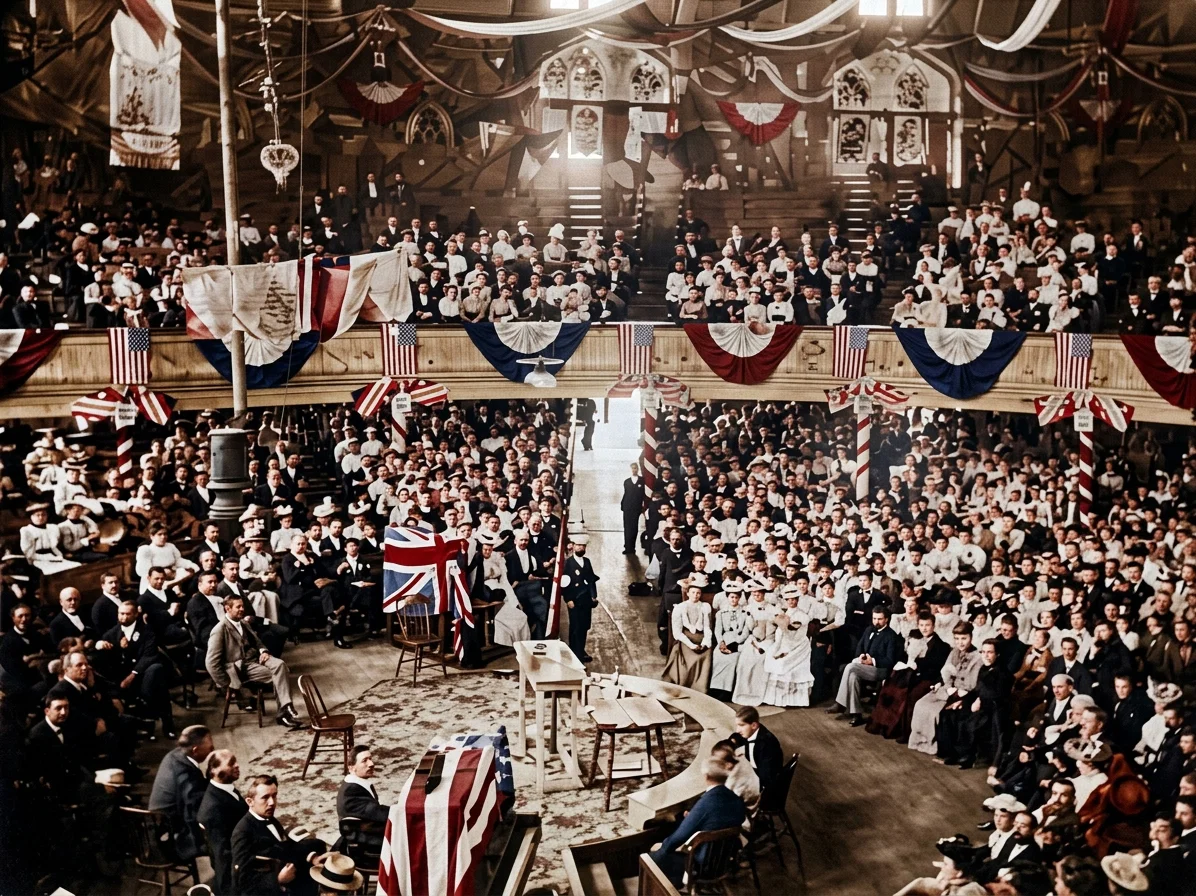
The endeavor to live a Christian life is the highest aim that young or old can have, and it is sad to see such endeavor perverted or turned from its original purpose. The term world endeavor as signifying a broader mission was sometimes substituted for Christian endeavor. It was publicly stated that “patriotism” was the keynote of this convention. A deep interest was manifested in the political affairs of the nation; “the line between civil and religious matters should at this convention be forever wiped out.” The pulpit of the convention assembly room was completely covered with the flags of the United States and Great Britain, and allusions to the prospective alliance between these two countries were greeted with tremendous cheering and applause. Under this union these nations would be invited in their gigantic strength to carry the Gospel and Christian civilization to all other countries, even to the ends of the earth.
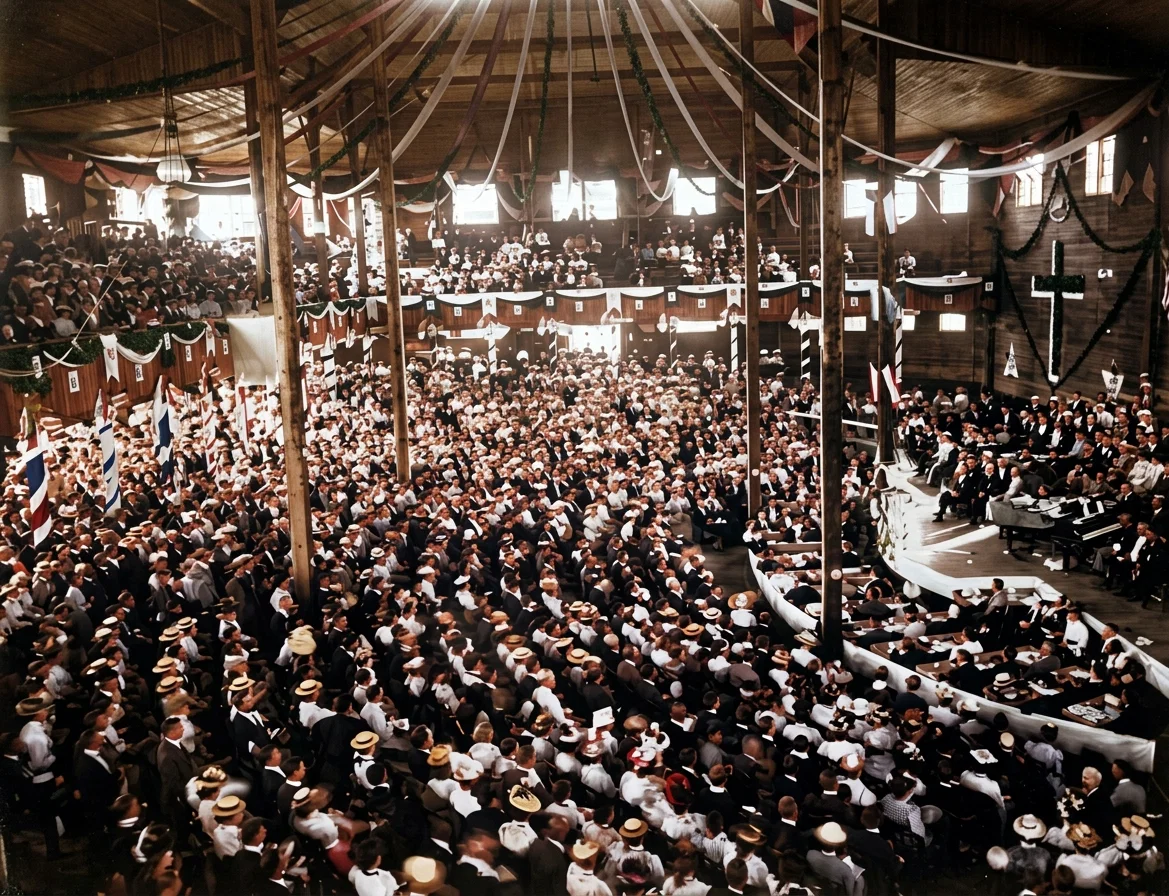
Auditorium of the Centennial Grounds, Nashville, showing first general meeting of the Y. P. S. C. E. at the International Convention.
Scene in the Union Gospel Tabernacle, Nashville, where the devotional meetings of the International Convention of the Y. P. S. C. E. were held.
The recent conflicts with Spain were cited as proof that God was on the side of the American arms. It was stated that the signal victory of Admiral Dewey at Manila harbor, and the more recent naval engagement near Santiago, were as marked demonstrations of divine interference and the presence of God with the conquering forces of the nations as any that were recorded in the book of Exodus. Such overwhelming defeat of the enemy, with almost no loss of life whatever on the part of our soldiers, was undeniable proof of the presence of God with the hosts of His Israel of to-day. No allusion was made in this connection to the experience of our land forces in Cuba, the many hundreds who have fallen before the foe. One speaker said if the victory at Manila had been recorded as one of the experiences of ancient Israel, the higher critics would say to-day that that was an impossibility, that it never could have occurred.
It seemed to be taken for granted that war by a Christian people in defense of right was justifiable. In this particular the incidents and practises of Old Testament times were made the basis of reasoning. The non-resistant teachings of Christ in His instructions to His followers were not introduced in this matter. There seemed to be an unfortunate forgetfulness of the statements of the Master that His kingdom is not of this world, that His followers are not to resist evil, or seek to avenge themselves. The distinction, “Render therefore unto Cæsar the things which are Cæsar’s; and unto God the things that are God’s,” seemed to be left out of the question, as tho no line should exist between the things of religion and the concerns of earthly governments. The endeavor of our youth and of all Christians, it was thought, should now be along the lines of national issues, loyalty to this Christian government and its institutions.
There was, it was said, no danger of this nation’s ever going to war against Great Britain, for there was too much of the Spirit of Christ in each of these for them to ever fight each other. The question arises whether the Spirit of Christ merely keeps us from fighting our friends, or will it not also restrain us from fighting our enemies? “Love your enemies, do good to them which hate you.” Luke 6:27.
Representatives of the National Reform Association and American Sabbath Union were on hand to impress upon the people the necessity for more aggressive work along the line of sabbath (Sunday) reform. The observance of Sunday was presented as the foundation of national greatness and national security. Undermine the Sunday and the nation will go to ruin. So an effort was made by these Sunday advocates to focus the whole matter down to the point of earnest effort to secure a better observance of the national weekly rest day. Strict Sunday observance was represented as the emblem of good government, a righteous nation, and Anglo-American civilization. On the other hand, Sunday desecration led to the debasing indulgences of the European Sunday holiday, immoral pastimes, Spanish bullfights, and was in fact an emblem of Latin and Spanish civilization. To be a good Sunday-keeper is to be a good American; to be a Sunday desecrator is to accept of Spanish customs and Spanish tendencies, and of course it would be hard to find anything more unpopular now than a Spaniard.
Strong appeals were made in behalf of the sabbath (Sunday) cause. Much stress had been put upon the necessity of obtaining the abiding presence of the Holy Spirit. Said the representative of Sabbath reform before a limited number of workers: “You have been told how to get the Holy Spirit; I can tell you how to keep it. Your daily period of consecration will amount to nothing unless you go to work.” And the work presented to them was to circulate literature on the subject of stricter Sunday observance. In this way the blessing could be retained.
The matter of consecrating the tithe to God had been considered, and many had testified to the great blessing they had received in returning to the Lord the tenth of their income. The same speaker urged that not all of this money be used for foreign missionary or church work, but that a part of it be invested in Sunday literature to distribute among the people, for the work of converting the heathen to Christianity was seriously hindered by their knowledge of the fact that the Sunday was not observed as it ought to be in the country from which the missionaries come, hence the necessary work to be done was to reform the heathen at home. The people must be enlightened so that we can procure stricter laws for Sunday observance, and have them enforced.
It was stated that the preachers ought to be well acquainted with the law. A good Christian citizen is one who will help to make good laws, and, when necessary, to enforce them. Thus the sentiment of the people must be educated up to the point of enforcing the Sunday laws.
Good arguments were made in behalf of the enduring nature of the Sabbath commandment. We might as well talk about abrogating the fifth as the fourth commandment. It was stated that the Sabbath is a divine institution; that it inheres in the very nature of God Himself, as well as in the nature of man, for whom it was made; that that law is just as immutable as the law of gravitation; that we might as well think of abolishing sunlight as the Sabbath day.
(Continued on page 13.)9
International Christian Endeavor Convention.
(Continued from page 8.)
The strange thing in this regard is that those who make this argument do not discover that it is the seventh day of the week, the Sabbath, that is mentioned in the fourth commandment, and not Sunday, the first day of the week. What more reason is there for applying the fourth commandment to the first day of the week than there would have been to apply the first commandment to the calf that Aaron made? We hope many will see this point and be led to turn away from the precepts and commandments of men to the true observance of God’s memorial, the Edenic Sabbath, the Lord’s day, the real Christian Sabbath, because instituted and observed by Christ our Lord at the close of creation week.
To take a comprehensive view of this great Christian Endeavor movement we see a large body of well-designing men, women, and youth, endeavoring to do something for Christ and humanity. We see also a persistent effort made to divert the attention and work to political issues, national and international concerns and alliances, glorying in national emblems rather than in the cross of Christ, and concentrating the endeavor on the work of securing a closer connection between the Church and the State, securing legislation favorable to religious bodies and institutions, particularly the observance of the first day of the week. That these societies would not be very energetic in the way of securing Sunday observance unless urged on to do so by zealous leaders and agitators, would seem to be indicated by the fact that only three local organizations reported having done anything in that line. This was held up as indicating remissness in duty, when it was really a credit to the organization.
That many of these workers may, like the eloquent and devout Apollos of old, gladly learn the way of God more perfectly instead of heeding the misleading voices, is to be confidently expected.