Baker an' me went off on a vacation one summer. It's not very frequent we do, but I'm no ways sorry we did that time, fur we see a heap an' come back cheered up like everything.
We went to Canady. Only staid a month, an' wusn't afraid to go boat-ridin' onto them big lakes, nur to come home when 'twas out nuther; fur Baker hain't no bank cashier nur nothin' that-a-way. We wus to my oldest sister's that I hadn't see fur—well, I couldn't have been more 'an five I persume when she married Mark Williston an' went off up there. I kin mind how mother wept their weddin' day when the folks all shook their han's an' wished 'em well. Barbara wus twenty, an' right smart o' help an' company, an' goin' so fur off mother didn't never 'low she'd see her ag'in. An' she didn't, fur travelin' wus a mighty big job in her day to what we hev it.
Williston wus a Englishman an' 'peared stiddy-goin' an' good like. His folks lived in Canady, some on 'em, an' some in England; an' after him an' her got up there to 'em, she foun' out they wus tremenjus rich. Barbara nur none of our folks knowed nothin' about it before, fur he jest worked like common folks, an' tho he wus pretty well dressed, he didn't act stuck up.
But it turned out that the summer he come to father's he wusn't needin' work at all. Him an' another young chap had come acrost the lake 'lowin' to ride round a spell a horseback an' see the States an' gether up flowers an' rocks fur botany. The other one got homesick, never bein' used to takin' things as they come, like pore folks, so he went back; an' when Williston got to our house after ridin' a month or so, he thought he'd be prouder to take Barbara back along than any amount of botany an' bugs. Not wantin' she should hev him jest fur his money, he said nothin' about hevin' it, an' asked fur work after boardin' a spell. Father didn't need him, so he teached our school two winters an' clerked fur Riley John Wheeler the summer between 'em. He wus at our house considerable offen, an' at last they married—him an' Barbara—an' went away off there.
Father an' mother hung back about it till they'd learnt his ways. His folks couldn't help takin' to Barbara, if they wus high up an' her pore; fur she wus that good an' kinder quiet an' gentle like, an' no ways bad looking nuther. Williston an' her lived along, an' didn't have no children; but they both liked 'em, an' liked to teach 'em; so, after thinkin' an' talkin' over about how many little ones wus in the worl' a'ready that hadn't no sort of trainin', an' them havin' so much money to do with, they went at it, them and his folks, an' started up a orphants' home an' school both together.
She kep' writin' about it now an' ag'in, fur years an' years, an' allus wanted that Baker an' me should come up an' pay 'em a visit after we wus married, an' see them orphants. Fin'ly she writ a kinder pitiful letter about father and mother bein' dead so long, an' her so fur from us all, an' 'peared like she thought we'd orter come up, fur she couldn't nigh leave them children to come to Bean Blossom. So Baker says: “It don't look right not to go, mother. People likes their folks if they air rich; an' we'd best to go.”
Baker's awful kinder clever that-a-way about all my folks. So we went. She'd tol' when in the very last of June they'd hev a commencement, an' we laid out to be there an' see 'em commence. Baker had all his hay an' grain cut, it being a unusual forred year, an' the other work jest laid till we got back. We hev a heap of milk an' fruit that time of year, but Uncle Dan'l Philip's girls an' Ben picked an' canned, an' milked an' churned on the sheers, besides seein' to the stock, etc. Baker had a good suit an' shoes by him, an' so a white vest, mohair coat, cravat, an' Panama hat fixed him out.
A SAMPLE OF GRAPES, SONOMA COUNTY, CAL.
I got Maria Pillsbury to make me a black grenadine, with big sleeves an' two ruffles. I had a black lace shawl I hadn't wore none to speak of, an' Maria he'ped me to pick a new bunnet. I never had one I liked no better. 'Twas black lace with satin strings an' bows an' a bunch of laylock blows kinder hangin' over to one side like. When I got all them on, and my congress gaiters an' half-handers, I looked mighty spruce; an' Baker wus right decent lookin'.
I never thought of donnin' my fin'ry till we got there, tho. A gray poplin's plenty good enough to ride 'roun' in the dust an' smoke in, an' then it'll bresh, an' a chip bunnet's far becomin'er fur meetin' cinders an' rain in than all the lace ones a-goin'. But Baker hain't me by a long ways. He wus jest boun' to wear that white hat an' vest a-travelin', but I hel' out till he see 'twouldn't do.
We started a Monday and sailed along all night on the railroad cars, then went acrost Lake Erie in a wonderful big, fine boat run with a biler under it, that I wus plum certain would blow us all up every minute, an' then more cars, till we got there Wednesday evenin'. Baker hired a hack, an' we wus tuck clean out to the edge of the city, an', if you'll believe me, we foun' the buildin's that Barbara's man an' her owns looks like a young town theirselves. There's a great, wide, high house, with towers an' trimmin's here an' there over it, besides a lot of plainer ones and barns. Up over the gate we druv in at, onto a arch, it says, “Williston Park,” an' the house does set right back into a park of trees, flowers, fountains, an' everything nice. We got out onto a side gal'ry. Baker paid our hack fare, an' then a young feller showed us into a room an' give us cheers; an', turnin' to Baker, said somethin' about cards.
I wus that 'shamed! He didn't think what the feller wus peggin' at, but I did, an' turned it off by sayin', “Don't you pay no 'tention to him,” meanin' Baker. “You jest go tell Mis' Williston her sister's come, an' I don't 'low she'll want no pay fur lettin' of us in.”
He 'peared right tickled we'd come, fur he bowed to me an' went out kinder laughin'. We didn't hev to wait long; fur most d'rec'ly a fine, tall woman, with nearly white hair, come hurryin' in to us, an', lookin' me straight in the eyes, says she, “Are you my sister, really?”
“Yes,” says I, “if you're Barbara Williston. This is Baker an' me.”
I can't tell jest how it wus then, but I know we grabbed an' kissed an' cried, an', when she got time frum me, Barbara shuck han's with Baker, an' tuck us off upstairs to her own settin'-room, an'; I'll warrant, 'twould hev tuck a extra nimble-jinted reportin' chap to a writ us down, fur a spell. She sent out fur Williston, an' he couldn't 'a' be'n frien'lier or treated us cleverer than he did that evenin' an' the hull time we wus there with 'em. We eat supper up there, but next mornin' we went downstairs with all of 'em, an' it wus a reg'lar sight—them orphants, from three years old up to eighteen, an' every one as lively as a cricket. They all stood behind their cheers till they'd sung grace, one young man a-leadin', an' then set down an' acted as good as I've seen some grown folks to hotels. I wus that tuck up watchin' the older ones helpin' the little fellers an' learnin' 'em,10I forgot to eat, till I see one boy punch another one's ribs an' wink towards me.
Breakfast over, we all went to a big back parlor to family prayers. One girl played a organ while they sung. Williston read part of a chapter, talked a little, an' answered some questions they asked about it, an' prayed; an' then they sung ag'in, an' all went out quick an' quiet like. Then Barbara tol' me all how they do with 'em. She said they teached 'em some good, useful book learnin', an' how to work too, so they could take care of theirselves when they wus growed up. They learn every boy a trade of some kind, how to keep accounts, how to garden, mend his own clothes, and cook a few easy victuals. The girls all hev trades, too, an' accounts, besides plain sewin', cookin', an' how to keep a house, an' all of 'em hev their schoolin'. While we wus there I went all over an' through them buildin's an' groun's an' see the children to work an' hear 'em recite their books, too. It wus downright interestin' to look at 'em. They cook, wash dishes, sweep, make beds, dairy, iron, wash, scrub, typewrite, print, kindergarten, carpenter, trim hats, hoe, prune, blacksmith, carve wood, make toys, dresses, bricks, an' 'tend the stock, besides playin' the pianner an' fiddle, an' paintin' of pictur's. There 'peared to be a good, stiddy, knowin' woman at the head of each of the girl's work, an' the same sort of man a-showin' the boys; an', tho there's some lazy an' some mean ones, they hain't liked by the rest; an' they're all powerful proud of their work, a-sayin', “Look here, auntie, at my flower bed,” or whatever they'd worked at, an' I'd bug my eyes out, an' tell 'em the youngsters to Bean Blossom couldn't nigh tech that.
PRISCILLA ANN BAKER.
REVENGE”—“FORGIVEN
By Kate Gilliard
“BUT I say unto you, Love your enemies.” Matt. 5:44.
“Revenge! revenge!” our fierce hearts cry.
But, lo! a voice comes in reply,
Pleading, with love and sorrow, too,
“Forgive, they know not what they do.”
O loving Christ, who bowed Thy head
Upon the cross for us, and bled,
Grant us Thy grace to say anew,
“Forgive, they know not what they do”!
—Kate Gilliard, in Boston Evening Transcript.
IN WATER STREET MISSION.
JERRY MCAULEY’S successor in the Water Street Mission in New York tells this story to show how the river thief’s “Helping Hand” is still lifting up lost men:—
“A man came into our meeting one afternoon with 1,000 forged railway tickets in his pockets, and he had the plate with him with which he did the work. He was on his way to the Roosevelt Street ferry, intending to meet an accomplice over in Brooklyn, but he happened to stop in at our place.
“As he sat there listening to the testimony of ignorant redeemed men, the Spirit of God took hold of his soul. He went out, but didn’t go over to Brooklyn. He came again in the evening, and the Lord troubled him mightily. He went out and got on the ferry-boat, and when the boat reached the middle of the river, he dumped the railway tickets, plate, and everything overboard into the river. Then he came back to the meeting and knelt down for prayers.11Jesus met him there, and forgave his sins, and gave him the witness of the Spirit that he was born again. He made a confession right there before us all. He was a Swede, a fine-looking man; he was never drunk in his life.”
“But the next question was how he should get a living. So he knelt down and asked the Lord to send him a job. He got a job digging holes for the railroad piers. They had to be dug ten or eleven feet deep, and it was hard, dirty work; his hands got dreadfully blistered. He took his wife to the top floor of a tenement house—they had never lived in such a place before; but he was saved, and every $1.50 a day that he earned was clean money. Finally one of his former acquaintances heard where he was, and found him at work, and said to him, ‘Why, John, are you crazy?’”
“‘No,’ said John, ‘I never was so sane in my life.’”
“‘Well, what’s the matter?’”
“‘I have found Jesus,’ said John, ‘and given my heart to God.’”
“‘But, John, look here! We never had such a good thing on our hands as we have now. There’s $10,000 in it if you will come and join us.’”
“‘No, sir, no more of that for me.’”
“‘Well, John, you’re in hard luck; let me help you,’ and he pulled out a roll of money and offered it to John.”
“‘No, sir,’ said John, ‘I won’t take it.’”
“‘Well, come along with me to my hotel.’”
“John went with him to the Fifth Avenue Hotel, but he wouldn’t agree to go into any counterfeiting scheme. After he got home, he put his hand into his pocket and found there $300 in bills which the man had put into his pocket without his knowledge. He thought about it for a moment. The devil said: ‘O, come, now; keep it; he gave it to you! Just think how many holes that will fill up.’ But the struggle was short. He just said, ‘Lord Jesus, if you ever stood by me, stand by me now,’ and he went back to the hotel and gave back the money.”
“The man was greatly surprised, and said, with tears in his eyes, ‘John, if I could have what you have got, I would give up everything I own in the world.’”
“‘This man has helped to save hundreds of others. He has maintained his integrity, and is trusted by some of the wealthiest and most respected business men in New York City.’—Ram’s Horn.”
THE WAY TO INDEPENDENCE.
“Come, Charlie. I want you to drive a few nails in the shed for me,” said Nettie to her brother the other day.
Charlie was splitting wood at the time, and her father, overhearing the request of his daughter, said:—
“Why not drive them yourself?”
“Because I can’t,” she replied.
“Because you can’t? Why, McCarty says there’s no such word in the book. Come here, and I’ll show you how to drive nails.”
With hammer in one hand and nails in the other he went into the shed, drove a few into the door, and then gave the remainder to Nettie. She found it an easy thing to drive the nails, and felt quite proud of her achievement in the mechanical art. She having completed the work, her father said:—
“Now, my girl, that lesson makes you independent. Some of these days I’ll teach you how to drive a horse, sharpen a knife, and whittle, too, without cutting your fingers. Don’t let the doors creak on their hinges for want of an oiled feather; or the little children’s shoes, or your own shoes, get hard in the winter time for the want of a little grease.
“And as for you, my boys,” said the father, turning to Charlie and his little seven-year-old brother, “you ought to learn how to make a bed, sweep a room, or sew on a button. A little cooking will not hurt you. Many a beefsteak and fish have I cooked in my day, and my mother told me when I was a boy that I could beat any boy making a pot of coffee. There is no telling what your lot may be, or where you will be cast sometime during life. The most helpless people I have met with were those who could only do one kind of work. All you boys and girls should learn some one thing very well, and make that your dependence for a living; add to it as much skill as you can; for it costs nothing to carry knowledge, and it enables you to pave your way to independence.”—Anon.
BARLEY ROLLS.
By Mrs. A. C. Bainbridge
One cup of pearl barley put to soak in four cups of cold water for several hours, or overnight. Add one cup of cold water and set on the stove to boil in a double boiler with cold water in it also.
Let it cook several hours until the kernels are very soft and will crush easily in the fingers. Then turn it out in a bowl to get cold. It is better to let it stand overnight and get thoroughly chilled, as the rolls will be lighter.
In the morning turn the barley out on a well-floured board, using any flour that pleases you, each kind producing a roll of different density and taste. If there is a light crust like skin on the barley, peel it off and cast it aside.
Knead gently until the whole seems light (fifteen or twenty minutes at the most) and will form into rolls on the board with the hand. Form the rolls about three inches long and one and one-half or two inches thick, round the ends, and bake at once.
Roll them several times while baking, that they may brown evenly. Use a little oil to keep them from sticking to the pan, and to make them roll easily when you shake the pan.
Give them thirty minutes at least, and let them cure or cool on a board in an open state.
They will be light and yet close, and having no sugar or butter in them they will be really sweet.
“If at first you don't succeed,
Try, try again.”
MRS. A. C. BAINBRIDGE.
A LITTLE HEROINE.
“Nannie, dear, I want you to hem those napkins this afternoon without fail. Can I trust you to do it? I must go out for the whole afternoon, and can not remind you of them,” said Mrs. Barton to her little girl.
“Yes, mother, dear, I will. You can trust me,” said Nannie.
Now, Nannie did not like to hem napkins any better than you do, but she went at once to the work-basket, took out her needle and thread and thimble, and began work. Pretty soon she heard the sound of music. It came nearer, and at last it sounded right in front of the house. She dropped her sewing to run to the window, and then she stopped.
“No, I promised mother, and she trusted me,” said Nannie to herself, as she sat down again and went on sewing. Soon the door burst open, and in rushed several little girls.
“Nannie! Nannie! Where are you? There is a monkey out here and a trained dog, and they’re playing lovely tricks. Come on.”
“I can’t. I promised mother and she trusted me,” she answered.
“They coaxed and scolded, but all to no purpose. So they left her.
Just as she finished the last napkin, her mother came in.
“My little heroine,” she said as she kissed Nannie.
“Why, mama, I didn’t save anybody’s life or do anything brave; I only kept my promise,” answered Nannie wonderingly.
“It is sometimes harder to keep a promise and do one’s duty than to save a life. You did a brave, noble thing, and I thank God for you, my dear,” said Mrs. Barton.—Philadelphia Methodist.
Temptations and Idleness
Some temptations come to the industrious, but all temptations attack the idle.—Spurgeon.
The Art of Gentle Reproof
THERE is an oblique way in reproof which takes off the sharpness of it.—Pope.
THE HERO OF THE SLUMS.
By Susan Teall Perry
THEY hurried along the crowded street,
Through the chilling wind and the dismal sleet—
The ragged boy and his sister Jen—
She was just six, but he was ten.
Turning a corner, they chanced to pass
A merry lad and a glad-faced lass
So warmly clothed and so well fed,
But they scarcely glanced at Jen and Ted.
“How grand it must be to live like those,
Have plenty to eat, and wear warm clothes!”
The sister said, while she tighter clasped
The brother’s hand, as the wind swept past.
“O, never you mind, Jen, we’re most there
At the mission rooms, where folks deal square!
You’ll get warm clothes and a dinner prime,
And, Bill Sykes told me, ‘a merry go time.’”
“Now here we are, Jen. Just look up and see
These words about ‘you’ve done it unto Me.’
Don’t stop—move on—now brace ’gainst the door.
There’ll be a hundred kids here soon, and more;
They’ll push and squeeze, but you stand your ground;
Then, if the things run out and don’t go ’round,
We’ll be right on hand, the first ones to serve.
In times like these we must keep up our nerve.”
Ted’s words of course must be very wise,
Yet the tears would gather in Jen’s blue eyes,
For the frosty pavement was so cold,
And the shoes she wore were thin and old.
Shivering she stood among the throng,
And whispered, “Must we be waiting long?”
While the little toes so cold and blue
Ted chanced to see peeping out her shoe.
Then the noble brother from his head
Took off his cap and softly said,
“Just put your two feet on this, and then
You’ll find they’ll warm right up, dear Jen.”
When the doors at last did open wide,
He pushed his loved sister first inside.
“O, do, please, ma’am, ’tend to her,” said he,
“She’s so cold and hungry—don’t mind me!”
A lovelight fell on Ted’s thin, pale face,
Like a shining from the holy place,
As, standing there with a noble pride,
He watched his wee sister led inside.
Ah! earth’s heroes are not always those
Who live up aloft and wear good clothes;
Down in the slums is many a soul
Whose name shines on God’s honor roll.
—Susan Teall Perry, in Christian Work.
DARK VENEZUELA.
VENEZUELA is, like all Roman Catholic countries, robed in dense darkness. From a letter from a devoted lady missionary now laboring in that land, we take the following extracts, not giving the name and address, for fear of imperiling her existence:—
“One living daily among the people is saddened greatly by the sorrows, sins, and deep darkness of their lives; and yet I can never get over praising the Lord for His wonderful leadings, not only to this land, but to this opportunity of living among them. Occasionally one might long to get away for a day or an hour from the sorrows and burdens which press so heavily, to the companionship of those who have known Jesus and who are living saintly lives, but it can only be a passing thought and then a deeper rejoicing that our fellowship is with the Father and His Son Jesus Christ, and that we are counted worthy to be ‘burden-bearers.’ As you probably know, my health has been far from strong, so I have not therefore been enabled to do the aggressive work that I had hoped; but it has at least been progressive, for I have had many opportunities of reaching the hearts of some, and now, as I am stronger, Señora — and I are planning (D. V.) a more aggressive work in the hill country, reached by train, foot, and donkey-back, and in this new work we ask your sincere prayers, united with ours, that tact—Holy Ghost tact—and wisdom may be given, and that we may indeed be filled with the Holy Ghost.
“Traveling expenses, except on foot, are very high here. Since the last persecution, when they were planning to drive me out of town, because of their evident fear of me, and a thought that it is best to let things be quiet, I have been endeavoring ‘to buy up the opportunities,’ sowing the seed here and there, visiting the sick, dispensing a few remedies, dressing wounds and sores, clothing and sewing for the poor, translating some tracts, teaching the Word to —, also a little boy and girl, also giving a few English lessons.
“I often wish that I could really convey an idea of the social condition of the people. Jesus is ONLY a name, with no power behind the name. They have scarcely any shame in their sins. Their hate they vent out in various and diabolical ways. Men and women with contagious disease will peel off a little skin and put it in wine, coffee, and other drinks, soups, or food, and invite their enemy, or send it to him. Leprosy and like diseases are thus spread. New Year’s eve is always spent, especially by the men, in doing their dark deeds and venting out spite until towards the morning. The friends in the house had great fears that harm would come to me. I succeeded in quieting those of — as to my life, but the mother feared that at least something might be done to the house, and they sat up until after midnight; but, praise the Lord, while other houses on all sides bore traces of evil, nothing was done to us or ours. I lay down and slept without a fear until midnight; then I was awakened by the voices, and heard the people passing and repassing until morning, almost dawn.
“The people are most superstitious; witchcraft and the ‘evil eye’ are believed in by the common people mostly. A poor woman two doors from here has a little baby. She is intelligent enough. She told me personally that she trembled and feared all the first nights that the witches would come and carry him off, or suck his blood; for they do such things until the child is baptized, so she says. They told me not to look steadily at the baby or I would kill him. The witches fly in the air, laugh, talk, do their bad deeds, give sickness, kill cattle and other animals and people. Can you believe such things possible in a civilized country, seven days out from New York? There are other things which I may tell you of later, but these are enough to give some idea of the dense darkness of this poor people, without the light of the Gospel, bound down in fear by the power of Satan. Do you wonder that our hearts are heavy when we hear upon every lip, ‘Jesus,’ ‘God,’ ‘Blessed will of God,’ ‘Your blessing, my mother, father, uncle, aunt,’ or whom it may be, and, ‘God bless you, my child’? And how hopeless the task seems, when the lives are so immoral and so dark of all who speak the words! Pray with us that a mighty wave of Holy Ghost conviction may pass over the land.”
OUR WORK AND WORKERS.
AT Alamosa, Colo., two persons were recently baptized by W. B. White.
BROTHER W. ZEIGLER reports the baptism of ten candidates at Denver, Colo.
EIGHT persons were added to the church at North Yakima, Wash., at the last quarterly meeting.12
AT the last quarterly meeting of the church at Boise, Idaho, three members were added.
AT the last quarterly meeting in Toronto, Ont., nine persons were baptized by Brother M. C. Guild.
Two CANDIDATES were baptized at Cañon City, Colo., on the 23d ult., by Brother G. W. Anglebarger.
AS THIS paper goes to press, camp-meetings are in progress at San Diego, Cal.; at Fort Smith, Ark.; and at Hildebran, N. C.
THREE members were added to the Swedish Church at Duluth, Minn., by baptism, July 16. These were the fruit of Bible work.
THE Illinois Conference has a colporter wagon in the field, and an experience of three months has given very satisfactory results.
THE Missionary Worker, of London, England, notes the recent baptism of five candidates at Hackney by Brother E. J. Waggoner.
FOUR persons were baptized in Sacramento, Cal., July 31, by Brother B. L. Howe. Four others had been baptized just before the State camp-meeting.
BROTHER J. S. WASHBURN, reporting labor at various points in England, notes that at Southampton one was baptized; at Hull, four; at Birmingham, three; and several candidates were awaiting the opportunity at Kettering.
THE pastor of a Baptist Church in Chicago recently preached in the tent which is being used in a series of meetings in that city by Brother A. W. Bartlett and Chas. Everson. One of his flock has become one of our most active workers.
A NOTE in the West Virginia Monitor says that it is reported in Wheeling that there are more copies of the SIGNS coming into that city than of any other religious paper. That is because the friends of the cause it represents are working for it.
AT the recent California State camp-meeting a fund was started by the Scandinavian brethren to purchase a tent for use among the people of that nationality. The tent is now ready, and its initial service is to be in Humboldt County, with Brethren L. P. Jacobson and A. Brorsen in charge.
BROTHER J. H. KRAFT, laboring in the vicinity of Lafayette, Colo., reports four additions to the faith. He says that he asked one sister how it was that she so readily decided to keep the commandments of God. Her reply was, “We have prayed to God for light, and He has heard our prayers and sent the truth to our door, and we could not reject it.”
BROTHER D. H. SOGGS, in reporting to Echoes from the Field concerning the work in La Junta, Colo., says: “Our Sabbath-school increases in numbers every Sabbath. By request we gave a Bible reading on Matthew 24 in the Baptist Church on Sunday evening, which was listened to with interest. The pastor wanted me to read to them again.”
IN connection with the tent work in St. Thomas, Ont., ten have taken their stand on the truths presented by Brethren W. R. Matthews, P. M. Howe, and B. Hagle. More than a score have said they believed that the seventh day is the Sabbath, but the “law of the land” is deemed a hindrance to their obedience of the truth, because it forbids labor on the first day of the week.
A GENERAL meeting for Ireland (the first) was held June 24 to July 3. It having become manifest that the work in Ireland had reached that stage where it was necessary to have a local committee to take the general oversight, Brother Wm. Hutchinson, Isaac Bell, and J. McAvoy were appointed. During the meeting a church organization was effected, and twelve persons were baptized.
THE Minnesota Worker of July 27 says: “Brother Francis Hope, of London, England, gave an interesting illustrated lecture in the Minneapolis Church last Sunday evening on the ‘Horrors of the Cuban War, and the Christian’s Relation to War.’ With stereopticon views he illustrates many points of the truths we teach, so that children as well as older people will be impressed by them as in no other way.”
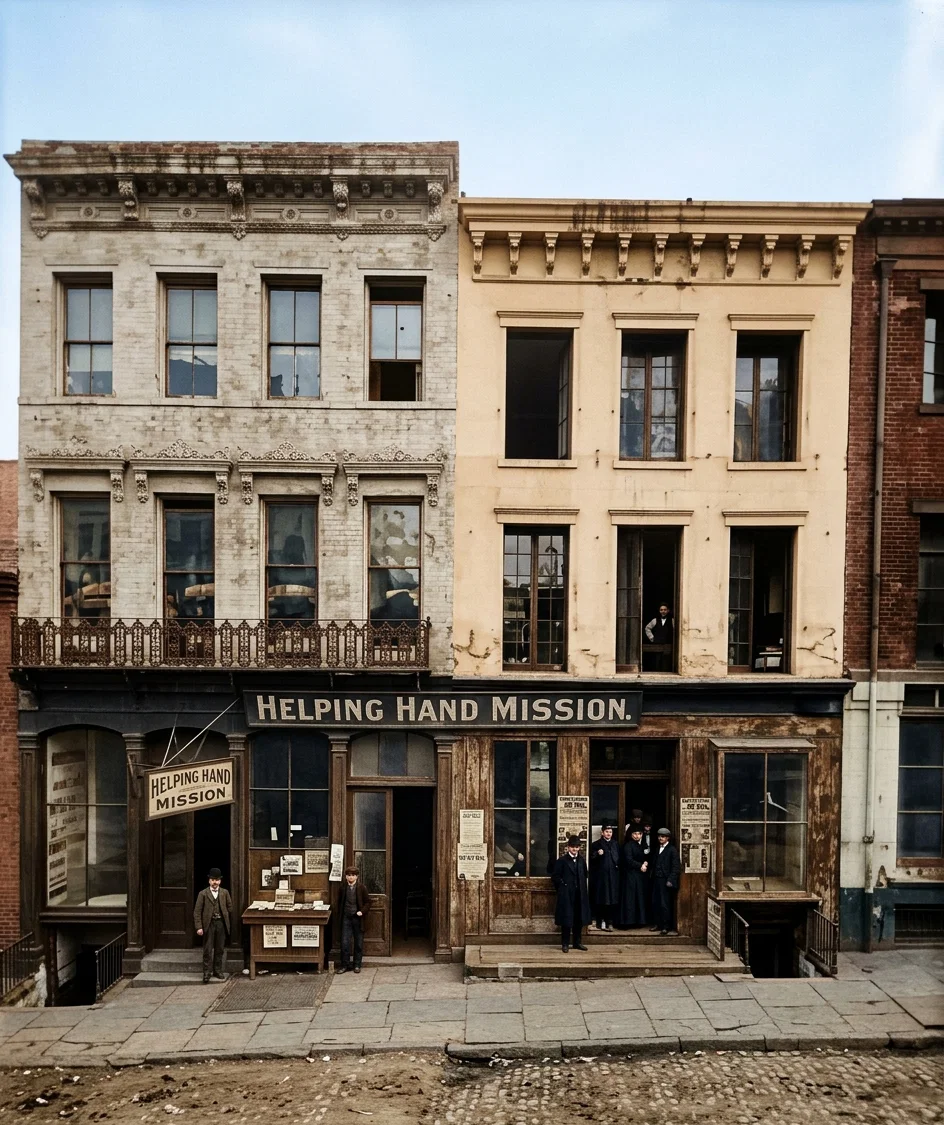
ONE HOUR’S WORK OF THE HELPING HAND MISSION.
It is Sunday night. A sad and wretched man is aimlessly walking along Kearny Street. He has been reviewing his past fruitless life—he is self-condemned and hopeless, despairing, yet rebellious, for his review has shown him what he might have been. He is penniless, and hungry, not knowing where to lay his weary head; and, more than all, his physical suffering is the torture of mind as it recalls the prattle of three darling boys, the cheering and loving words of a devoted wife, the confidence of a generous and patient brother, and the trust and respect of many friends who were ever ready with substantial aid and encouraging counsel; but now, alas! all have abandoned him to his selfishness, to the degradation his indulgences have brought him.
How sad and lamentable the spectacle! How lonely and miserable he is!
He arrives at Commercial Street. He hears the sweet hymns he heard his mother sing when his heart was pure and receptive. His attention is attracted; he listens and then draws near to an assemblage of Christian workers. A young disciple of the Master is now repeating the message, “Come unto Me, all ye that are weary and heavy laden, and I will give you rest.” This friendless and forsaken man hears the message—his conscience has been awakened, and unconsciously he responds, “Amen.” His heart and mind are touched by the same influence which impels these people of God to come upon the street and hold up the Redeemer of the world. He now desires more than all things else to come to the foot of the Cross, and leave there, forever, all the sorrows and burdens of sin he is no longer able to bear. His response, “Amen,” has brought to his side the man of God who has been instrumental in awakening this hopeless and despairing soul. He invites this hitherto friendless man to go with him to the Helping Hand Mission, near at hand; and there all barriers—will, selfish motives and aspirations, and, more than all, his carnal appetites, were given up—not regretfully, but gladly and honestly.
Now the kingdom of God doth reign, and this sinful and friendless man of one hour ago is on the highway of usefulness, with the best Friend on earth to encourage and uphold him in all the dark and trying hours of his remaining days.
God bless the Helping Hand Mission, is the prayer of this saved man, the author of these simple lines.