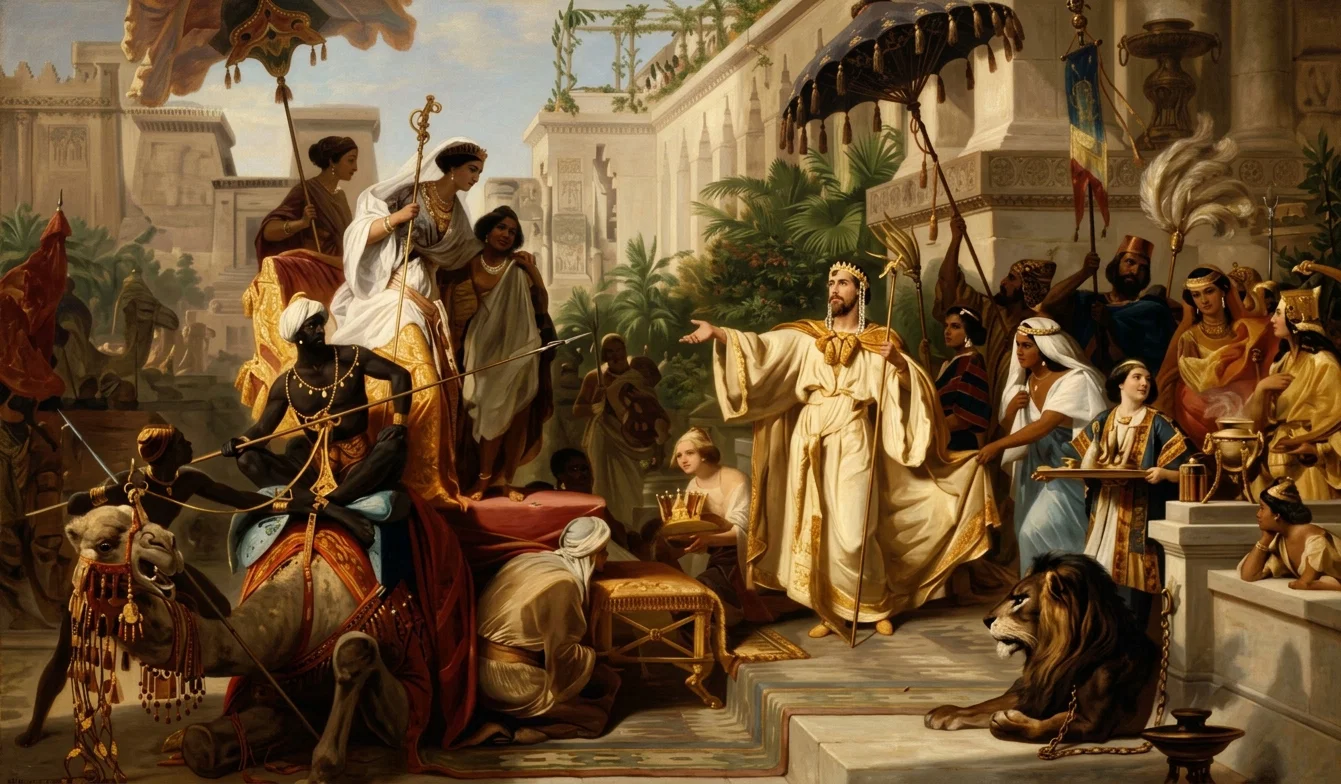
In the height of its greatness and glory the kingdom of Israel stood at the head of the world's mighty nations. The shining light of that kingdom in its day of splendor was its king, Solomon, the wise.
“And when the queen of Sheba heard of the fame of Solomon, . . . she came to Jerusalem with a very great train, with camels that bare spices, and very much gold, and precious stones.” I Kings 10:1, 2.
Born a prince, educated to rule, the reins of government were placed in his hands at a most auspicious moment. The bloody days of the nation in its wars for subduing the heathen of the land were well over. Israel's arms had been victorious, and the din of battle had changed to the pleasant note of busy husbandry and outspreading traffic. The flower of the nation's prosperity burst in all its glory.
These events came to pass not in an obscure corner of the earth. Great things had the God of Israel in mind when He wrought so wondrously for His people in bringing them from servitude in Egypt to be the greatest nation in the midst of great nations. With mingled emotions of envy, fear, and awe surrounding nations had watched the marvelous progress of this peculiar people, whose God so mysteriously yet mightily revealed Himself in their behalf. Thus was He teaching the nations who knew Him not to know Him, the only God.
And God was with Solomon, and because of his humility and request for wisdom, told him:
“Lo, I have given thee a wise and an understanding heart; so that there was none like thee before thee, neither after thee shall any arise like unto thee. And I have also given thee that which thou hast not asked, both riches, and honor; so that there shall not be any among the kings like unto thee all thy days.” 1 Kings 3:12, 13.
And the promise was fulfilled. “And God gave Solomon wisdom and understanding exceeding much, and largeness of heart, even as the sand that is on the seashore. And Solomon's wisdom excelled the wisdom of all the children of the east country, and all the wisdom of Egypt. For he was wiser than all men; than Ethan the Ezrahite, and Heman, and Chalcol, and Darda, the sons of Mahol; and his fame was in all nations round about.” 1 Kings 4:29-31.
With the ushering in of peace and plenty there flocked to his courts ambassadors from every part of the world, and the marts of the enlarged and beautified cities of fair Canaan teemed with the commerce of merchant princes from near and far. The temple, pride and glory of the chosen people, and diadem of the earth, was builded; cities sprang up here and there,—“cities of store,” and cities for chariots, and cities for horsemen; men of war, and servants, and princes, and captains, and rulers of chariots, and horsemen multiplied; great enterprises, the wonder of the world, were undertaken; ships sped to distant countries over the Great Sea and through the Red Sea, fetching “gold, and silver, ivory, and apes, and peacocks;” nations became tributaries, “and they brought every man his present, vessels of silver, and vessels of gold, and garments, and armor, and spices, horses, and mules, a rate year by year.” 1 Kings 10:25.
“And when the queen of Sheba heard of the fame of Solomon concerning the name of the Lord, she came to prove him with hard questions,” bringing presents many and valuable. “And Solomon told her all her questions; there was not anything hid from the king, which he told her not. And when the queen of Sheba had seen all Solomon's wisdom, and the house that he had built, and the meat of his table, and the sitting of his servants, and the attendance of his ministers, and their apparel, and his cupbearers, and his ascent by which he went up into the house of the Lord; there was no more spirit in her”—literally, it took her breath away. 1 Kings 10:1-5.
In all this the queen saw the hand of the Lord, and her words of admiration were turned to words of praise to the God of heaven: “Blessed be the Lord thy God, which delighted in thee, to set thee on the throne of2Israel; because the Lord loved Israel forever, therefore made He thee king, to do judgment and justice.” 1 Kings 10:9.
“And all the earth sought to Solomon, to hear his wisdom, which God had put in his heart.” Verse 24.
“So King Solomon exceeded all the kings of the earth for riches and for wisdom.” Verse 23.
Yes, King Solomon in the height of his power was gloriously adorned, and very great.
A Comparison by the Great Teacher.
“Consider the lilies of the field, how they grow; they toil not, neither do they spin; and yet I say unto you, That even Solomon in all his glory was not arrayed like one of these.” Matt. 6:28, 29.
This is a remarkable statement. But it is so, because the Lord says it is, and as we apply ourselves to consider the matter, as our great Teacher asks us to do, we discover a few faint glimmerings of its truth. The proposition illustrates the vast difference between the artificial and the natural. The pomp and glitter of the greatest earthly kingdom, the throne with all its appurtenances adorned and bedecked with the gems and diamonds of earth, the apparel of rarest texture and costliest fabric, the ease and luxury which alone unlimited riches and treasures can buy, all these and the unsurpassed worldly glory of them is less, far less than the beauty of the adorning of the humble lily of the field.
Not the power and wealth and skill and wisdom of all the kings of the earth, and of all skilled artificers, can reproduce the simple lily as it stands appareled by the hand of the Creator. There is a fabric the fineness of whose texture and the delicacy of whose tintings and perfumes are forever beyond the skill and wisdom of mortal hand. There is a structure whose pillars and walls, and arches and architraves, and balconies and balustrades, are living members, throbbing, pulsating with the mysterious inflowing life of the Master Builder. There is a temple whose corridors and chambers speak in infinite accents the glories of Him who inhabits them and adorns and beautifies by His glorious presence. Yes, indeed, here is a glory beside which the artificial, even the glory of a Solomon, fades into obscurity.
The Lesson of Faith.
“O ye of little faith” were the words addressed by the Master to those who heard the lesson. They are addressed to us to-day. There were those then who were anxious about their food and raiment, and the cares and business of this life occupied their attention and took their time. Even the professed children of God were anxious concerning such matters. Is the situation materially different to-day, unless it be for the worse? Are you anxiously planning and looking ahead to the morrow concerning food and clothing? Whether or not you are a professed child of our heavenly Father, He wants to teach you to trust Him to supply every need of this life, even the little things of life.
How forcibly is the lesson urged home to our comprehension! “Why are ye anxious concerning raiment? Consider the lilies; . . . yet I say unto you, that even Solomon in all his glory was not arrayed like one of these. But if God so clothe the grass of the field, which to-day is, and to-morrow is cast into the oven, shall He not much more clothe you?” Notwithstanding the lily is so marvelously beautiful, and its adornment immeasurably beyond the glory of Solomon and his throne, yet it is but grass of the field. It endures, with its glory, for only a day. But in that day it subserves its purpose, existing for the praise and revelation of its Maker.
But you, O man, who are you, whom God says He will “much more clothe”? Why does He promise to bestow on you such extraordinary care? O, He will make a man, even one who is the chiefest sinner, “more precious than fine gold; even a man than the golden wedge of Ophir”! Isa. 13:12. He has made you and me to reveal in and through us His mighty power to save from sin; He has made you to be a revelation of Him not for a day, but to reveal Him and praise Him eternally. He has made you a marvelous temple, a temple formed in His image, for His own indwelling, and He will, if you will to let him, clothe you with the beauty of holiness, His own righteous garment. Altho He is the “high and lofty One that inhabiteth eternity,” and dwells in “the high and holy place,” yet He also dwells “with him that is of a contrite and humble spirit.” Isa. 57:15. This is the adorning of priceless worth, the shining raiment, far surpassing and transcendently glorious.
The Method of Obtaining.
“Ye can not serve God and mammon. Therefore I say unto you, Be not anxious for your life, what ye shall eat, or what ye shall drink; nor yet for your body, what ye shall put on. Is not the life more than the food, and the body than the raiment?” “For after all these things do the Gentiles [who serve mammon only] seek; for your heavenly Father knoweth that ye have need of all these things. But seek ye first His kingdom, and His righteousness; and all these things shall be added unto you.” Matt. 6:24, 25, 32, 33, R.V.
We have seen why a man is of more importance than the grass of the field, and of more value than the birds of the heaven. Then how reasonable, how simply reasonable it is in view of God's purpose concerning us, that we should seek first of all the inward adorning of a meek and quiet spirit—His kingdom and His righteousness! And then the kind Father speaks to us in visible words—a world of living, infinite, ringing words—through every sprig of grass, every flower of the garden or field, every leaf of every tree, every bird of the air, in short, through every one of the myriad forms of life in the natural, visible creation, that “all these things”—the food and raiment, the necessary things for our life here—will be added unto us. Shall we trust Him, and Him only?
An Example.
The Teacher weaves into His lesson a notable example as proof that God does as He says He will. This example is the same Solomon whose outward adorning is contrasted with the adorning of the lily. The Lord asked Solomon in a dream to name what he would that the Lord should give him. What a field for choice!—riches, honor, power, long life, all that the natural heart might dictate. No, the young man feared God, and he asked for wisdom to properly perform his duties, and that he might “discern between good and bad.” He sought God first and His righteousness and wisdom. “And the speech pleased the Lord,” and because Solomon thus sought Him, the Lord said, “Behold, I have done according to thy words; lo, I have given thee a wise and an understanding heart; . . . and I have also given thee that which thou hast not asked, both riches, and honor.”
Creative, redeeming, keeping power is just the same now as it was 2,900 years ago, or 1,900 years ago. The riches of money and honor may not be ours as they were given to Solomon. The desire for them even must be subordinated to the service of one Master. The lesson He taught was not that the added things would be this sum or that amount, but enough for all needs, and He knows what are our needs. The example is used to show that God fulfils His promises.
And those promises are as certain as is the certainty of the existence of the visible creation around us. No proof is required to demonstrate the latter. We know it. It is self-evident. So our Father wants us to know the fulfilment of his divinely appointed plan; for it is both plan and law,—“Seek ye first His kingdom, and His righteousness; and all these things shall be added unto you.” Let us try it, and prove Him. This is the greatest thing in the world. L. A. PHIPPENY.