OPPRESSIVE SLAVERY

8%

Pacific Press Publishing Company · Oakland, California · Jul 14, 1898

FromSigns of the Times, Vol. 24, No. 28.

Read the full edition

OPPRESSIVE SLAVERY.

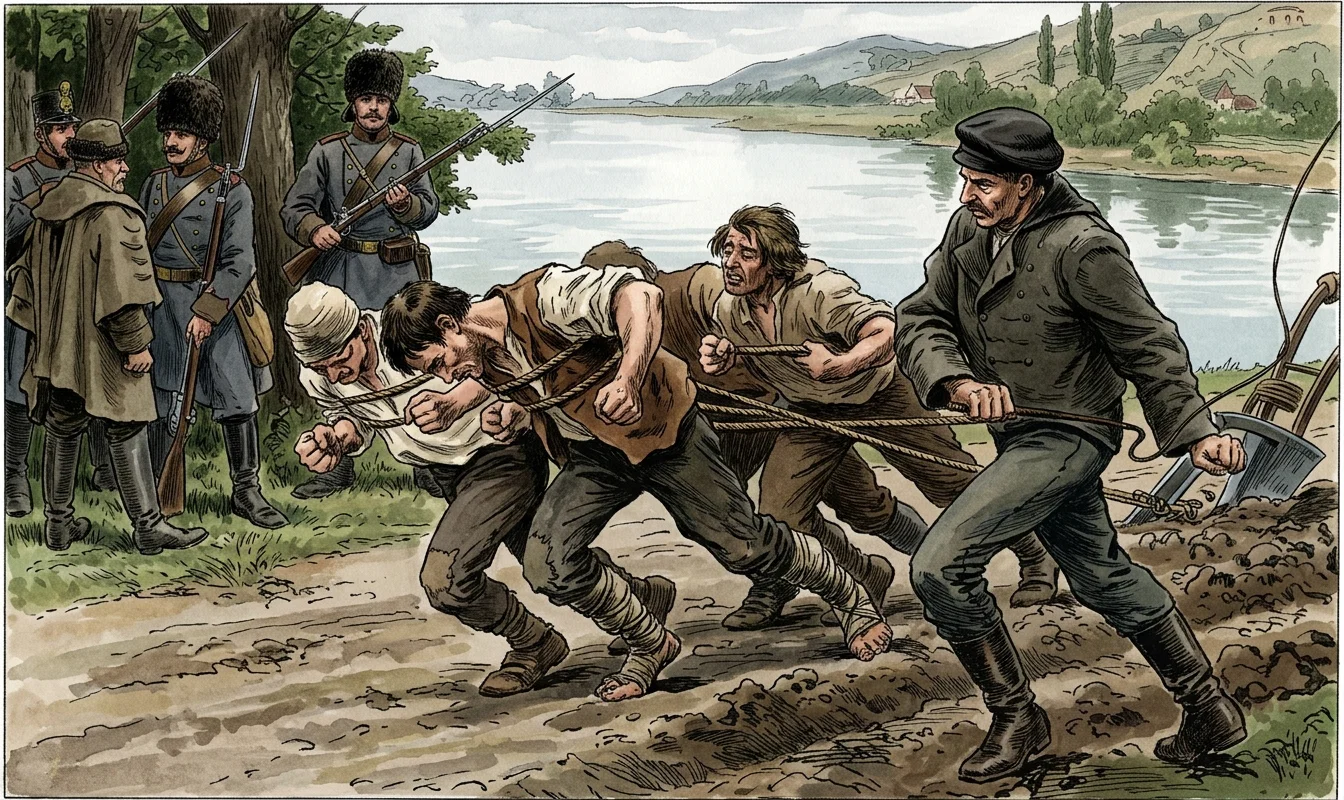
OUR cut on this page gives a view of men in Hungary harnessed to a plow. The man walking at their side with whip in hand has all the appearance of an ox-driver. The soldiers standing guard in the background illustrate the military despotism that is exercised over these unfortunate men. If the slavery that was in this country forty years ago stirred to the depths the hearts of Garrison and Lovejoy and Lincoln, what would be the effect produced on such men by a scene like this? God “hath made of one blood all nations of men for to dwell on all the face of the earth.” Acts 17:26. But when one class of men assume the complete ownership of another class, what will they be able to answer to their Maker when He calls them to give an account?
Throughout the northwest of Hungary the “noble landowners” have the habit of demanding fifty days’ labor out of each year from the laborers or peasants on their estates, without any pay whatever for their services. All the male population of the village located on his domain is summoned before the “noble,” and he selects the number he wants and sends the rest to their homes. The spread of the educating principles of freedom among these poor people has awakened them to the awful injustice of their degrading servitude, and the recent revolt and rioting there was an expression in a very forcible manner of the rising discontent. The landlords, by the aid of the army, have been able to suppress the revolt for the present, but the discontent is even greater than ever.
HUNGARIAN PEASANTS HITCHED TO A PLOW AS HORSES.
What must be the mental darkness and the supremacy of selfishness on the part of those who can so brutally enslave their fellow-men! How is it possible for a person to use as he would a horse, a fellow-man, who has the same feelings, the same impulses, and the same rights to freedom as himself? The one cheering thought in connection with it is that very often the oppressed slave is not nearly so degraded as his tyrannical oppressor.
But oppression is not confined to Hungary by any means. The wealthy men of that country still cling to their medieval forms of tyranny, and so it looks worse from a superficial view than what may be found elsewhere. But how much worse is it than the “sweat shops” and other forms of oppressing the weak and poor in the large cities of this and other countries? We say that it is hard-hearted tyranny to take fifty days of a man’s time and render him no equivalent in return. But is it not as great hard-heartedness and as cruel tyranny when we see fellow-mortals by the thousands dragging about the alleys and dark lanes of our cities, destitute of the barest necessities of life, while we are surfeiting ourselves in riotous and wanton living, and never so much as thinking to extend a helping hand? Hungary is truly in a deplorable condition. But the misery there is only a different type of the same oppression that exists under a differing garb in every corner of the earth.
The great sin that caused Satan’s expulsion from heaven was the exaltation of self. He began to think upon the promotion of himself. He did not have the good of others in view. It was only his personal desires, ambitions, and gratifications that were considered. And as we scan the records of the past or look at the condition of things as they are to-day, we must be impressed with the wonderful hold that selfishness has gained. As a general rule, there is a motive of self-interest at the bottom of every act. This statement may seem extravagant at first, but closely analyze all your acts, and the motives which prompt them, then place beside them the life and teachings of the one unselfish person—the Son of God—and see how truly destitute you are of unselfishness without alloy.
It may seem to men that such oppression as is found in Hungary and elsewhere to-day is passing without notice by the divine Father. But hear His startling words concerning it:—
“Behold, the hire of the laborers who have reaped down your fields, which is of you kept back by fraud, crieth; and the cries of them which have reaped are entered into the ears of the Lord of Sabaoth.” James 5:4.
Then this oppression of the laborer is being carefully noted, and there is a time coming when an account will have to be rendered.
If we are careful to study the whole of this fifth chapter of James, and particularly the first few verses, we will see that the oppression of the laborer results in the “heaping together of treasure for [or, as by the Revised Version, “in”] the last days.” Great reformers are striking hard against the evils growing out of this “heaping” up of wealth. But all that they can do seems to be of little avail against it. Plainly the “last days”—the time in which selfishness reaches its supreme and unbearable limit—are reached, and the one remedy, the one and only star of hope, is the promise of the soon coming of the Lord; for when He comes, all this sin will be destroyed.
He is coming very soon. Everything shows it. The very elements are loaded with the signs that foretell it. And toward that glad day of His appearing every one may turn with joy. For every sin, every oppression, will then be consumed by the brightness of His righteous glory. Get ready to enter into the joy of that longed-for time. T.