LOOKING UNTO JESUS

9%

Pacific Press Publishing Company · Oakland, California · Jun 23, 1898

FromSigns of the Times, Vol. 24, No. 25.

Read the full edition

LOOKING UNTO JESUS.

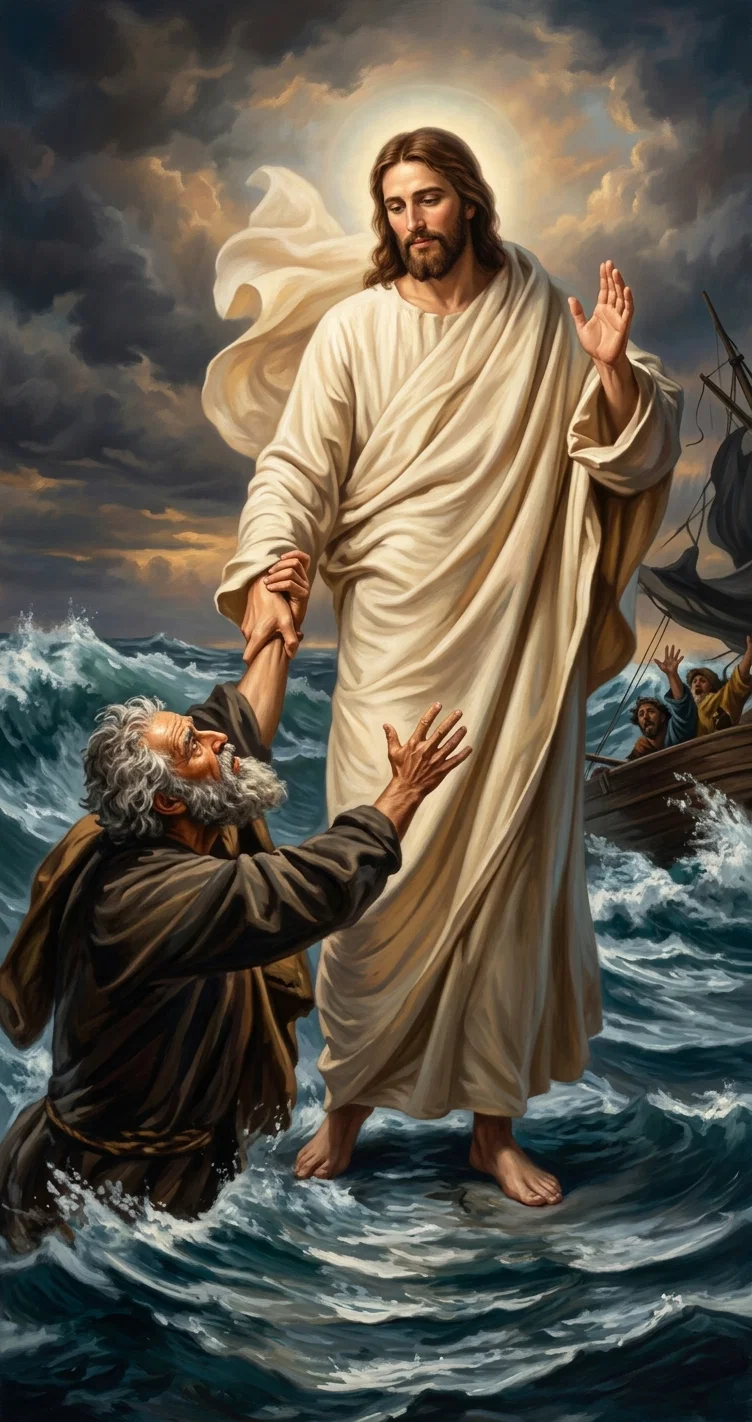
“And Peter answered Him and said, Lord, if it be Thou, bid me come unto Thee on the water. And He said, Come. And when Peter was come down out of the ship, he walked on the water, to go to Jesus. But when he saw the wind boisterous, he was afraid; and beginning to sink, he cried, saying, Lord, save me. And immediately Jesus stretched forth His hand, and caught him, and said unto him, O thou of little faith, wherefore didst thou doubt?” Matt. 14:28–31.
“O thou of little faith, wherefore didst thou doubt?”
This question is asked of you to-day, even as it was asked of Peter by the Master on the waves of Galilee nineteen centuries ago. Rather, it comes in modern form, present tense,—Why do you doubt?
The bidding may or may not be for you to step forth and walk upon the water. The act itself enters not into the account where perfect faith exists in the word of Him who bids us act. There is nothing in the account of Matthew of this incident,—nothing elsewhere to teach us that we ought to emulate this act of Peter. It appears to have been a sudden impulse, characteristic of the impetuous nature of the man, and born at the moment he realized that it was indeed his Lord and not a messenger of evil. Whatever may have been his motives as the reality of the scene with its meanings and possibilities burst upon him, the Master, knowing the heart of the disciple altogether, embraced the opportunity to teach Peter and the others an important lesson, and bade him, “Come.” And the lesson is for us to-day.
It is a sad fact that we are inclined to become careless of our regard for the Bible and the wonderful truths it contains for us. We read the words, but unless we meditate upon them, feed upon them, believe them, and order our lives by them, as the voice of God to us, they will accomplish nothing for us except our condemnation. The record of Jesus’ mighty works becomes so common that we often fail to realize what is involved in them. We are inclined to judge that we would not have been as careless as was Peter. But this was really a remarkable thing, for a man to walk upon water, and that Peter’s courage gave way is after all not particularly strange. Place yourself by the side of a body of water and imagine, if you can, what would be involved in actually walking safely over those unstable, lapping waves, and what the faith to do it would comprehend. But, you reply, circumstances alter cases; were my Lord walking there, showing that such a thing was possible, it would inspire confidence, and if He bade me come, it would be an easy thing to do. No, I think under the same circumstances not one of us would do better than Peter did.
This well illustrates our attitude at the present day toward the Word, and it places far greater responsibility upon us for our conduct than we adjudge rested upon the actual participants in the events themselves. We feel that we would not fail where they failed. This is virtually saying that we grasp the situation in all its bearings, and know what it means for us. We thus leave ourselves without excuse. It really becomes a serious matter when we begin to apply the lesson at home. If the example of our Master before our eyes, and His word, “Come,” would, we think, have inspired us to action—and it ought to—we are brought face to face with the question whether or no we really believe that word now. Aye, there is the point; for the scene is before us. The Master, our Example, says, “I am with you alway, even unto the end of the world;” and that word, which “endureth forever,” rings in our ears across the centuries, “Come.”
Had Peter faithfully complied with all that was implied in that simple command and invitation—for it was both—he could not possibly have failed. It proceeded from Him who formed the waters, and as it went forth, there went with it power to enable the one to whom it was addressed to do all that the occasion required. It was a foundation solid as a rock, a pathway paved with omnipotence. Peter stepped forth upon it; the waters became firm beneath him; but “when he saw the wind,”—the waves tossed by the wind,—he was afraid, and began to sink. What a lesson, what instruction, for us!
Power superhuman, the power of God, became his to use, and worked for him the moment he assented to the fact that it was able to do the work and showed his belief and trust in it by acting. But that wonderful force, at his service by that simple mental operation and the physical act that responded to it, worked for Peter only so longas the word rang in his ears, and his eyes were fixed on his Source of power. This is the definition of faith derived from this incident. Note his failures: he allowed other things to distract his attention; his mind wandered; his eyes turned from the Saviour, and the word faded away, and its power ceased to sustain him.
How is it to-day? Has that Source of power failed? Is the outflow less now than it was then? Are not these things written for our admonition, upon whom the end of the world is come? Then are not the words spoken directly to you and to me? Do you believe them? If so, they will be an incentive charged with divine power to stimulate us to action as real as was Peter’s. We will take every blessed promise in the whole Bible as the word of God; we will see Jesus our Master, and the Father, before us, and will hear the gracious invitation, Come up higher, into a fuller knowledge and realization of the Christian’s privileges; know what the power of God is. Dear friend, let us grasp the situation, and prove the power that awaits the first step upon that which humanly seems, from all human experience, nothing but yielding waters.
But for your soul’s sake remember the lesson of faith: let there be no, “If Thou be the Lord,” but, “I know whom I have believed.” Keep your eyes fixed upon the heavenly vision; concentrate your mind, your all, upon the Source of power and the Word; do not think of self, or what others may think or say or do; mind not the surroundings, and be not distracted by air, nor water, nor fire, nor “height, nor depth, nor any other creature,”—see Jesus only, and the power will not cease its mighty working, tho the earth be removed. That time is coming soon, when the air shall pass away with a great noise, when the elements shall melt with fervent heat, and the earth will be removed as a cottage. In that day there will be nothing substantial to stand upon but the Word of God. Let us learn how to stand and walk upon that Word to-day, that we may not be afraid then. L. A. PHIPPENY.