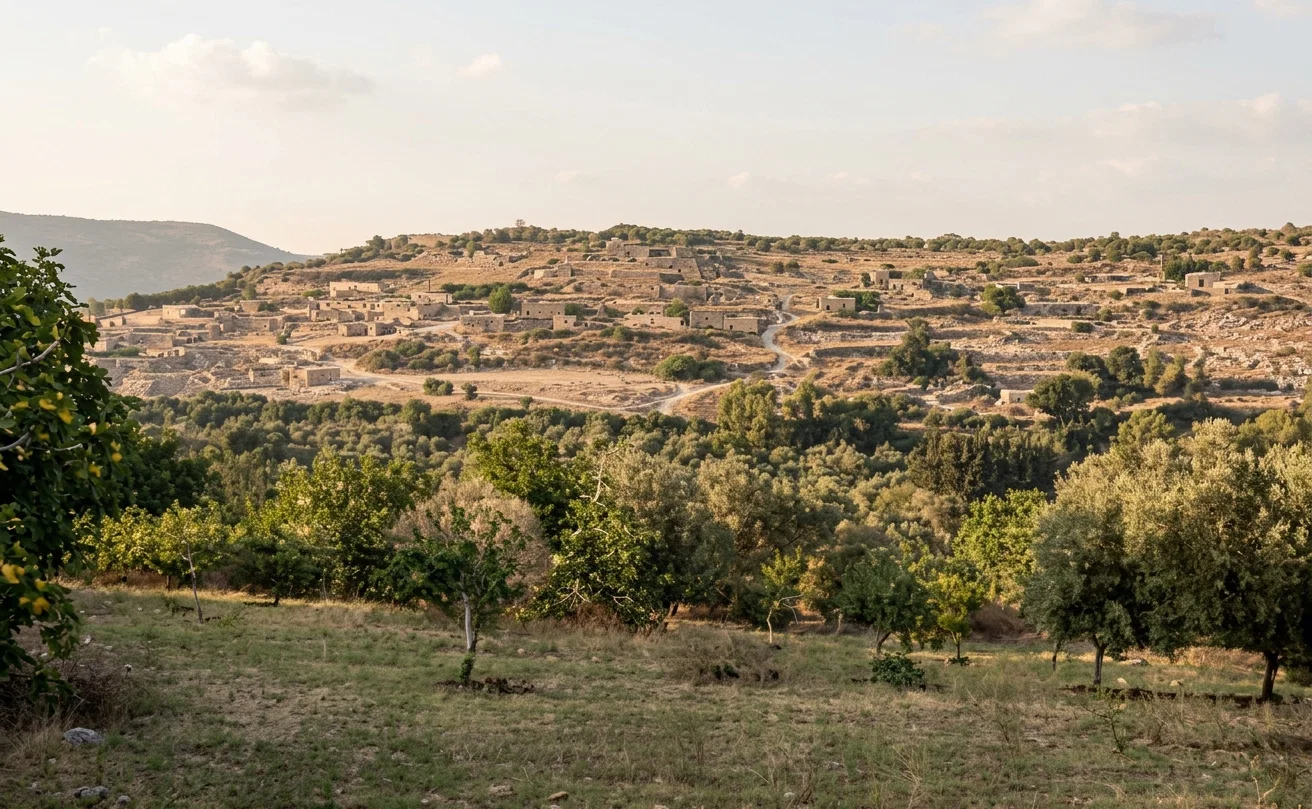
FRIDAY, January 7, early in the morning, we started from Nazareth for the Sea of Galilee. It was with a keen sense of pleasure that we entered upon this journey. What land is so fraught with thrilling memories as the regions round about Galilee? In the early morning of midwinter the air is fresh and crisp; ascending from Mary’s Well to the north, the road was narrow, and in places so rough and rocky as to be almost impassable; so the first half hour of the journey we walked, till the hill-top was reached. From here we had a fine retrospective view; it is claimed by those that have traveled extensively that this is one of the finest views of all Palestine.
After passing the summit of the hill, we descended gradually to the north by a winding road through quite well cultivated valleys. Here and there are olive and fig orchards. The tops of the hills are generally bare rock, and large portions of some of the valleys are so thickly covered with stones as to be good only for grazing. All of this country from Nazareth to the Sea of Galilee belonged to the tribe of Zebulon.
Nearly one hour from Nazareth, we passed Gath-Hepher, the birthplace of Jonah the prophet. 2 Kings 14:25. Nearly nine hundred years before Christ, the word of the Lord came to Jonah at this place commissioning him to go to Nineveh. In going to Joppa to take a ship for Tarshish, he would pass via Nazareth, across the plain of Jezreel, over Mt. Carmel, and along the shore of the Mediterranean, about three days’ journey. Gath-Hepher is also mentioned in Josh. 19:13, as on the border of the possessions of Zebulon. The place is now but a poor, small village. Near it is shown what is claimed to be the tomb of Jonah.
Scarce half an hour from Gath-Hepher, or nearly an hour and a half from Nazareth, is Cana, where Jesus performed His first miracle by turning water into wine11was taken from this place. While we were watering our horses, several women came with jars on their heads to draw water. They were poorly clad and barefooted, and looked inferior to the women of Nazareth.
A few minutes beyond the spring we reach the village of Cana, called Kefr Kenna in the Arabic. Its population is 600, one-half being Moslems and the other half Christians. The road leading from the spring to the village is lined on both sides by cactus hedges some fifteen feet high. Here and there some of the crimson fruit, called cactus figs, could be seen. At places the road was quite muddy, and as the horses would shy from one side to the other in their efforts to avoid deep holes, we were in constant danger of being suddenly thrust against the threatening spines of the cacti. In the village is a Greek Church, where one is shown a broken water-pot, claimed to date from the wedding at Cana.
CANA OF GALILEE, WHERE JESUS TURNED THE WATER INTO WINE.
Cana is also of interest as having been the home of Nathanael. John 21:2; 1:46. Having lived so near Nazareth, Nathanael was well acquainted with its reputation, hence when Philip said to him: “We have found Him, of whom Moses in the law, and the prophets, did write, Jesus of Nazareth, the Son of Joseph,” he at once replied, “Can there any good thing come out of Nazareth?” One might conclude that living within an hour and a half’s walk from Nazareth, Nathanael might have been personally acquainted with Jesus; but the Scripture indicates that this was their first meeting. John 1:48.
After leaving Cana we traversed a long, fertile valley, in the land of Zebulon; here and there is a poor village; and usually in the vicinity of the villages are olive and fig orchards. The farming is very poorly done. Should the soil be no better tilled by farmers in America, it would scarce yield a meager living. All through this region the birds are quite plenty. In places, the land is exceedingly stony. After four hours from Nazareth we reached an extensive and fertile, undulating valley. The view here is exceptionally fine; the land is less stony, and the whole reminds one of the valleys of Switzerland, except that trees are almost entirely wanting. It takes us over an hour to cross this valley. At its northwestern extremity rises a conspicuous point called Horn Hattin, to an altitude of 1,135 feet.
While the coachman stops to water and rest his horses, we walk on ahead. As our road passes within half an hour’s walk of Horn Hattin, we determine to ascend it; for this is called the Mount of Beatitudes. It is quite generally accepted that it was here that Christ preached the Sermon on the Mount. The Jewish professor accompanied me; as I proposed to leave the road and ascend the mount, he objected; for he had no special interest in places which are connected with the life of Christ; so he tried his best to dissuade me by assuring me that the distance was very deceiving, and that it would be too fatiguing, etc. But my interest was too great to be easily turned aside; hence I encouraged him to leisurely continue along the road while I made a hasty excursion to the summit; but he was afraid to be left alone, and so unwillingly accompanied me, every little while making fresh efforts to turn me from my purpose.
On the way up we crossed successively plowed fields, meadows, and patches overgrown with weeds; part of our way lay along a ridge, a mound of stones and earth, cast up as a defense in the noted battle which took place here in 1187, when the Moslem general Saladin finally defeated the Crusaders.
As we neared the summit, all at once, to the east, a portion of the Sea of Galilee burst upon the view. The day was fine, and the sea calm; the mountains to the east of the lake were high and treeless, with many ravines leading down towards the sea. As we ascended, more and more of the lake came in view, till we could see nearly the whole length from north to south. At the north end we could plainly see where the Jordan flowed into the sea, and the plain on which Capernaum was situated.
From the summit of Horn Hattin the view is exceptionally fine; to the south are fine stretches of rolling valleys flanked by dome-like hills, mostly covered with soil and green with verdure; to the south rises Mt. Tabor, and to the southeast rise the hills of Gilead and the Hauran Mountains; as our eye sweeps from these towards the east, the lower end of Lake Galilee and the country of the Gadarenes come in view; then the precipitous mountains just east of the lake, and nearly north, looking up the valley of the Jordan, we see in the distance the white summit of Mt. Hermon. Almost directly north we see Safed, a city of 25,000 inhabitants, at an altitude of 2,749 feet, the highest of any town in Galilee. This is a great center for the Jews, it being held as one of the sacred places; for, according to a tradition, the Messiah is to come from Safed. Most of the Jews here are Polish emigrants, under Austrian protection. Looking to the west, we can see a wide range of the hills of Galilee, nearly to the Mediterranean.
The ascent of Horn Hattin is an easy one from the south, the land sloping gradually from the valley to the summit; but on the west it is abruptly broken off. Just beyond, to the west, is a deep valley extending down to the lake. The abrupt cliff commencing with Horn Hattin extends also nearly to the lake; and it was in these cliffs that those notorious robbers had their dens whom Herod destroyed by lowering soldiers with ropes from the summit.
No better place for a large gathering could be made than the gentle and extensive slope to the south from the summit of Horn Hattin. A sermon delivered from this mount could readily be heard by thousands; and the air is so clear that the speaker could be distinctly seen at quite a distance. Then the beautiful and extensive surroundings, with hills, valleys, mountains, grain fields, meadows, Lake Genessaret, and villages and cities, olive and fig orchards,12and palm trees, furnished an almost endless variety of scenes for object lessons. From descriptions which I had read of the Mount of Beatitudes, I had never received the idea that the surroundings are so extensive and so picturesque. Let us rest here awhile, to contemplate the beautiful views and review the many interesting scenes with which they are connected.