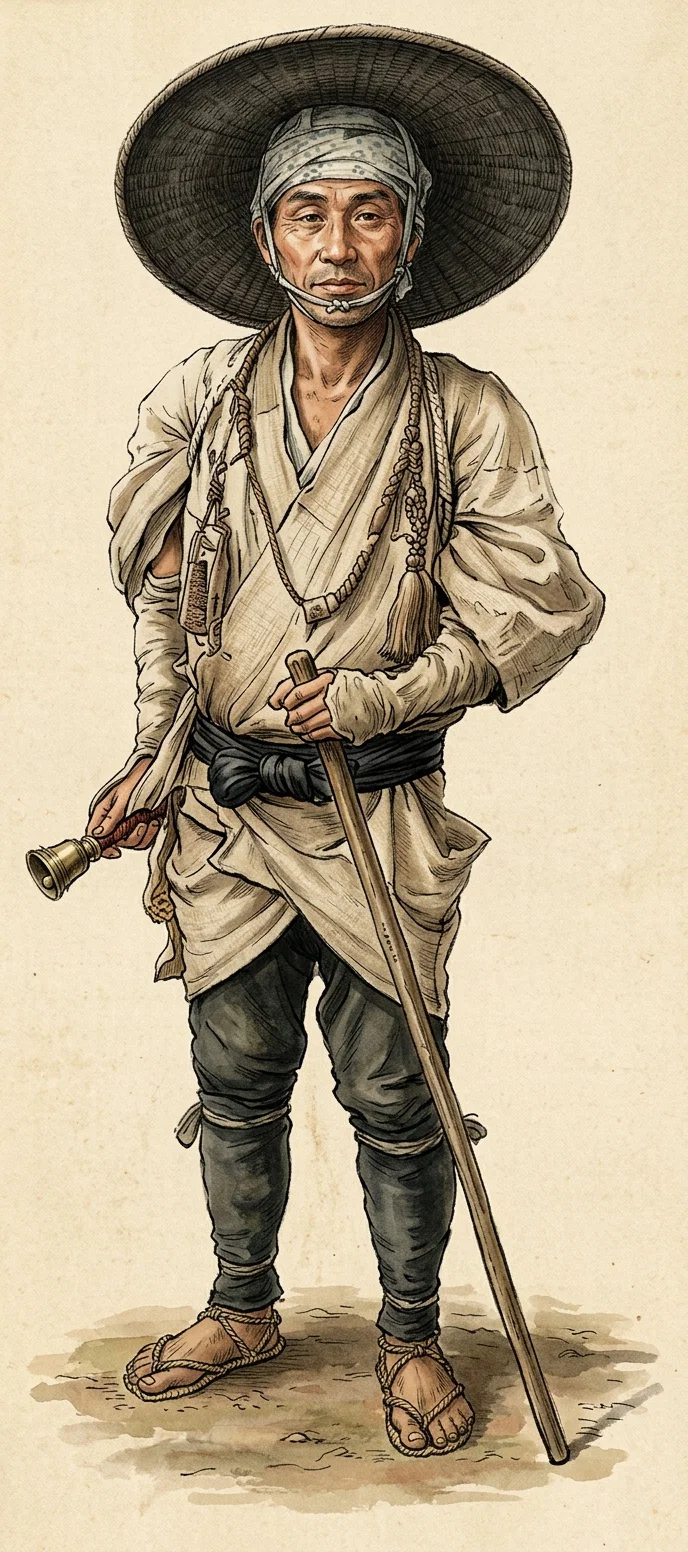
Like all other man-made religions, the pagan systems of Japan look to no higher power for deliverance from sin than to man himself. The sinner, acting under instructions from the priest, becomes his own saviour. Doing penance for sin is a common practise.
Last January while out walking one evening, I was attracted by an unusual jingling of bells behind me. As they were rapidly approaching, I looked round for fear I might be in danger of being run over. Instead of seeing a vehicle or a troop of cavalry, I saw a squad of young men dressed in thin white cotton shirts and drawers, with small bells attached to their belts. Traveling in a brisk trot, they soon passed out of my sight; but there being such a contrast between their dress and the weather, my curiosity was aroused to know what it all meant. On making inquiry I learned that they were doing penance, and traveled in squads for company. It seems that a period of about six weeks at the beginning of the year is set apart for general self-abnegation and punishment—a period corresponding closely to the Catholic season of Lent.
The people confess their sins to the priests, and the priests prescribe the punishments, which are various and graded according to the nature of the offense or degree of guilt. Giving up for a certain period some luxury, as tea, tobacco, or wine; fasting for a certain length of time; walking back and forth barefoot on the rough stones between the gate and the temple so many hours; going barefoot from shrine to shrine to worship so often, etc., are among the remedies prescribed for sin.
About the severest punishment of which I have learned is that which came under my notice last January. I have been told that young men go to wells and dash buckets of water upon themselves, and in their thin clothes, dripping wet, go through the cold from shrine to shrine to obtain absolution from their sins.
The natural man would rather do something11to save himself than to receive salvation as a gift. If he could only make satisfaction for his sins by self-inflicted punishment, there is scarcely a man, I dare say, who would not gladly pay the penalty, however severe it might be, if he could only be allowed to continue in the indulgence of sin. Penance is like paying a debt. A man at the close of the year on settling with his creditors feels free to contract other debts, to be settled at the end of the next year. So it is with the sinner. He looks on his sins as a kind of debt. If he satisfies his conscience by doing penance, he feels free to go on as usual and commit sins to be atoned for at the next settling season. At any rate, that is the way the matter seems to be regarded over here.
Deliverance from sin through Jesus Christ can be obtained as a free gift. But it not only requires an acknowledgment but an abandonment of sin. The difficulty lies in forsaking sin. When teaching God’s Ten Commandments to my classes, the remark is often made by the pupils, “I think it would be very hard to obey these commandments,” or, “I think it would be impossible to keep this law.” Leaving God out of the reckoning, it would be impossible. “But with God all things are possible.”
He who has said to do, will give the power to do. He not only can make us free from the sins of the past, but can give us the ability to overcome the temptations of the future.
These people are not so very different from unconverted people of so-called Christian lands. All act on the same principle. The differences are chiefly individual. It requires less to satisfy the consciences of some than others. Some men, often professed Christians, after spending the greater part of their lives in violation of the tenth commandment, feel that they have done something truly meritorious if they devote a few thousands of their ill-gotten gains to establishing a charitable or educational institution. Others whose consciences are more hardened think to atone for their sins by making provisions in their wills for the outlay of a few thousands in charity after they are dead. The Pharisees in the days of Christ thought that by giving more careful attention to the traditions of the elders, they could make compensation for setting aside the commandments of God.
Many professed Christians to-day act in a similar way. They zealously perform self-imposed duties—things more in harmony with their own carnal natures—to satisfy their consciences for refusing to do what the Lord has required. All such are idolaters, for the Word of God says that covetousness is idolatry, and again, “Whosoever shall keep the whole law, and yet offend in one point, he is guilty of all.”
The pagan, the Catholic, and the Protestant, who choose to follow a way that is contrary to the commandments of God, are serving the same master, and will meet the same fate unless by sincere repentance and faith they find deliverance through Jesus Christ. He does not save people in their sins, but from their sins.
From early spring to the beginning of winter, religious feasts are very frequent. All temples and shrines, like our Catholic Churches, are dedicated to dead heroes. The birthday of the hero is the time usually selected for the festival. These occasions are apparently anticipated with great pleasure, especially by the women and children. The streets for several blocks around are at night illuminated with Chinese lanterns. The image of the hero is carried in state through the streets, amid the shouts of the people. It is a time of great rejoicing.
Last Sunday, April 17, a feast was held at Shiba temple, near our place, in Shiba park, which was attended by many thousands of people. It reminded me of a Fourth of July celebration in one of our large cities. These are times of ingathering for the priests; for I understand that all are expected to drop a coin into the temple treasury. If so, the priests of Shiba temple must have received a cart-load of coppers last Sunday.
We are doing what we can to turn people from these vanities to the service of the living God, the Creator of the heavens and the earth. The field is so large and the work so great that were it not for the promise of the Saviour, “Lo, I am with you alway, even unto the end of the world,” we should feel that it were a hopeless task. Not so, however; for the Word of God says that the last message shall gather from every nation, tongue, and people. We know that God has a people here, and with His assisting grace we shall endeavor to find some of them.