And now let us walk about Nazareth! What a delightful privilege! In the enthusiasm of the moment all else is forgotten, and our minds rest on the scenes that were here enacted nearly nineteen centuries ago. But our fellow passenger, the Jewish professor, does not share our enthusiasm; he still holds to the tradition that nothing good could come out of Nazareth.
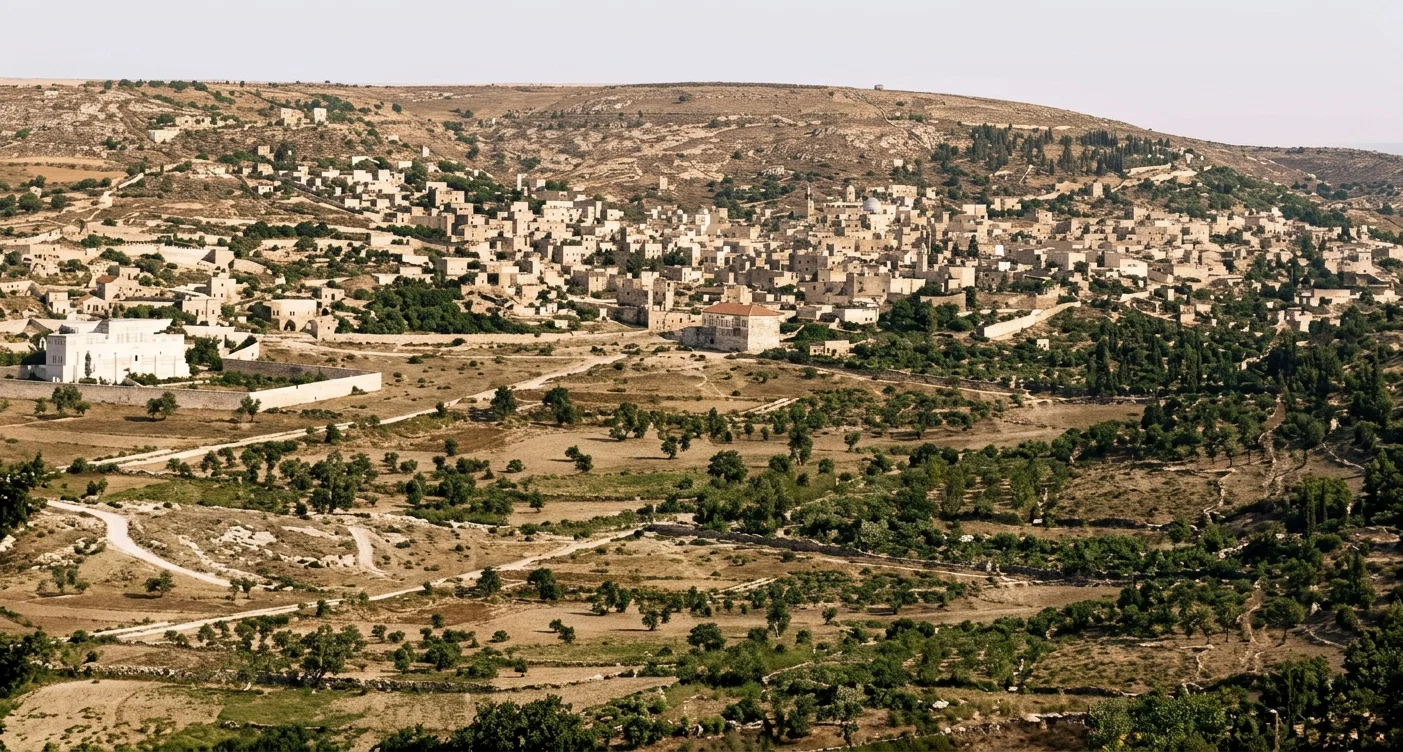
First, let us ascend the hill on which the city is built; in half an hour, we are on the top, above the city. From here, we have a fine view of the whole town, and a wide range of the surrounding country. Nazareth itself presents a pleasing picture. Many of the buildings are quite new. The houses are mostly white. While, as in ancient times, the majority have flat roofs, some have the more modern tile roofs. The scene is enlivened by fig, olive, and cypress trees. Church spires, domes, and minarets speak of a population of Christians, Jews, and Moslems; while in the various styles of architecture we observe that there are Latins, Greeks, and Protestants here.
The hills round about Nazareth are mostly rocky and barren; in the valleys, there is fertile soil. Quite a large portion of the population of Nazareth is engaged in farming and gardening; the chief articles of trade are grain and cotton. Looking beyond the immediate surroundings of the town, we see to the east the round dome of Mt. Tabor, so long held to be the mount of transfiguration; in consequence of this belief, three churches were built on its summit, in execution of the proposition of Peter; but recent investigation tends to show that the transfiguration took place on some part of Mt. Hermon. Back of Mt. Tabor, we see the indentation which indicates the valley of the Jordan, and just beyond, the hills of Gilead. To the southeast, we can see the hills of Gilboa, and southerly, the great plain of Jezreel, lined on the south by the mountains of Samaria and Carmel.
As we stand looking over this interesting and varied scene, we remember that in outline the view was the same when Jesus spent His childhood days in Nazareth. He may, perchance, have many times climbed the same hill; He certainly viewed these surroundings during the larger part of His life on earth. As He studied the Scriptures, He could, looking out from the hills of Nazareth, see many of the places where the Old Testament scenes took place. But the picture then was much more pleasing than now. Then Galilee was in its prime; it was perhaps the most densely populated then of any period in its history. Regions now barren and bleak were then green with verdure, olive and fig orchards, and vineyards;11places now lying in desolate ruins were then teeming with life.
While we are on the hill, there is one more point to be noticed; to the south of us is the spur of a hill with one side almost perpendicular; it is claimed that it was from this cliff that the people of Nazareth endeavored to precipitate Christ. Let us now descend into the city and view some of the many institutions located there. Here is an orthodox Greek Church, dedicated to the angel Gabriel, in memory of his visit to Mary at the time of the annunciation. Then there are also the Greek monastery, the Russian boys' and girls' schools, the Russian teachers' college, and the Russian hospice.
Near the center of the town, we see an object of special interest; it is the Latin (Roman Catholic) church of the annunciation. It is claimed that on the spot occupied by the church the angel appeared to Mary, and hence it is held most sacred by the Latins. But whether it be the exact spot or not, the blessed fact remains that the angel did appear to Mary, and that Jesus Christ was born of the flesh and dwelt among us,—took our nature upon Him that He might impart His nature to us.
NAZARETH AS SEEN FROM THE SOUTHEAST.
Besides the church of the annunciation, the Latins have a monastery with a school, a hospice, a nunnery, an orphanage and school. Protestants also have several institutions, of which may be mentioned the church and mission school, a hospital, an orphanage and girls' school, and a Bible depot.
In the Catholic and Greek institutions are shown many things connected with the life of Christ, such as the kitchen of the Virgin Mary, the workshop of Joseph, the rock on which the house of Mary stood, the table of Christ, and the remains of the synagog in which Christ stood up to read on the Sabbath. But without stopping to question the authenticity of all these claims, let us descend to the lower and central part of the town, to a large fountain.
This is called Mary's well. It is the only spring in the town, hence it is quite certain that it is the one from which water was drawn in the time of Christ. Doubtless Jesus, as child, often accompanied His mother to this well as she came to draw water. As in those days, so to-day, the women carry the water from the fountain to the home. A short distance from the spring is a large stone basin to collect the water; at its side is a trough for watering the stock. At this basin or fountain, the women and girls come from all parts of town with stone or earthen water-jars on their heads. When we were at the fountain, there were about twenty there filling their jars. It is a rare thing for a man to carry a jar of water; perhaps this is why Christ gave to His disciples the sign of a man carrying a pitcher of water, as an easy means of finding the one who was to show them the house where they were to eat the passover. Mark 14:13.
The clothing is loose and flowing, as represented in pictures of Bible scenes. The modern daily newspaper does not exist in Nazareth, but the ancient one does; at the fountain the news of the day is passed about. One might conclude that without the daily paper and the telephone, the people of Nazareth would know but little of what is transpiring; but the fact is, this fountain gossip is more than equal to a journal with but one edition daily; here are several editions daily. The village fountain seems to be a sort of bureau of information. When Abraham's servant desired to find a wife for Isaac, he went to the fountain; likewise did Jacob when he desired to find his relatives; and Moses when he fled to the land of Midian.
The population of Nazareth is about eight thousand, three-fourths of these are Christians and the remainder mostly Mohammedans. Each confession has its particular quarter of the town and its own government. The people of Nazareth are noted for their turbulent disposition. And as these Oriental towns maintain much of their ancient character, it is likely that the people were of this temperament in the days of Christ. This fact adds an additional charm to the meek and lowly spirit of Christ. He not only took upon himself our nature, but grew up in a town which had such a bad reputation that it was said even as far away as Jerusalem that nothing good could come out of it; and was surrounded by a people of specially tempestuous character. That they were of this stamp is evident from the manner in which they treated Christ when He read in their synagog; one moment “all bare Him witness, and wondered at the gracious words which proceeded out of His mouth;” but the next moment they “were filled with wrath, and rose up, and thrust Him out of the city, and led Him unto the brow of the hill whereon their city was built, that they might cast Him down headlong.” Luke 4:22–29. The fact that Christ could, among such a people, develop such a mild disposition in sinful flesh, should be an encouragement for all, specially those placed under peculiarly unfavorable circumstances. With this lesson deeply impressed on our minds let us close our day's visit in Nazareth. We will return to the German hotel and seek rest for another excursion on the morrow.