MY LADY'S PLUMES

6%

Pacific Press Publishing Company · Oakland, California · May 5, 1898

FromSigns of the Times, Vol. 24, No. 18.

Read the full edition

MY LADY'S PLUMES.

You observed the hat of the lady who walked in front of you down the fashionable part of the main street the other day. You have not noticed, perhaps, that on my lady's hat are some tall, pliant plumes, long as those of the ostrich, but far more beautiful, with delicate filaments as light as frostwork on a winter window.
These long, filmy plumes on my lady's hat are the plumes of the white egret. Naturally, they are pure white, but pure white not being barbaric enough for the use of civilization—tho it used to serve Southern Indians who wore these plumes—they are dyed any color of the rainbow, losing, thereby, none of their beauty.
My lady's hat, if worn too long, will lose its purpose and cease to attract. She must, therefore, change it. The plumes in the new hat must be of different color. For these new plumes she looks to her milliner. The milliner looks to the great wholesale supply house of the metropolis. The wholesale supply house looks—and with much anxiety these days—to Thomas Jones, market shooter, or, technically speaking, plumage hunter.
Thomas Jones knows where there is an egret roost, or, as he will call it, a “white crane roost.” Really, he does not mean a roost so much as a nesting-ground, where thousands of birds nest in a small tract of the isolated, wet forest or “dead-tree swamp.” Such rookeries were once common in Florida, but are so no longer. Thomas Jones may know of one in Mississippi, Louisiana, or Texas, and holds himself fortunate if he does, for they are scarce enough to-day.
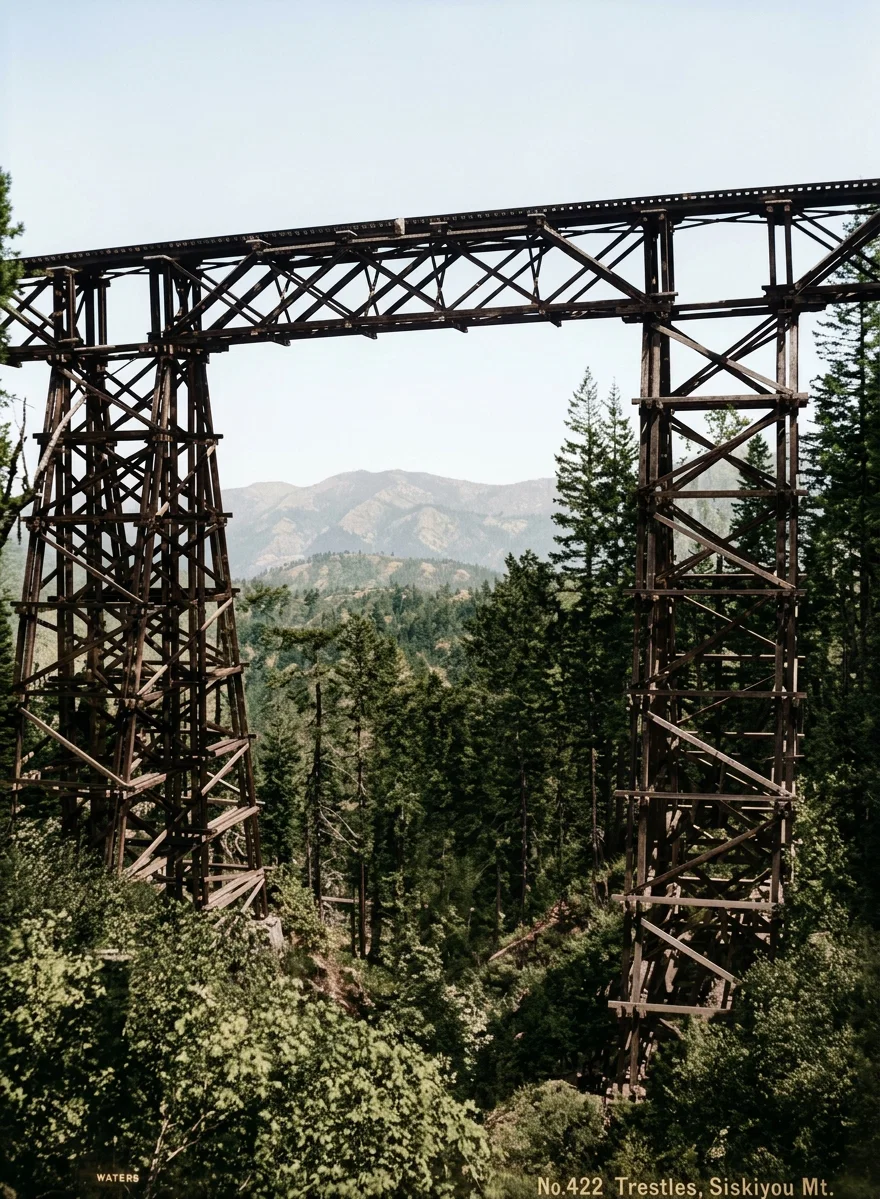
CALIFORNIA SCENERY, No. 16.—From San Francisco to the summit of the Siskiyou Mountains, the San Francisco and Portland Railway numbers its river crossings by nearly a score, and its tunnels by sixteen. The climb up the Siskiyou Mountains is one of indescribable grandeur. The road loops, and doubles, and runs in circles, and stretches back and forth, in climbing the mountain, till in one place five lines may be counted, but a few rods apart, but miles by the railway. One distance of 6 miles between Dunsmuir and Sisson climbs 646 feet; a stretch of 14 miles climbs 1,300 feet. The high trestle above is one of the many sights on the road. Of the building of this road the “Railway Age” of May 11, 1898, says: “The tremendous mountain ranges constituted a barrier not only discouraging to those who were called upon to provide money for overcoming it, but it was even believed by some would baffle the skill of the engineer and the railway builder if the completion of the work was really undertaken. The Southern Pacific Company, however, did undertake and did successfully carry through this great work; and now the traveler, by palace car between the chief cities of California and Oregon, is enabled to view, along portions of the ‘Shasta Route,’ the grandest mountain scenery of the Pacific Coast, and probably of North America.”
Mind you, the plumage hunter does not go into the roost until spring has well advanced. When he reaches the roost, the low trees, bushes, and grassy brush clumps are full of nests, and the nests are, or soon will be, full of young birds. The busy life of the colony goes on. The parents come and go, traveling, no one knows how far, to get food for the gaping young birds in the nest. Thomas Jones notes the high, projecting snag of the tallest tree near the edge of the colony. There is a white crane on that limb. It seems to him there always is one there. In short, it is a habit of the bird to alight on the highest branch offering itself.
Out of the thousands of nests in the vast colony, how can the parent egret pick its own nest, since all look so much alike? Thomas Jones often wonders about that, and sometimes laughs a little to himself. The parent egret has been out after food, and returns to the colony. Without a second's hesitation he picks out his own nest and pauses for an instant directly above it, high up in the air. Then he lets his long legs drop straight down, and, throwing his wings up, just falls down through the air, feet first, in the most comical and awkward-looking way in the world, tho he never misses his nest by an inch, but lands just where he wanted to. As he thus backs downstairs out of the air, his long plumes, attached in a little clump at his shoulders, and spreading out over his back as far down as the longest tail feathers, flare up in the air, reversed and standing up over his head as he drops, as a white garment would in the resistance of the air.
On these plumes Thomas Jones fixes his eye. He shoots an egret and satisfies himself that the plumes are “ripe,” i. e., in their prime condition. Then he builds his camp on the best ground he can find near by, and the next day is ready to go to work.
Surely Thomas Jones is not going to kill these birds right in the nesting season, when the helpless young are in the nest and must die also if their parents die! That can not be possible, you say. Yet that is precisely what he is going to do. It is not his fault, he will tell you, that the plumes are not good in the fall, winter, or early spring, and are not prime until the height of the breeding season. “Here are the plumes, found at much labor, reached at much danger,” says Thomas Jones, blind and deaf further than that, “and there is the price offered me for them, so much an ounce, perhaps $40 an ounce, or perhaps as low as $140 a pound.”
Is this right, to kill these birds at this time? I am not clear that we should ask this question any more of Thomas Jones than of the wholesale milliner's supply house, or of the retail milliner, or of every lady on the street. Only the fact remains, pitiless, horrible, unspeakable, that the gathering of the plumes is a harvest of death, a harvest untimely, disastrous, because it is reaped at the sowing-time of life. Every egret killed for its plumes is killed when it is helpless through its blind, natural love for its offspring, and when its death means the death of all its helpless young. Does the wholesale man know this? Does he care? Is it not the one thing to be remembered that my lady must have her plumes? . . . White—they are white, these plumes. It is mockery. They should be the blackest sable, and they should stain black the white fingers that caress them.
But Thomas Jones can not stop to argue. The next day he pushes quietly into the edge of the nesting-ground. He ties his boat firmly within easy range of the tall snag he saw the day before. He takes out his rifle—the 22 shot will make no noise, and it will serve his purpose perfectly. There is an egret on the tall snag. Taking a steady aim, Thomas Jones fires, and the bird whirls down, dead. One or two other birds start on their perches in the same tree, but settle back. One by one they, too, whirl out and lie in a white tangled mass at the foot of the tree. An egret raises herself up above the rim of the nest on which she sits, and the tiny bullet pierces her. She whirls down, lying white and motionless. The little ones gape and cry, but no food comes. The father was killed on the tree near by.
One by one, out of the nests, off from the limbs of the trees, here, there, anywhere—for the birds are all about, and so stupid with the breeding fever that they will not leave—the slender white birds meet their doom. That tall snag has yielded twenty victims. Thomas Jones has not moved from his boat. He has over two hundred birds down. He can tell by his cartridge boxes, for he rarely misses a shot. It is easy shooting.
After noon Thomas Jones goes out and gathers up his spoils. A cut of the knife and the clump of plumes is off. The carcass of the egret is left lying. Two hundred carcasses of egrets are left lying. That many more tomorrow. Many more than that the next day, for by that time the wailing of the dying young of the first day's victims will have ceased. From then on, day by day, increasing in three-fold ratio, the harvest of death goes on, steadily, pitilessly, on the sowing-grounds of life, out in the silent wilderness where the birds have tried to hide their homes.
In less than a month it is all over. The long, white lines no longer cross the country going to and from the feeding-grounds. The white forms no longer appear on the naked trees. Doubly naked the forest stands in silent desolation. Sodden and discolored the once white forms below the trees sinking into the slime. From beneath the trees, and from the nests up in the trees, a great stench goes up. Not a bird, young or old, is left alive. The old ones stayed till death came, bound by the great instinct of nature to remain with their young.
Jones, a little yellower, but not sick, for he is a healthy man, packs his feathers carefully and hies him to the railway for a swift and secret journey out of the country. He wonders where he can find another roost next year. Behind him is desolation.—E. Hough, in Forest and Stream.