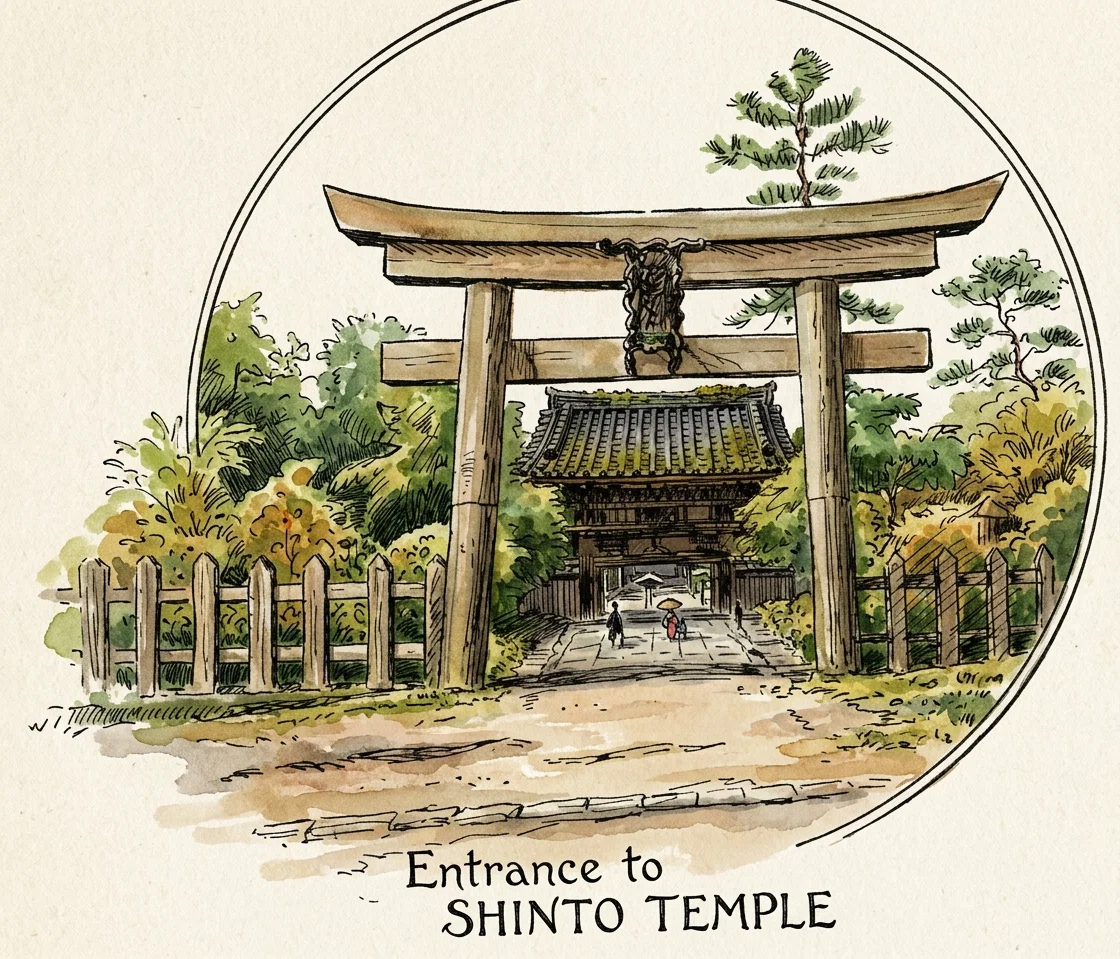
The most ancient religion of the Japanese is Shintoism, a species of ancestor worship. The notion that the spirits of their ancestors return to earth and exercise a special guardianship over the destinies of their posterity is well-nigh universal. As far as my observation has extended, this opinion prevails among those who are Buddhist, as well as the adherents of the older religion.
The Shintoists have numerous temples, but no images that are objects of worship. They repel the charge of idolatry, but it is said their temples often contain images of men of national reputation, but that no worship is performed before them.
There are two or three classes of Shinto shrines, the national, the community or district, and the household. In the first, prayer is made to the imperial ancestors, who are supposed to be the guardians of the nation. In the second, supplications are made to the spirits of local benefactors. Every household has a shrine, dedicated to its own ancestors. Prayer is offered before the shrine daily—usually in the morning and at night. When the family partake of food, a portion is placed before the shrine for the refreshment of the souls of the departed ones.
The love of country and respect for parents are very strong among all classes, and are so interwoven with their religious sentiments that it is difficult to persuade them that it is wrong to perform acts of worship to their dead friends. This is one of the greatest stumbling-blocks to their accepting Christianity. Because Christianity condemns such things, they regard it as antagonistic to true patriotism and filial duty.
The most important piece of furniture in11a Shinto temple is a large metallic mirror, circular in shape and about two or three feet in diameter. This is a memorial of a great event in Japanese mythology. It seems that about the time the gods were planning to organize the Japanese people into a government, a certain goddess of great power and influence becoming offended, from some cause not well known, hid herself in a cave. As the projected organization could not be carried out without her aid, various means were employed to dislodge her from her hiding-place. At last the idea occurred to some wise man to place a mirror in such a position that she would come upon it unawares. This scheme was crowned with success. On beholding herself in the mirror, the goddess was so well pleased with her personal charms that she immediately became good-natured toward everybody, came from her retreat, and performed her part of the ceremony of establishing the Japanese Empire. The original mirror is supposed to be in a temple further south. The gods are the supposed ancestors of the emperor.
Entrance to SHINTO TEMPLE
The anniversary of the death of a father or mother is observed with special acts of devotion—from the emperor down to the poorest coolie. All of the family who can go, visit the grave, where they pray and make offerings of flowers and food. The emperor’s parents are buried at Kyoto, the former capital of the country. He and his family go twice a year to pray at the graves of his ancestors.
The Shinto priests are pensioners of the government, but their compensation is very small. The temples belong to the government but are in many cases in a very dilapidated condition, which would indicate that this ancient religion has not as strong a hold on the people as it formerly had.
As the people become educated, these myths will be discarded. The Shinto, like every other heathen, believes in the immortality of the soul, as the foregoing would indicate. He also believes in a kami, or great spirit, a chief of all gods, and in many grades of inferior spirits reaching down to man, but his religious devotions are paid to those who have once lived in the flesh.
Buddhism.
Buddhism was introduced from Korea and China in the sixth century of the Christian era, but in a greatly modified form. At first the opposition to it was very strong, but after it was changed so as to harmonize more with the customs and religious views of the people, the opposition ceased and it soon became popular. Its moral precepts are far superior to those of Shintoism. For this reason the more religiously inclined of the people embraced its doctrines. There is a great lack of unity among its adherents—there being no less than eight distinct sects. What their differences are I am not sufficiently informed to state.
While the moral code of the Buddhist is good, his practises are abominable. His priests are notoriously corrupt—so corrupt that the more respectable of Buddhist papers are now crying out against their abominations, and predict the speedy downfall of the whole system should not a radical reformation be begun at once.
As far as I have observed, about the only difference between Buddhism and Shintoism, aside from the moral code of the former, is that, in addition to the superstition of the latter, there has been added a system of worship which is a very gross kind of idolatry. The Buddhists have temples, shrines, and a priesthood of their own. These are to be found everywhere. While there is nothing in the outward appearance of their temples to remind one of Roman Catholicism, the interior arrangement of both and the manner of worship are strikingly similar. The priests go through posturings and genuflexions, and mutter in an unknown tongue before images of the Buddha in a way that is very much like the services of Catholicism. There are many other points of similarity. Each has its holy water, the rosary, incense, and lighted candles, and tapers—all used for the same purposes for which they are used in the Catholic Church.
Again, the organization of Buddhism is almost the exact counterpart of Catholicism. It has the same orders among the priesthood—priests, bishops, archbishops, etc. Whether they acknowledge the authority of the Grand Lama of Thibet or not, I do not know.
It has also establishments of monks and nuns—a more forbidding set of human beings one would not wish to meet.
They may be seen any day going around in their dirt and rags from door to door muttering prayers and begging for pennies or rice. Yes, I almost forgot to mention purgatory. Our Catholic friends do not hold a monopoly of that valuable institution either. Their Buddhist cousins have it and know how to use it as well as they. A man’s ability to get through quickly depends upon the willingness of his friends to pay. It is hard for the poor wretch who dies penniless or who has no friends to help him through.
The query naturally arises, Did the Catholics borrow from the Buddhists, or vice versa; or have they both a common origin? The probabilities are that they are both derived from the same system of ancient paganism.
But the wonder is that they should retain so many features of the parent religion as evidenced by these similarities.