Immediately after the Saviour’s baptism and His anointing by the Holy Spirit, He began to proclaim, “The time is fulfilled.” Mark 1:15. This “fulfilled” time could be no other than that which had before been predicted as the period when the Messiah should be revealed. The only time prophecy which pointed specifically to that event was that of the sixty-nine weeks of Dan. 9:25, and therefore this particular prophecy must have been in mind when the Saviour went from His anointing to publicly proclaim the time fulfilled.
But as the sixty-nine weeks of that prophecy were to end with the anointing of the Messiah, so the seventieth week must necessarily follow on from that limit, to indicate the close of Christ’s earthly mission, and the last special privileges that mission was to confer upon the Jewish nation. The angel had told Daniel that the Messiah would “confirm the covenant with many for one week; and in the midst of the week He shall cause the sacrifice and the oblation to cease.” Verse 27.
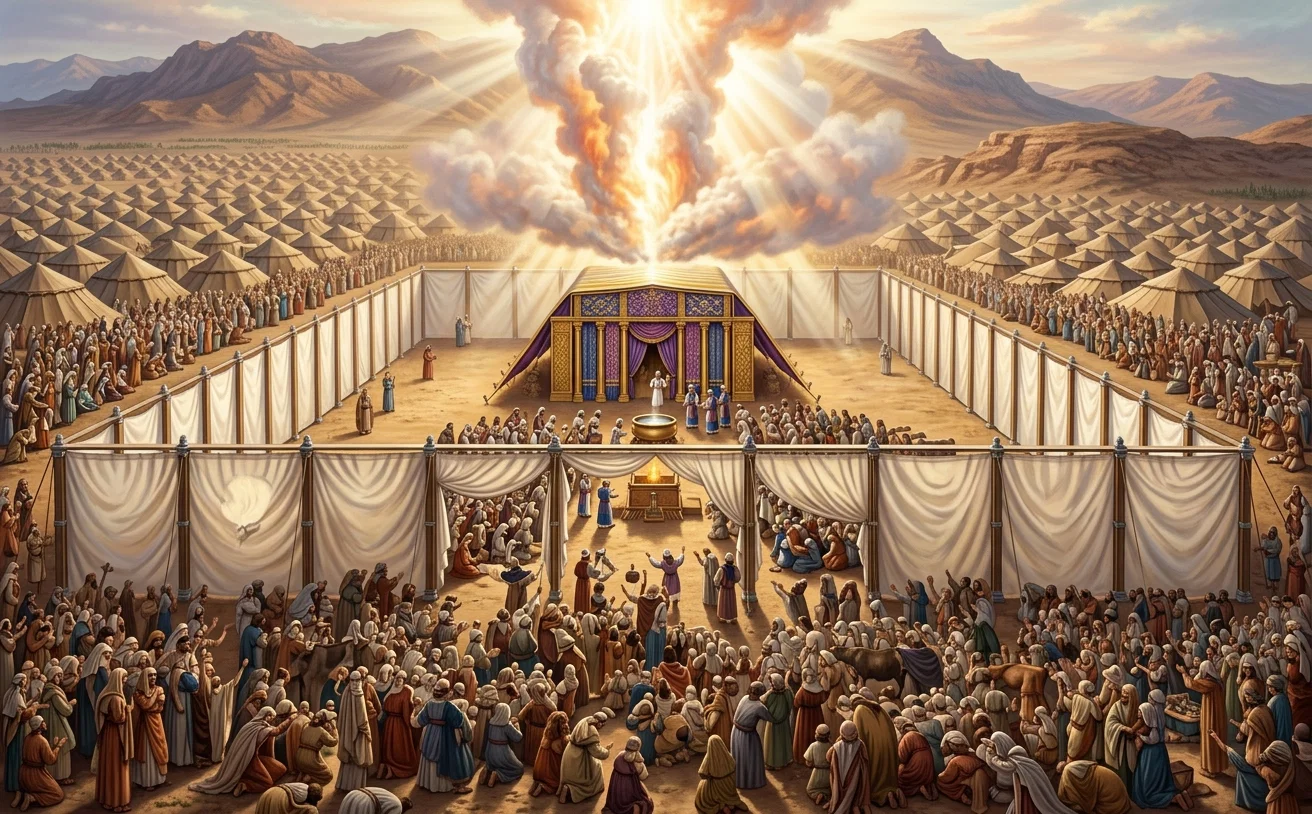
THE DAY OF ATONEMENT IN THE WILDERNESS. (See Leviticus 16.)
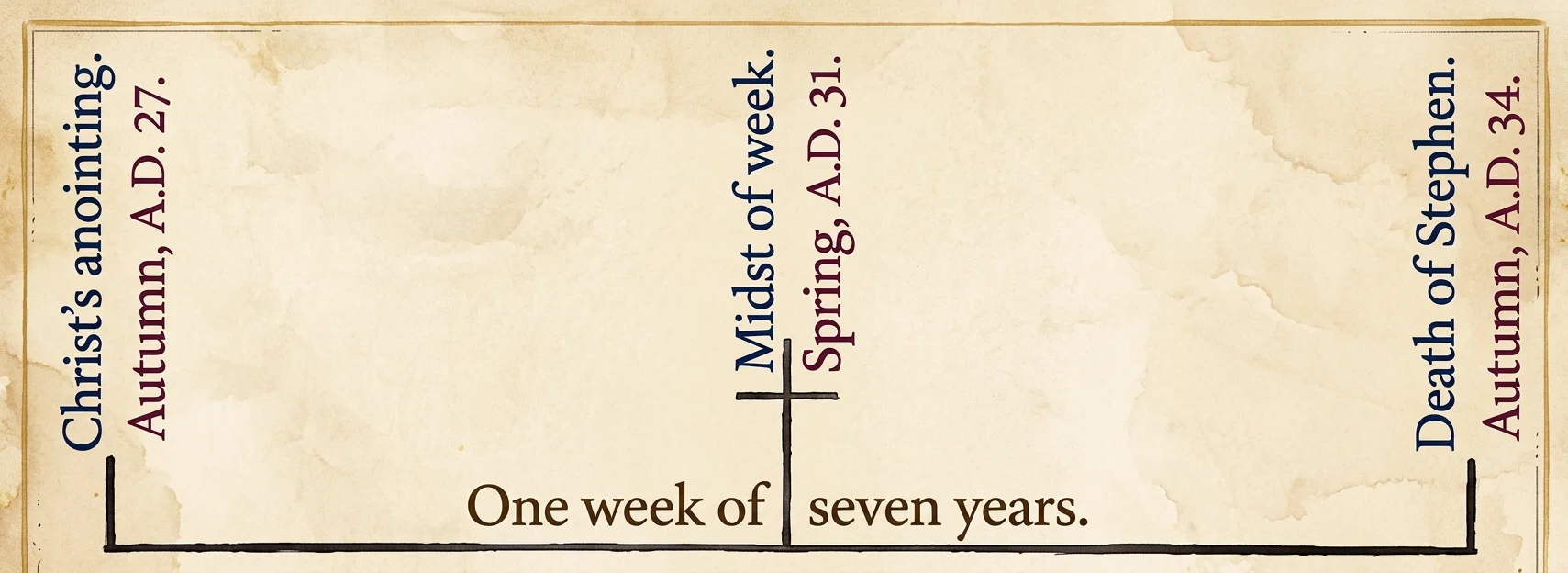
A week being composed of seven days, the “midst of the week” would occur at the end of three and a half days. The time here used being symbolic, it indicates three and a half years, at the end of which the sacrifices and oblations of the Jewish ceremonies were to be of no avail. Since these all pointed to, and were typical of, the work of Christ, which was to culminate in His death, it follows that they could be rendered obsolete only through His death. It is well understood that the earthly ministry of Christ closed at the end of three years and a half from the time of His anointing in the autumn of A.D. 27. At the fourth Passover which He attended (John 2:13; 5:1; 6:4; 13:1), in the spring of A.D. 31, He was betrayed and crucified. That this event marked the end of sacrificial offerings for sin, and the close of the earthly sanctuary service, was plainly indicated by the veil of the temple being miraculously rent in twain, as Christ yielded up His last breath on the cross. Matt. 27:50, 51.
After the death of Christ, His disciples preached to the Jews for three and a half years more, in the endeavor to confirm the work of Christ among them. At the end of this time the Jewish Sanhedrin formally rejected Christ by a systematic persecution of His followers, which resulted in the death of Stephen, and the scattering of the church. Acts 8:1. This final act of separation from Christ by the Jewish nation was in the autumn of A.D. 34. To make this matter plain, we will illustrate by a simple diagram.
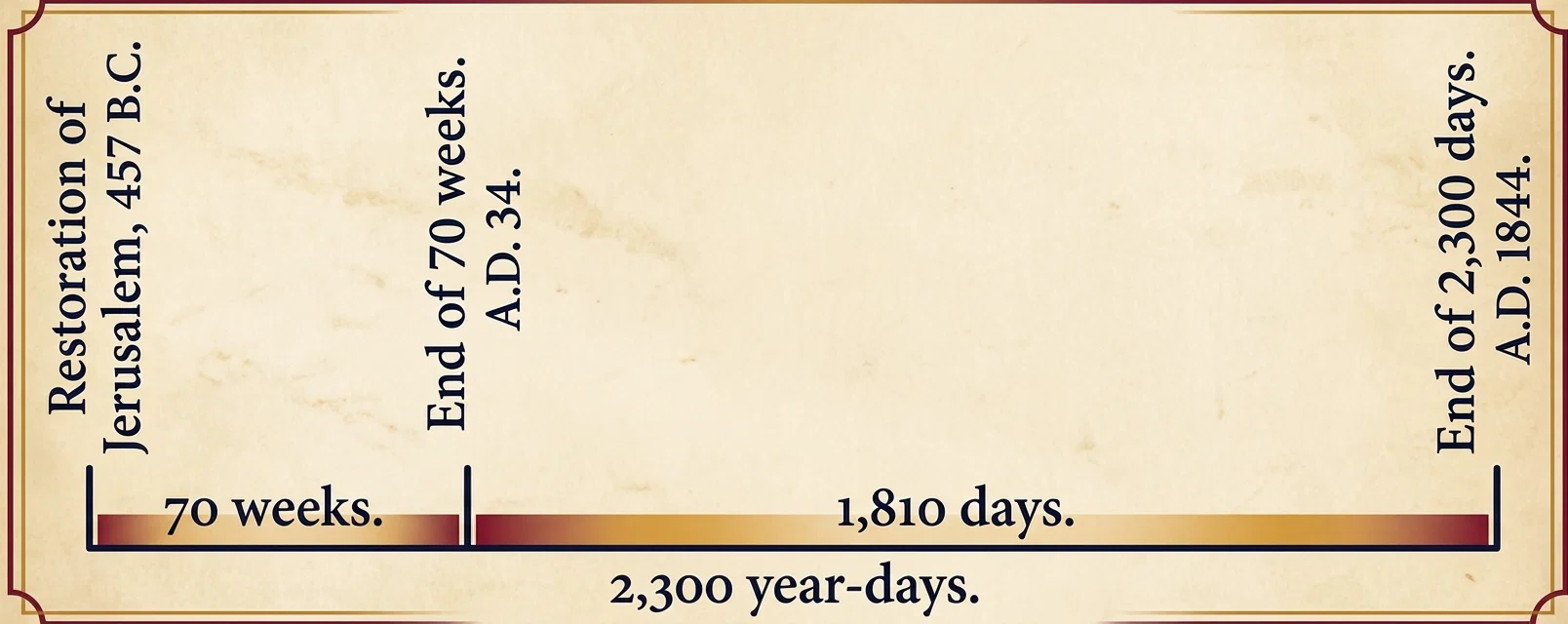
This was the close of the seventy weeks which the angel had said would be cut off from the 2,300 days, and especially given to Daniel’s people, the Jews. From that time forth full attention was to be given to another people, because the Jews had rejected the Saviour’s priesthood in their behalf. In fulfilment of the Lord’s own statement to that people, that the kingdom of heaven should be taken from them, and given to “a nation bringing forth the fruits thereof” (Matt. 21:43), the time had now come for men to be raised up and commissioned to bear the name of the Lord before Gentiles and the kings of the earth (Acts 9:15; 22:21). Referring to this point afterward, when his message was scorned by the Jews at Antioch, the apostle Paul said, “It was necessary that the Word of God should first have been spoken to you; but seeing ye put it from you, and judge yourselves unworthy of everlasting life, lo, we turn to the Gentiles.” Acts 13:46. See also Rom. 1:16 and Matt. 10:5, 6.
Thus the ending of the 70 weeks, or 490 days, of the prophecy is surely established. This time having been cut off from the 2,300 days, the close of which were to bring men to the great day of atonement, we have 1,810 days to add to A.D. 34, to introduce that solemn work. Carrying out this arrangement, we find the 2,300 symbolic days, or literal years, ending in 1844. To make this clear, let us again illustrate; see the second diagram.
The conclusion thus reached is unavoidable, new and startling tho it may at first appear. Every step in the line of thought has been carefully considered before being taken; every point in the chronological inquiry has been fortified in passing, so that there can be no other decision reached. Let us briefly review.
We have found that the atonement work of Christ was foreshadowed in the cleansing of an earthly sanctuary; that this cleansing was performed at the close of the Jewish religious year, and that a single day only was occupied in that work. It was also seen that the services of that typical day of atonement consisted in removing from the people and camp of Israel, all the sins of the year just passing, which had been confessed and borne into the sanctuary, through the body of a sacrificial offering, personally made by each sinner. The very nature of that atonement constituted it a time when every person in Israel must either have all his past sins removed, or bear them himself outside of the camp. In other words, it was virtually a day of judgment to all concerned. But all those ceremonies were the shadow of the real atonement. Whatever is shown in a shadow must appear in the substance which casts the shadow. The real atonement, therefore, is the final summing up of the world’s guilt, and placing it where it belongs. Its work must be to remove those sins from the heavenly sanctuary which have been conveyed there by personal confession, and lay them on the head of the great scapegoat, Satan, who, as the originator of sin, must bear them to their final end. But, as those sins which have not been thus taken into the sanctuary can not be included among those removed from the sanctuary in its final cleansing, they remain on the sinner, who must bear them himself, with all their consequent shame.
This final work of deciding men’s destinies began at the close of the 2,300 days of Daniel’s prophecy, or in the year 1844, as patient investigation has already proved. At that point of time the cases of men, beginning with those most ancient, have been passing under examination, in order to decide who shall be accounted worthy to obtain the better world, and a resurrection from the dead, at the coming of the Lord Jesus Christ to earth. The progress of this work will be noticed in the next paper. JOHN ORR.