REPORT OF ORPHAN HOMES AT HARPOOT, ASIATIC TURKEY.
By Mrs. Mary E. Barnum
December 16, 1897, was the first anniversary of the opening of the Harpoot Orphanages. At first we hired two houses, then two more, and then as the need increased, two more homes were thrown open in the town just at the foot of the steep Harpoot hill, making six in all, three for boys and three for girls, under our immediate care.11
In visiting these homes one is struck by the marked change in the appearance of the children. Last winter many of the children had a sickly look, and some seemed stupid. They were often ailing, or seriously sick, and five boys and two girls died. They were so enfeebled by their previous destitution as to have no power to resist disease. But now nearly all are plump and rosy, while the dull faces have brightened wonderfully, and nearly all are ambitious to learn and are making sensible progress in their lessons. The older boys devote a part of each day to shoemaking, tailoring, and carpentering, in all of which they are doing well. There are no trades for girls, but they spin, knit, sew, crochet, and help in cooking and housework.
Let us go to one of the girls’ homes on Sunday. The bell is soon to ring for Sunday-school, and we find the girls standing in a row in the yard waiting for the first stroke of the bell. They greet us by repeating in concert the golden text of the lesson.
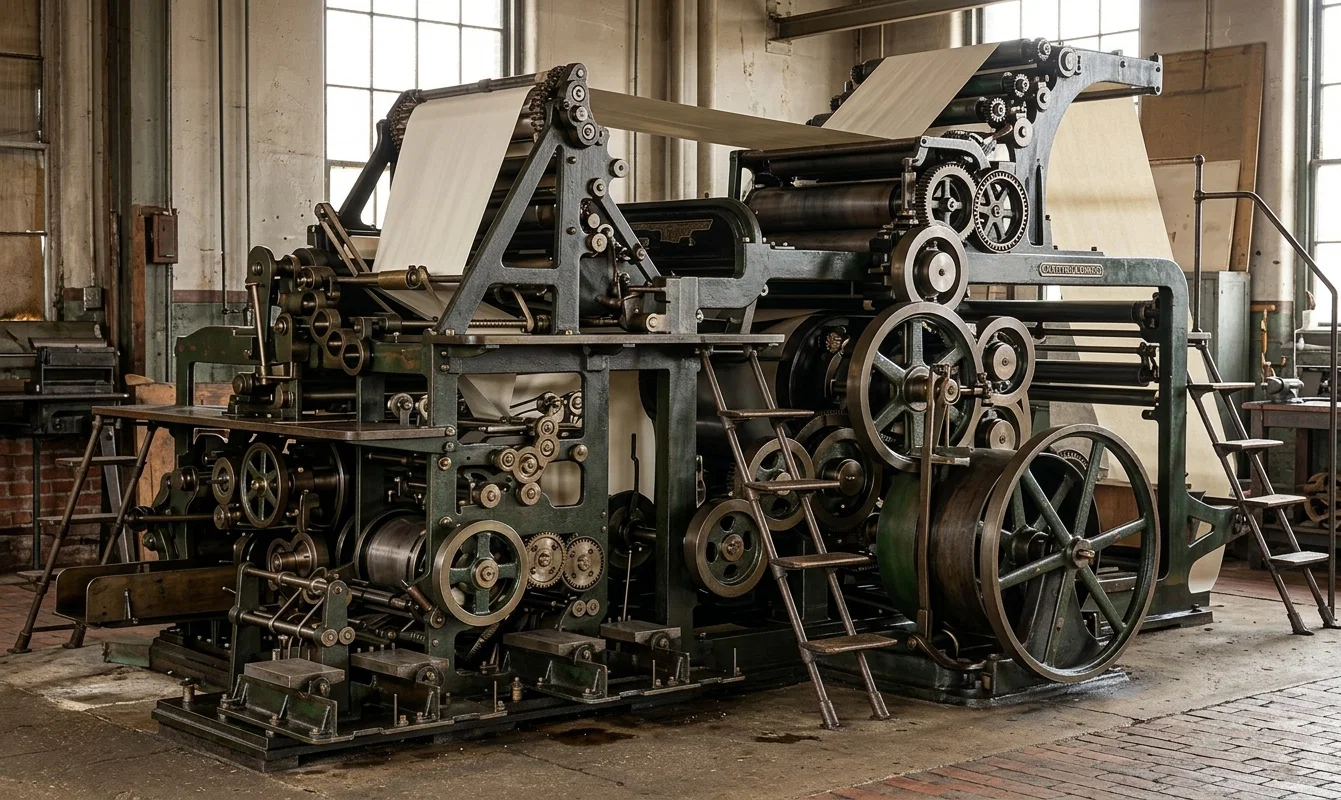
The above illustration shows our new WEB PERFECTING PRESS, built expressly for the “SIGNS OF THE TIMES” by the C. B. Cottrell & Sons Co., of New York. As will be noticed, the sheet is fed into the press from a large roll at the rear. It is then printed on both sides, folded, pasted, and trimmed, and delivered all complete at the rate of from five to ten thousand copies per hour, the grade of work determining the rate of speed. The slower the press is run the better the work appears. Curved electrotype plates are used, and special machinery not shown in the engraving was built for making these plates. This is not a newspaper press, but was built for doing the finer grades of book and periodical work. It is provided with Cottrell’s patent “shifting tympan,” a unique device for the purpose of preventing “offset.” This “shifting tympan” is so arranged that a clean sheet can be made to cover the cylinder at the will of the operator, while the press is in motion. The press is 18 feet 8¾ inches long, 11 feet 7¾ inches wide, 7 feet 7¼ inches high, and weighs 36,000 pounds, including the auxiliary machinery. It is the only press of the kind on the Pacific Coast. Presses similar to this are used on which to print some of the great illustrated journals and magazines of the east.
Now let us take a peep at them on a week-day morning. The little girl who answers our knock runs back to tell her companions, who rush out with beaming faces to give us a welcome and then quietly return to their work. They have breakfasted and are now sweeping and clearing up before going to school. One bright little damsel with a large apron is busy in kitchen work. “How are you, little head cook?” we ask, and she smiles back her answer. The “house mother” privately tells us that she is a very faithful worker. How happy they all are as they flit about, busy with their work!
Five little girls were brought to us one bitter cold day lately, with bare feet and scanty clothing. They had been there several hours and were shivering with cold. Is it any wonder that two became ill? The youngest, six or seven years old, had such a white face, with large, sad eyes; but it was delightful to see how the children who have been in the home longest crowd around the new-comers and take them under their special care.
In one of the homes is a young girl with a scarred face. Her parents were both killed, and she received a cut across her nose. She held the parts together as she fled to the house of a Turkish neighbor, and the wound was healed. One little boy of six has a misshapen head because a part of the skull was cut off with a sword. He is a dear little fellow. Another boy was wounded in two places on his head, and his left hand is disabled. Many of the parents were killed, others died from want, fear, and suffering, after the massacres, and the children were left destitute. Some have mothers who are barely able to keep themselves alive by begging, as work is not to be found. In a few cases the mothers have married again, but the step-father has been unable or unwilling to care for her children, too.
It takes money as well as time to keep these children only decently clad, and their coats and cotton tunics often show many patches. Our winters are cold, and the children must have coats and sacks. We are much indebted to the kindness of Dr. Joseph K. Greene, in Constantinople, who has interested others in sending us not only many articles of clothing, but unmade goods and colored blankets, all of which have been invaluable.
In eight cities belonging to our field we have 18 homes, with 763 boys and girls in them. And in 33 towns and villages are 354 orphans placed in private families, making a total of 1,117. Of these the Germans care for 205, the Swiss for 20, the English for 200, and America for 692.
We have received $25,000 and expended $22,295, leaving $2,705 on hand. We are deeply grateful for the gifts received. The cost this year for caring for so many children has been greater than it will probably be another year, because we have had to furnish the hired houses, and some of them needed no little repair, and we have had to provide beds and bedding for all.
God has wonderfully blessed this work. Our dependence is upon Him, while we still look to His children in Europe and America to send the needed funds. We think you will not wish us to turn out any of these orphans for lack of money.
This is a work which must continue for a number of years till the children can take care of themselves, and we think it is a work which gives much promise for the future.