REGARDING, as we must from the evidence presented in former papers, the atonement as Christ’s closing work for the world, the time when that service is being performed becomes the most solemn period in the history of the fallen race. To those who are alive when it closes, the time will be one of infinite consequence, as marking the end of their probationary career. Will God bring such an event suddenly upon men, and that without ample warning? To do this would not be in line with all His recorded dealings with men; for surely, when He designed to bring a flood of water upon the earth, to destroy it, He gave adequate notice of His intention, telling Noah that the world should have a hundred and twenty years of probation, in which to prepare for that event. Gen. 6:3.
Everything permitted to come upon the world, which would affect the destiny of His people, or any part of them, has been faithfully heralded beforehand, that all might be fully prepared to meet the issue. Moreover, He has said, “Surely the Lord God will do nothing, but He revealeth His secret unto His servants the prophets.” Amos 3:7. It must be, therefore, that the prophets have somewhere revealed whatever is good for man to know of this most important matter.
Turning to the book of Daniel, we will find the record of a conversation between two heavenly beings upon this very subject. Said the prophet: “I heard one saint speaking, and another saint said unto that certain saint which spake, How long shall be the vision concerning the daily sacrifice, and the transgression of desolation, to give both the sanctuary and the host to be trodden underfoot? And He said unto me, Unto two thousand and three hundred days; then shall the sanctuary be cleansed.” Dan. 8:13, 14.
The occasion of this vision was a peculiar one to the prophet. He and his people were captives in Babylon, and the earthly sanctuary at Jerusalem, the sacred place of the Jews, was left desolate. This was a matter of great concern to all those captives, and while this calamity weighed upon their minds, it was fitting that the design of that earthly tabernacle should be pointed out through a prophetic vision, not only for the satisfaction of the prophet while in trial of mind, but for the benefit of those who should live when the fulfilment of the vision was to be accomplished.
It will be readily seen that the cleansing here predicted could not refer to the annual cleansing of the earthly sanctuary, since the two thousand three hundred days, if taken literally, would cover a period of nearly seven years. These days could not refer to the time when the Jewish captives in Babylon would return to Jerusalem to renew the services in the tabernacle there; for we well know that their return from that seventy years’ captivity could not begin to take place until 536 B.C., since their bondage began in the year 606 B.C., as shown by the chronological date in the margin of Oxford Bibles, opposite Dan. 1:2.
We must therefore conclude that these days can not be literal measurements of twenty-four hours. An additional reason for this conclusion is that, had the days been literal, the fulfilment of the vision they covered would have been met, not only in the days of Daniel and his people, but while they remained in their Babylonian captivity. But the prophet was told that, while the vision was true, he should shut it up, that is, not reveal it, because it was yet for “many days.” Dan. 8:26. He was also told by the heavenly messenger, in the same conversation, that the vision would be fulfilled at the “time of the end.” Verse 17. The days of the vision must therefore be recognized as symbolic, covering the many events reaching to the closing scenes of earth’s history.
While the rule for measuring time-symbols of prophecy is plainly given, and fully confirmed in various parts of the Bible, it is not necessary, for the present purpose, to look for it beyond the limits of the subject now under consideration. From a study of the first part of the ninth chapter of Daniel’s prophecy, we learn that he supposed the vision to refer entirely to the desolation of the tabernacle at Jerusalem, and that the time mentioned in the prophecy covered the period of the captivity. He therefore began a most earnest prayer to God, for Him to let his face shine upon that downtrodden and desolate sanctuary. Dan. 9:3–19.
While the prophet was thus engaged, the angel who had first talked with him came, and said: “O Daniel, I am now come forth to give thee skill and understanding. At the beginning of thy supplications the commandment came forth, and I am come to show thee; for thou art greatly beloved; therefore understand the matter, and consider the vision.” Verses 22, 23.
The object of this angelic visit was, therefore, to make Daniel understand the matter which was resting so heavily on his mind, namely, the fulfilment of the vision about which he was just then praying. This was to be accomplished by a consideration of the vision again, which the angel began to explain in detail: “Seventy weeks are determined upon thy people and upon thy holy city.” The Hebrew word here rendered “determined” is defined by Gesenius to mean, literally, to cut off; tropically, to divide, and so to determine. The seventy weeks here mentioned by the angel were, therefore, to be “cut off” upon the Jews and their sacred city. But cut off from what?—Why, from that which was under consideration, to be sure. The vision concerning the 2,300 days was the subject receiving attention. So, then, the seventy weeks, or 490 days which composed them, were to be cut off from the 2,300 days, and assigned to the Jews and their city, in the history of the sanctuary work. The remainder of the time, 1,810 days, are devoted to that history after the Jews have fulfilled their part in connection with the sanctuary service.
This division of the 2,300 days is, therefore, clearly settled. But to make the matter doubly sure to all concerned, the angel proceeded to divide the seventy weeks, establishing positive waymarks by which to follow intelligently to their close, and so to ratify the prophecy. He therefore said: “Know therefore and understand, that from the going forth of the commandment to restore and to build Jerusalem unto the Messiah the Prince shall be seven weeks, and threescore and two weeks.”
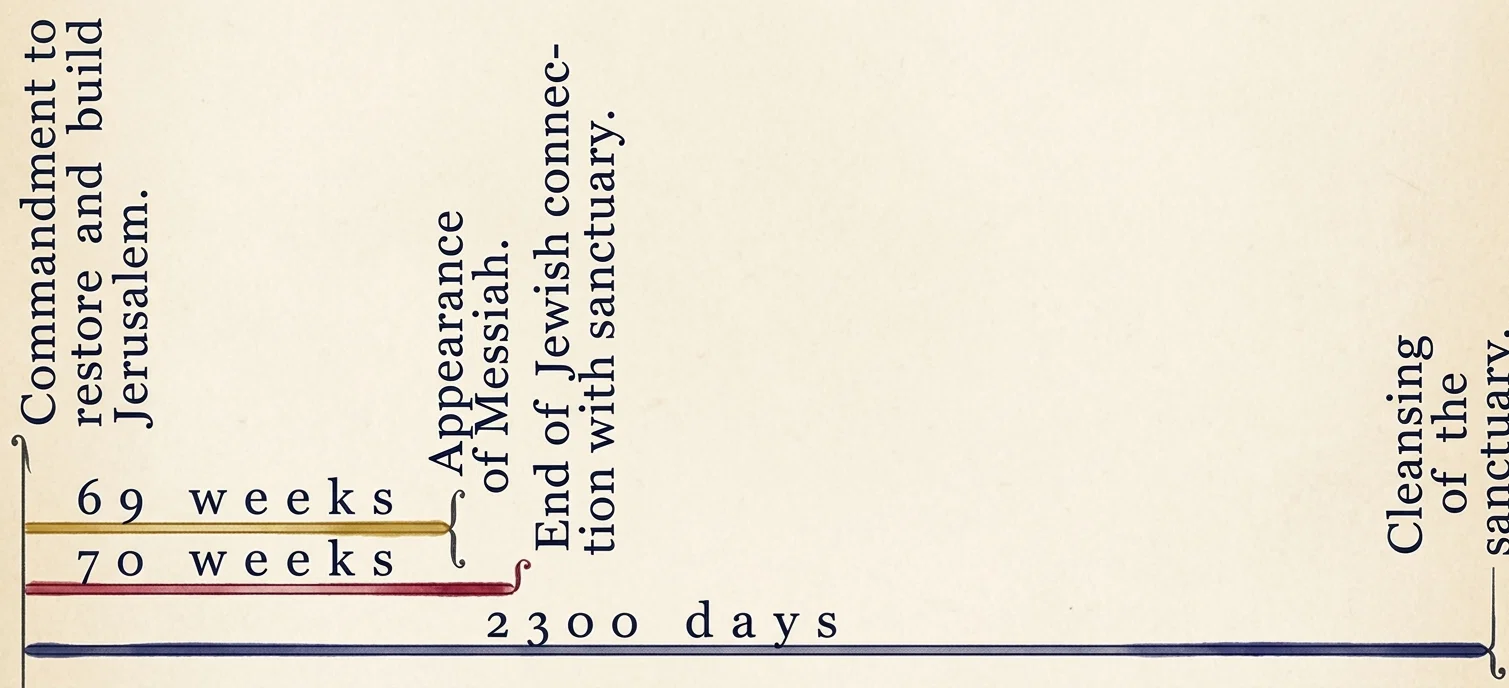
Here, then, is furnished a data from which to195reckon the 2,300 days, at the close of which the cleansing of the heavenly sanctuary was to be undertaken. It is very evident from what the angel told Daniel that, the seventy weeks being cut off from the full number of days given in the vision, the beginning of the seventy weeks must be identical with the beginning of the 2,300 days. This being true, the sixty-nine weeks must also begin at the same place, since they are a part of the seventy. This point may be fixed in the mind by a simple diagram, as follows:—
The three horizontal lines shown in the diagram all began at the time when, after the Babylonian captivity, a commandment was going into effect for the restoration of Jerusalem. The shortest of these lines,—the sixty-nine weeks, or 483 days,—reaches to the appearance of the Messiah. The name Messiah means “anointed.” John 1:41, margin. By comparing Acts 10:37, 38 with Luke 3:21, 22, we learn that the anointing of Christ to His work as Messiah, was by the descent of the Holy Spirit upon Him, at His baptism. Looking at the margin of an Oxford Bible opposite the last reference, we find that this anointing occurred in the year 27 of the Christian era.
Tracing these 483 days back to their starting-point, we look for the date of the commandment calling for the restoration of Jerusalem. Immediately upon the close of the seventy years of Babylonian captivity, Cyrus issued a command for such as were interested, to return to Jerusalem to rebuild the house of the Lord. Ezra 1:1–3. Only a little over 42,000 responded to this call. Ezra 2:64. These being too few to carry on the work successfully, matters were left in abeyance for seventeen years, till the reign of Darius, who issued another call for the work to proceed, and that with haste. Chapter 6:12. The people failing to execute the work under these two calls, the third and successful command was issued by Artaxerxes, sixty-two years later. The record of this command is found in the seventh chapter of Ezra, verses 11–26. Verses 7, 8, however, give the date of this command as the seventh year of that king, and the chronological table in the margin shows it to have been some time in the year 457 B.C.
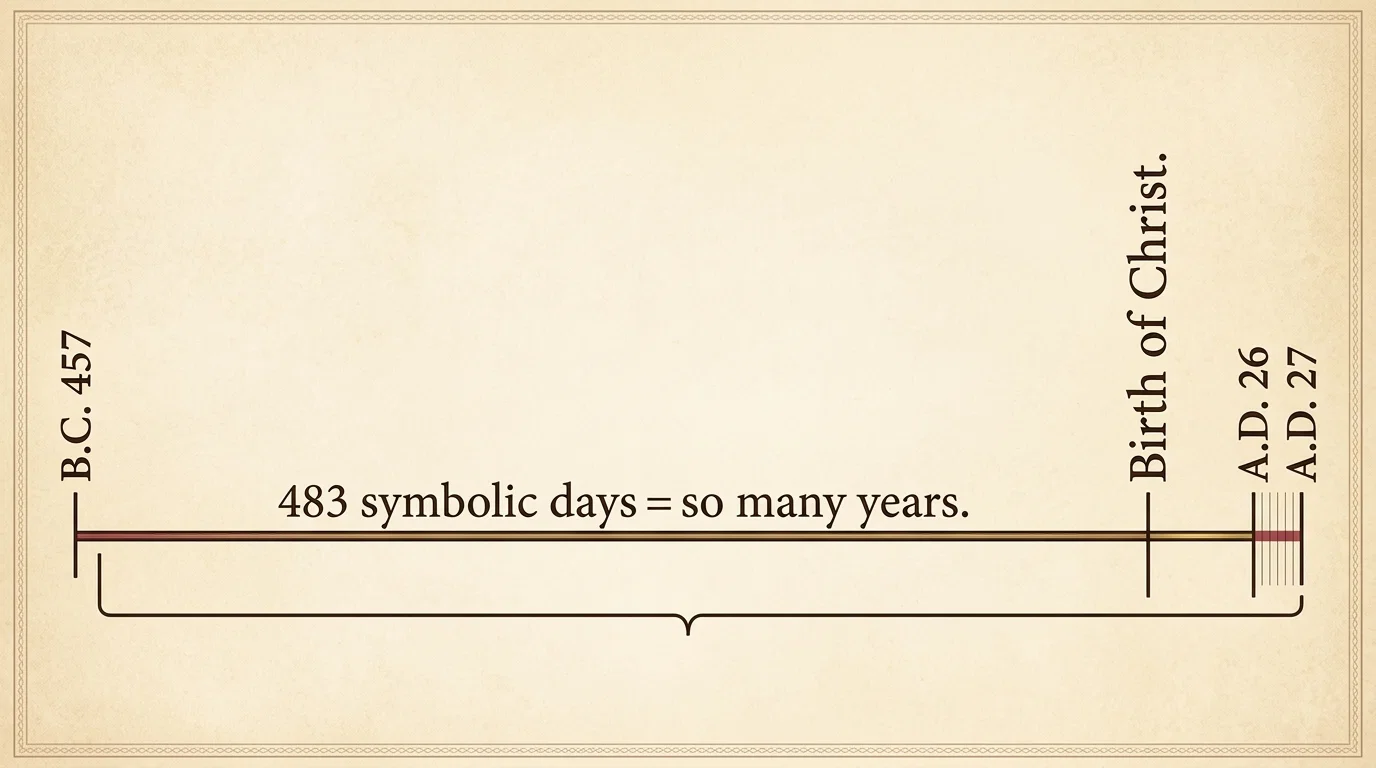
Taking this date and that of the anointing of the Messiah, and adding them together, we have a series of years, corresponding to the number of days the prophecy assigned to the interval between these dates. This matter will be clearer by a glance at another simple diagram:—
Adding the full number of 457 years before the birth of Christ to the entire time of 26 years after His birth, we have 483 years. But this result is secured only by beginning to reckon the time from the very first day of 457 B.C., and letting it include the very last day of A.D. 26. But we find that the work of restoring Jerusalem did not begin till that year was somewhat advanced. Ezra and his companions did not arrive in Jerusalem before the fifth month (Ezra 7:8), and then he attended to the autumn, or seventh-month ceremonies, before entering upon his regular work of rebuilding the city (chapter 8:35). It will be seen, therefore, that whatever time is lost from the first part of the year 457 B.C. must be added to the close of the year A.D. 26, which would bring the ending of the 483 years in the autumn of A.D. 27, as we find set forth in the chronological table opposite the record of Christ’s baptismal anointing. Luke 3:21, 22; Mark 1:10.
This ends the sixty-nine weeks, or 483 symbolic days, which were to extend to the Messiah. A consideration of the other time symbols in this prophecy must be reserved for the paper to follow. JOHN ORR.