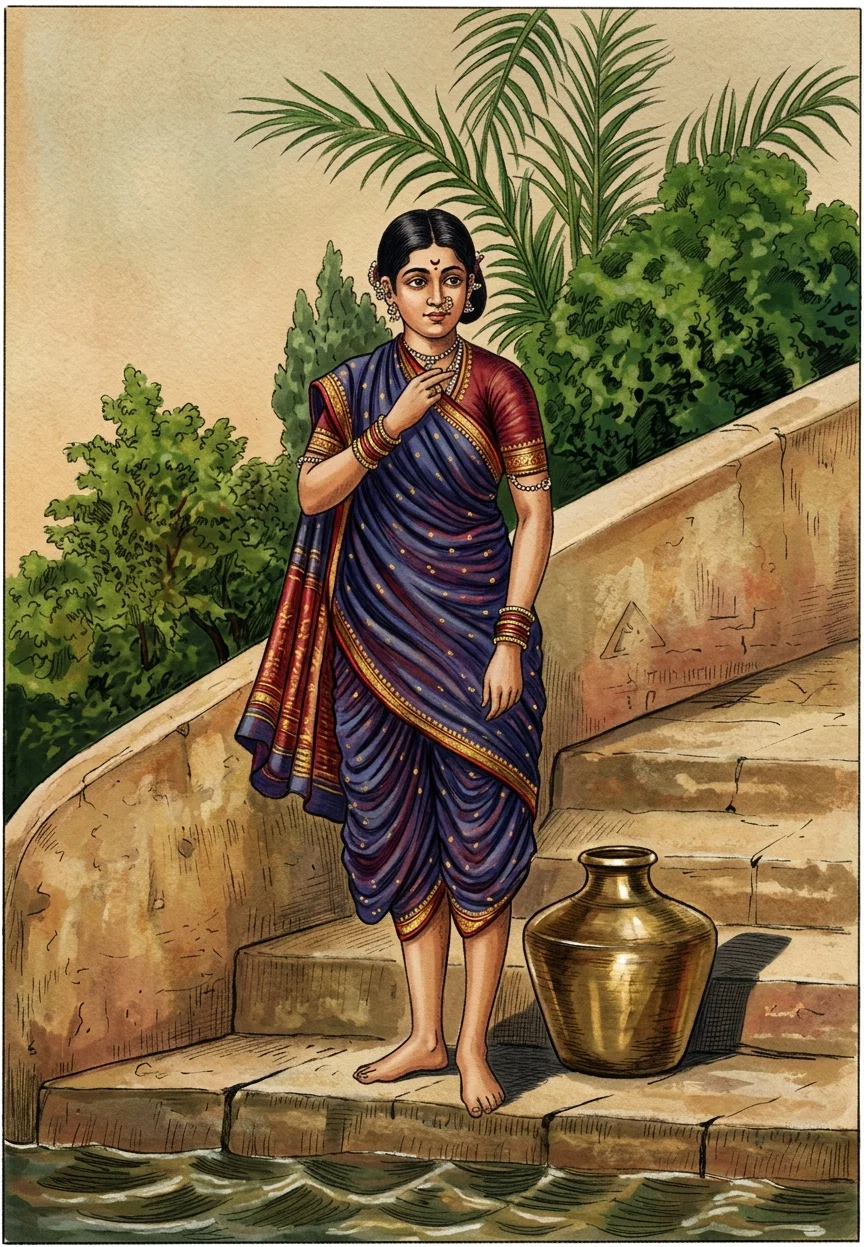
THE most conspicuous feature in the costume of the women of Hindustan is their jewelry. One great reason why girl babies are not welcomed at birth as are the boys is that the father knows that upon the occasion of the girl’s marriage he will be compelled to give her a dowry of jewels, and many a poor man wonders where the money to meet this expense is coming from.
These women of India wear bracelets, armlets, anklets, finger rings, toe rings, and earrings. Several rings are in each ear, and some of the lower rings are so low that they rest upon the shoulder, and sometimes they are so heavy as to break through the tender flesh.
Nose rings are seen, six or eight inches in diameter, tied to the right ear to keep them out of the way of the food.
Bands are worn on the forehead, from which heavy pendants hang; and it is not unusual for necklaces to extend from the neck to the waist line.
Beautiful chains are sometimes worn around the waist in lieu of a belt, and from three to ten bracelets on the ankles.
The low-caste women who daily go forth to their arduous tasks, wear heavy anklets and other jewelry made of pewter or clay, “to be in style.”
These people have learned the art of making jewelry out of very cheap material. Shellac is much used. Gold is not worn on the feet by even the highest in rank, but most dainty gold and silver breastpins and earrings are used by those who can afford them.
There are time-honored distinctions of dress, also, by which the different classes are readily distinguishable.
The highest-caste woman, or Brahmani, is invariably robed in a white sari. This is a strip of cloth five yards long and one and one-half wide, so arranged as to completely and not ungracefully cover the entire person, even the face when necessary.
The lower castes wear a bright-colored skirt, made scant in the back but very full in front, above which a small jacket is discerned. Then over head and shoulders the chaddar is gracefully draped. It may be of any color or material, but is often edged with gold or silver tinsel braid.
The women of the low castes need not keep their faces covered.
In addition to the sari, the Parsi ladies wear a very fancy head-dress, which would be very becoming if they were not compelled to wear it so low over their foreheads as to entirely conceal their jet black hair.
This fact was forcibly impressed on my mind during one of my visits to a Parsi family in India. The youngest and prettiest of the girls had pushed her head-dress back, showing a broad, high forehead and some of her hair, for which she was severely reprimanded, being reminded in very forcible terms that it was the mark of greatest disrespect for a young girl to allow even a particle of her hair to be uncovered in the presence of her elders. Poutingly she drew down her head-dress, knowing full well it was not so becoming.
The most wealthy Parsis dress very richly, and when they ride out unveiled, as they often do with their husbands, they present a charming picture.
The Mohammedan costume is neither pretty nor graceful. Trousers are worn awkwardly made, and substituted for the skirt. The poorer classes have theirs made very tight about the ankle, but full around the waist, while those belonging to the higher class have theirs fashioned to fit closely about the hip, then sloping out at the bottom. Sometimes they are so very full and long that it is necessary to tuck them into the belt, forming huge folds in front, but producing a very unartistic effect in the back.
A WOMAN OF ONE OF THE HIGHER CASTES.
(By a Native Artist.)
The jacket is a tiny little “play affair” made of a sort of flimsy material which barely serves as a foundation for the embroidery and trimming.
The arms are left bare, that they may be covered with bracelets. I have counted eighteen below the elbow and twenty above on one arm.
The chaddar is usually made of very thin material and often heavily trimmed.
The Mohammedan women are very fond of bright colors, and the high classes always wear them, especially red, while the low caste, in contradistinction to the Hindus, always wear white, or at least it shows that it was once that color. They wear a dress reaching to the ground and kept in place by a girdle.—Gospel in All Lands.